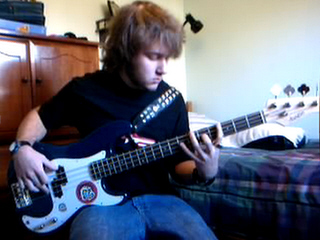
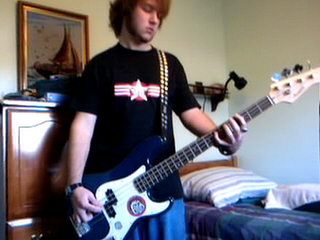
So now that you've got your bass and your amp you can start playing.There are 2 positions in which you can play the bass, seated and standing.
|
|
|
|
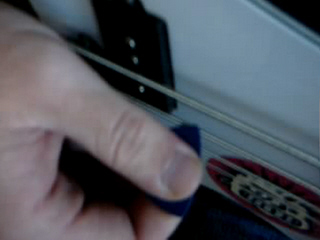
Playing with a pick gives you clarity, punch and evenness that is superior to playing with the fingers; however most bassists use the fingers exclusively. You will benefit from learning botht techniques by having more control over the sounds you can produce.
Flat picks come in various weights and gauges and the thickness will affectthe sound of the note plucked. A thin pick will give a thin sound and a thick pick will give a heavy sound. The medium pick is thin enough to flex a bit and firm enough to produce a full sound.
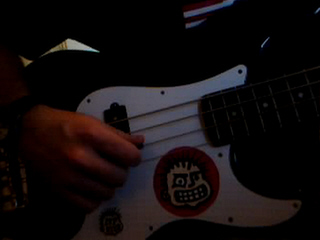
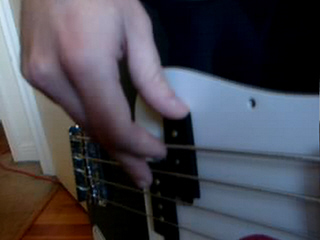
Playing with the fingers gives a very broad sound with a lot of fullness. The fingers can be used for almost any type of music, be it jazz, funk, punk or metal. While there are numerous ways to play the bass with your fingers the most common way is with 2 fingers. This style uses the index finger and the middle finger. The string should be plucked with the backside of the finger pad as opposed to the tip of the finger.
It is important to pluck the string with a light touch. Play the string with just enough force to get a good sound, and no more, excessive force can give a distorted sound. You can change the sound of the instrument by changing where the string is plucked. For example, if you pluck the string over the fingerboard, you will get a rich sound with reduced attack. If you pluck the string at the bridge (or close to it), you will get a sound that is percussive, with lot's of attack. A good sound that combines the two is found by plucking the string in the middle of the body, usually right over the pick-ups.
Now that you know how to play the strings in the open positions, you need to know what to do with the left hand.
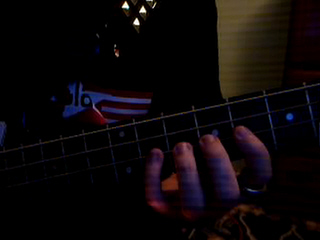
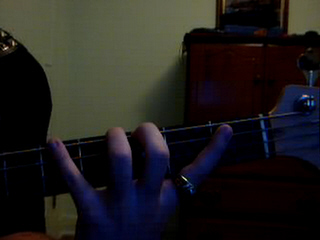
Hold the bass and spread your fingers on the finger board so that each finger is on a fret.On the bass each fret is reasonably large in the lower positions (frets 1 - 5), while the frets become narrower in the higher positions. You will have to strecht your fingers apart for a while to become comfortable moving around on the lower frets. When fingering notes in the left hand, try to fret the note just behind the fret line (don't finger in the middle of the fret). If you learn to finger the fret just behind the fret line, you will find that it takes less pressure and produces a better tone.
 |
 |