|
 The
name Miller-Cycle comes from the American Engineer, Ralph Miller, who patented his
version of the forced Otto-cycle in the 1940's. While similar to the
conventional Otto-cycle engine, the Miller-Cycle engine has two main
differences: The
name Miller-Cycle comes from the American Engineer, Ralph Miller, who patented his
version of the forced Otto-cycle in the 1940's. While similar to the
conventional Otto-cycle engine, the Miller-Cycle engine has two main
differences:
-
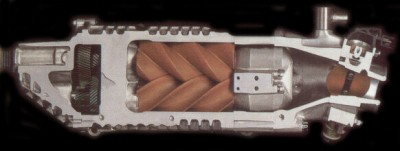
It depends on
a Lysholm compressor (click on the picture below for full specifications) Note the conversion:
160kPa = 23.206 psi.
-
The
Miller-Cycle engine leaves intake valve open during part of the
compression stroke, so the engine is compressing against the pressure of
the compressor rather than the pressure of the cylinder walls. the
result is increased efficiency at a level of about 15 percent.
 There are basically
four means that the Miller-cycle uses to obtain its increased efficiency. There are basically
four means that the Miller-cycle uses to obtain its increased efficiency.
-
Smaller engine (lower displacement
- 2.3 Liters)
-
reduced compression stroke and
pumping losses
(from late closing of the intake valve)
-
cooler intake charge (intercooled
air)
-
combustion improvements
The 2.3 Liter Miller-Cycle engine found
in the Millenia S is known
internally as the "KJ" engine, while the base 2.5 Liter is known as the "KL"
engine. The Miller-Cycle engine provides 40 additional horsepower
while achieving better gas mileage than the base engine - 20/28 vs. 20/27.
 |