SECTIONS
General Stuff/Energy and Matter
Electron Configuration & The Periodic
Table
Section 4: Electron Configuration
Light Waves-
Light Wave: A form of electromagnetic radiation just like x rays or radio
waves
Electromagnetic Spectrum- the spectrum of waves giving the radiation: frequency,
wavelength, from which you can figure out the amount of energy
Electromagnetic radiation is electric and magnetic fields oscillating at
right angles to each other and to the direction of motion of the wave.
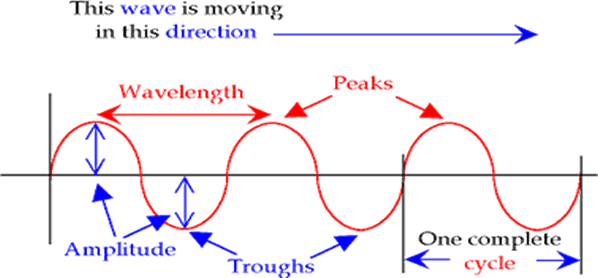
Amplitude- length from base line to crest or trough
Wavelength- distance between two crests or two troughs. Represented by
Greek letter nu. Generally, you can use meters as a measurement.
Frequency- number of cycles that go past a certain point by time. Measured
in s^-1. Represented by letter lambda.
Speed of light (c )- regardless of wavelength, constant c is 3.00 * 10^8
m/s.
FORMULA- wavelength = c/ frequency
Visible spectrum- what we can see (array of colors) ROY G BIV
Quantum Theory-
Quantum Theory: the theory that there is a fundamental restriction on
the amounts of energy that an object emits or absorbs, and each piece
is called a quantum (Planck’s Theory)
-pieces are very small
E = h (frequency)
Where E = energy measured in joules.
H is planck’s constant, 6.6262 * 10^-34 j-s
Photoelectric effect: made by Einstein, in this, electrons are ejected
from the surface of metal when light shines on metal, but different metals
have different minimum frequencies to release electrons.
-energy quanta are photons
-why violet light frees photons but red light doesn’t is because
violet has greater frequency: greater energy per photon. The photons
collide with electrons
Line spectrum- the pattern of light that metals emit based on their different
energy levels
Orbitals-
Heisenberg uncertainty principle- position and momentum of moving object
cant simultaneously be measured and known exactly (cuz to locate an
electron you must strike it with a photon, which will change it’s
position and momentum)
The Orbital Model is just basically the model that Bohr made.
Quantum #- (n), the amount of energy
Ground state- n= 1, energy level corresponds to the orbit closest to
the nucleus.
Excited state- the higher energy levels, n = 2, 3, 4
Radiation is absorbed when electrons jump from ground state to an excited
one. If it falls back to a lower state, radiation is emitted.
The sublevels in the model are s, p, d, and f.
S has 1 orbital, p has 3, d has 5, and f has 7.
Principles:
Aufbau- electrons added to the lowest orbitals and build up
Pauli- Electrons spin in opposite directions and 2 occupy each orbital
Hund- Electrons occupy equal-energy orbitals so that a maximum # of unpaired
electrons results
Section 5: The Periodic Table
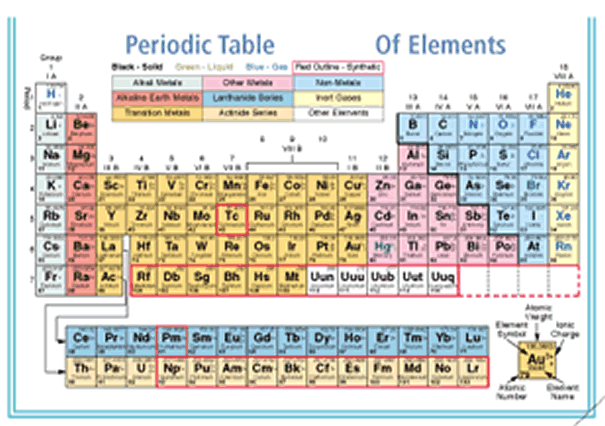
Periodic law: when elements are arranged in order of increasing atomic
#, their physical and chemical properties show a periodic pattern.
Period: a horizontal row
Group: a vertical column
Metal: solid, malleable, luster, electricity
Non-metal: not malleable, no electricity
Semi/metalloid: has properties of both; in the middle of table
TRENDS-
-atomic radius: gets larger going down a group, gets smaller moving to
the right
-ionic size- gets smaller as they lose electrons (how large ion is)
ionization energy- energy needed to remove 1 electron
Electrons in larger atoms hold more tightly
electron affinity- how badly it wants an electron- octet rule
electronegativity- ability to attract electrons in a chemical bond
Made By: Alecia Waite
CIPLC Student in Mr. Williams' Chem Class