SECTIONS
General Stuff/Energy and Matter
Electron Configuration & The Periodic
Table
Section 1: General Stuff
Scientific
Method-
The Scientific Method is a powerful way to answer the questions about our
world.
Hypothesis- a tentative answer to a question
-write it in cause-and-effect format
-should be testable
Theory- explains the reasoning behind a natural law. It could be
wrong, but we will take it as true because so far it has not
been dis-proven.
Experiments should be conducted so that other scientists can repeat
them.
Variable- the factor being tested
-all variables must be the same except for the one we’re testing
Conversions-
Make sure you know how to do conversions. Mr. Williams recommends
using the T-bar method. Here’s how.
Draw a t-bar. It looks like this.

Now,
put whatever you are trying to convert into the top left-hand square.
For example, if a problem says “Convert 3 dollars
to cents,” the thing you are converting is the dollars. So, dollars
would go in the top left-hand square.
The next step is to find out what you are trying to convert to. Now draw
an equals sign and put this after the t-bar (In this case, the cents).

Leave the line before cents blank until you find out your answer. This is where you will put your answer. Now, the goal of this is to get from the starting unit, the one you are trying to convert ($) , to the result, what you are converting to (cents). The way you do this is by knowing which units you can put in to be able to cross out and get the result you want. For example, you know that there are 100 cents in one dollar. So, you would write this. Now, cancel out the dollars unit. You are left with only the cents unit. This is a good sign, because your answer is in cents.

Remember to only cross out the unit, not the number. Now, you can do the math. You simply multiply all the numbers on the top. Then, you divide that by the product of all the numbers on the bottom. Since 3.00 times 100 is 300, and 300 divided by 1 is 300, our answer is 300 cents.
Section 2: Energy and Matter
Energy-
Energy- the capacity to do work or produce heat.
Work- the capacity to move an object over a distance against a resisting
force.
Kinetic Energy- The energy of motion. This means that something is in
motion.
-mechanical energy- machines
-internal energy- caused by random internal motion of particles in water
Potential Energy- Stored energy. This means that the energy has not yet
been realized. It is either stored in a conventional sense (like in a
battery), or stored as in it has the potential to have energy, as in
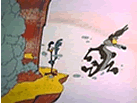
a car at the top of a cliff. With the car at the top of the cliff, the
car could fall, and because it is so high up, it would fall quite a ways.
This means it has energy because of its high position. This stored energy
is dependent on gravity. If there were no gravity, a car at the top of
the cliff might not have as much potential energy.
-chemical potential energy- caused by arrangement of particles
(fuel,food)
Electric Potential Energy- energy that is stored in charged particles.
Because particles have charges, they need to gain or lose electrons.
This process takes energy. Thus, by nature of having a charge, particles
have energy.
SI unit for energy is Joules. A joule is the amount of energy required
to lift a medium-sized apple one meter against the force of gravity.
A calorie is the amount of heat needed to raise the temperature of 1
gram of water 1 degree Celsius. Note that it is spelled with a lower-case
c. This is different than a Calorie. You see Calories on food packages.
The term “Calorie” with an upper-case c really means “kilocalorie”,
or 1000 calories. Do not get them confused.
The Law of Conservation of Energy: In any process, energy is neither
created nor destroyed. It is rather conserved. (Joule discovered it)
Temperature-
Celsius is a unit to measure temperature that is used throughout
the class. You won’t use Fahrenheit.
Kelvin- the SI measurement for temperature
Absolute Zero- the point at which all particles stop moving entirely.
This is –273 degrees Celsius, or 0 degrees K.
Matter-
Matter- anything that has mass and volume
Solid- matter that has a definite shape and volume.
Liquid- definite volume but not shape
Gas- no definite shape or volume
Physical change- does NOT alter the identity of a substance, like
cutting something, or tearing it
Chemical change- alters the identity of a substance, like cooking,
burning
Law of Conservation of Matter: Matter is neither created nor destroyed
in any process. (discovered by Lavoiser)
Changes in matter
-S to L - melting
-L to G - vaporization
-L to S - freezing
-S to G - sublimation
-G to L - condensation
Elements and Compounds-
Element- a substance that cannot be separated into simpler substances
by chemical change
Compound- substance that contains 2 or more elements combined in a
fixed proportion.
Law of Constant Composition: any given compound always contains elements
in the same proportions by mass. That is, the amount of each element
is fixed and proportional. For example, if the compound is H20 (water),
you would have 2 parts hydrogen to one part water, and that proportion
would not change.
Mixture- blend of 2 or more substances
-heterogenous- a mixture w/ visibly different parts. It can be separated
by filtration.
-homogeneous- doesn’t contain visibly different parts. It can be
separated by distillation, crystallization, chromatography.
Made By: Alecia Waite
CIPLC Student in Mr. Williams' Chem Class