SECTIONS
General Stuff/Energy and Matter
Electron Configuration & The Periodic
Table
Section 3: Atomic Structure
Democratus- came up with the concept of breaking things in half until
you finally come up with the smallest particle
John Dalton- came up with the idea that the atoms of a different element
are different, and that compounds come in fixed proportions of atoms
The Atom-
Atomic Theory of Matter:
-Each element is composed of small particles- atoms
-All atoms from a given element are identical, but they differ from
those of any other element
-Atoms aren’t created or destroyed (Lavoiser)
-Each compound has the same relative #s and kinds of atoms
Michael Faraday- discovered that atoms have charges. Franklin proved
this with the lightning experiment: the two charges attract each other
but repel
others of their own kind
Electric Current- a moving string of electrons
Cathode ray tube- partially evacuated air tube containing a cathode
(-) and an anode (+), and lined with fluorescent material. It allows
us to
see the radiation. For more info, turn to your book, page 97.
Radioactivity- the spontaneous emission of radiation from an element.
This was discovered by Bequerel, who put uranium on photographic paper
and saw
that it exposed the paper.
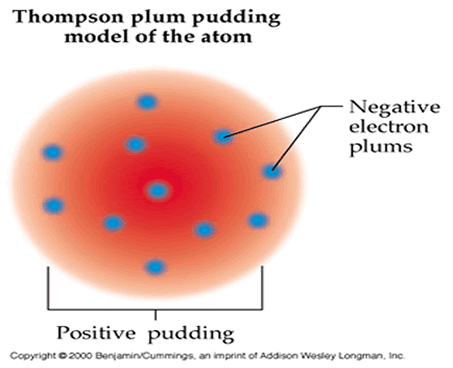
The first model of the atom was the Plum Pudding model. It was that
there was negative charges (plums) tossed into a pudding of positive
charge.
Rutherford disproved this by doing an alpha-
scattering experiment in which he shot helium electrons at thin gold
foil.
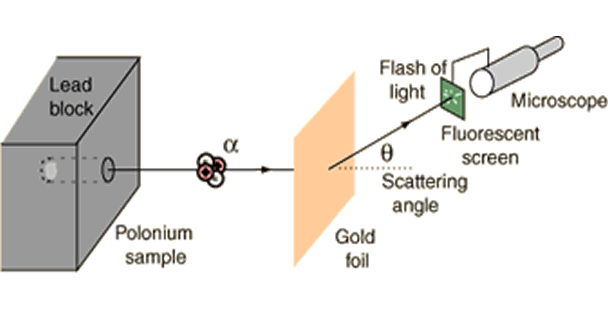
Rutherford’s experiment showed that the nucleus is very
dense and little negatively charged electrons existed around the small
nucleus. The nucleus was positively charged. Rutherford was right!
(so far, he hasn’t been disproven, so we’re just assuming)
Here’s an atom:
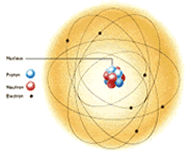
Proton: positively charged, located in nucleus
Electron: negatively charged, spins around the nucleus (represented by
the black). Very light
Neutron: weighs almost the same as proton. Located in the nucleus. Neutrally
charged.
Atoms and The Periodic Table-
We will often refer to the Periodic Table of the Elements in the back
of your book. It looks kinda like this:
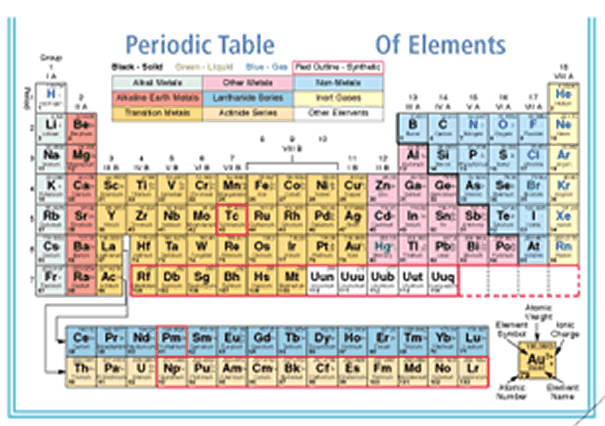
Atomic number: distinct number of protons in each element
Ion- the net electrical charge that occurs when electrons are lost
or gained in a reaction. This net charge can be figured using (the
number of protons) – (the number of electrons)
Mass number, or AMU: the weight of the element. This is the number
of protons + the number of neutrons. The one shown on the periodic
table is an average for that element.
Isotope- just an atom with a different mass # than all the rest.
They still have the same chemical properties, though. Some isotopes
are
more common than others. Like saying “Carbon-13”. If
a Carbon atom with 13 as an atomic mass ever existed, it would be
an
isotope, because most Carbon atoms have 12 a their mass number.
Made By: Alecia Waite
CIPLC Student in Mr. Williams' Chem Class