

Background:
Music censorship has greatly changed over the years. In fact, music technology has changed in general. In the 1950's, the world had vinyl records. Now, in 2004, we have mp3 players. We've gone from having to tote large, chunky albums around, to being able to fit tiny mp3 players in the palm of our hands. The evolution of technology, itself, has been amazing, especially considering the range of time all of this has happened. In only 50 years, the music industry has been revolutionized. As society changed, music reflected it. Through it all, music has remained one of purest forms of art.
Many factors change the level of music censorship. War is one of the major factors. Also included in this are the popular styles of music. Nowadays, the main focus of people who are pro-censorship is rap and rock. Although the reasons for music censorship change through time, the main ones are: pro- or anti-war content, sexual content, foul language (curse words), violent content, drug- or alcohol-related content, or for religious reasons (ex. Satanic songs). Another major reason is the pure fact that certain subjects are considered taboo by society. As South African musician Johnny Clegg said, "Censorship is based on fear." When a musician has lyrics that threaten the values of the established society, the people that hold power feel that they must silence this threat by censorship.
Another huge factor in music censorship is the introduction of mp3s and the ability to download music off of the internet. Because of this, some people believe that it is easy to get ahold of any music that they please. However, this is not the case. The way that most people become aware of new artists is through the mass media: T.V., radio, newspapers, magazines, etc. All of these are censored in one way or another. So although the music is online, uncensored, for people to listen to and/or download, the majority of people aren't aware of most of these artists because they aren't publicized in the media, and if they are, they are censored.
There are several ways that people edit music to censor the parts that are questionable. In the past, words have been changed to make it less offensive/questionable, such as the changing of the Rolling Stones' "Let's Spend the Night Together" to "Let's Spend Some Time Together." Another way music is censored is by simply taking out lyrics (bleeping out individual words) or editting out whole bars of songs.
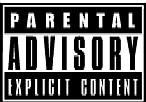
One of the main ways that people have tried to keep offensive or questionable music from young people is the parental advisory sticker sanctioned by the RIAA and the PMRC. However, these labels are not specific with the age specifications. Thus the age specifications are decided individually by companies. So if you cannot buy a stickered album at one store, all you have to do is go to another store to get it. In the year 2000, about a third of America's top-selling albums had parental advisory warnings.
<-------------------------------------------------------------------------------------------->
Opinions on Music Censorship:
Pro-Censorship:
Popular music is targetted by people who are pro-censorship, because they think that lyrics influence future actions taken. An example is the suicide of John McCullom, whose parents claim that Ozzy Osbourne's song "Suicide Solution" "aided, or advised, or encouraged" him to commit suicide. Other adults think that lyrics endorsing drugs or alcohol may encourage youth to partake in these activities. These worries led to the formation of the Parents Music Resource Center (PMRC), which sought the censorship of music. C. Delores Tucker of the National Political Congress of Black Women said, "No one and no industry should be allowed to continue the social and psychological poisoning of the young minds of this nation that occurs with the music industry."
Anti-Censorship:
For a lot of teenagers, music is an outlet. If a person can relate to a song, it will prevent them from doing anything violent or "evil." In opposition to pro-censorship ideas, many believe that if a person was going to commit suicide or do drugs or do anything else being promoted by music, the thought was already in the person's mind; it was in their nature. Therefore the action would happen sooner or later; music simply provoked the thought. More reasoning behind anti-censorship sentiment is the notion that censoring music violates the First Amendment, mainly the right of free speech, Thomas C. Grey said it best when he stated if you're going to regulate speech, then "you are going to create the danger of suppressing debate, [and] suppressing ideas." Several organizations that support anti-censorship views are the American Civil Liberties Union (ACLU), the National Coalition Against Censorship (NCAC), & Rock Out Censorship (ROC).
Local Opinion:
A sample survey of King George High School, grades 9-12, concludes that the majority of students own between 0 and 150 albums, and for the most part, there is a balance between the number of albums that have a parental advisory on them and those that do not. Parental advisories do not prohibit most people from buying particular albums, and very few people think that all music should be censored.
What does this say about the efforts to censor music? My results suggest that teenagers aren't basing their album purchases on whether or not it has a parental advisory. Rather, they are deciding to buy albums based on their musical tastes, and not because they think that they can "get away with it," as some adults suggest.
More importantly, it is proof that parental advisories do not prohibit young people from buying albums. Are the efforts of the PMRC and other organizations useless, then? Some would say "yes," but censorship laws still dictate what images can be shown and what words can be said (or sung) in the media.
+ Home
+ About
+ Timeline:
Pre-1950's
1950's
1960's
1970's
1980's
1990's
2000-present
This site is currently
UNDER CONSTRUCTION
