
-
- MAIN PAGE | THE GUEST ROOMS |
OUR BREAKFAST
| COMMON
AREAS | MORE
ABOUT US | IMPORTANT
NOTES | DIRECTIONS
- RESERVATIONS AND PAYMENT
- A
BRIEF HISTORY OF THE CARRUTH'S CONTRIBUTIONS TO DORCHESTER AND
BOSTON
- MAKE A RESERVATION
-
- A Brief History of the Contributions
of the Carruths in Dorchester
-
-
- reprinted from the Boston Herald, Boston,
Massachusetts
- A DEVELOPING STORY; A continuing series on the history
of building in Boston.
-
- The story of Herbert Carruth is one of an enlightened developer
who transformed the Carruth Street area of Ashmont in Dorchester
into one of the first and finest garden suburbs, a successful
bookstore owner and publisher, the head of the Board of Aldermen
and good government advocate, the first executive officer of
the Metropolitan Parks Commission, a Protestant who became a
Catholic, a Republican who became a Democrat and a man who ultimately
left the city after waging and losing a political battle against
fellow Ashmont resident and Boston Mayor John "Honey Fitz"
Fitzgerald, the grandfather of JFK.
-
- The death of Herbert Carruth was on the front page of The
Boston Globe the day after he died in Amherst on July 27, 1917,
but this important developer, whose only public remembrance is
a street in his native Dorchester, is a largely forgotten man
who was one of most progressive men of his time, not only a force
in real estate but an influential politician and parks official.
The Dorchester Beacon described him as "honest in purpose,
outspoken in opinion, quick in judgment and often hasty in word
and action."
-
 Along with landscape
architect Charles Eliot - the partner of Frederick Law Olmsted,
the designer of the city's Emerald Necklace of parks - Carruth
helped organize the nation's first organization to acquire and
improve public parkland and also brought a new style of housing
to New England, the garden suburb. Carruth commissioned the leading
regional architects to design houses he built placed on uninterrupted
richly landscaped lawns that turned the Ashmont area into one
of the most desirable places to live in late 19th century Boston.
Along with landscape
architect Charles Eliot - the partner of Frederick Law Olmsted,
the designer of the city's Emerald Necklace of parks - Carruth
helped organize the nation's first organization to acquire and
improve public parkland and also brought a new style of housing
to New England, the garden suburb. Carruth commissioned the leading
regional architects to design houses he built placed on uninterrupted
richly landscaped lawns that turned the Ashmont area into one
of the most desirable places to live in late 19th century Boston.
-
- The development of the first "railroad suburb"
in Dorchester was a long process that began with Herbert's father
Nathan Carruth. Born in North Brookfield, Mass., in 1808, Nathan
came to Boston at age 15 with nothing and built up a successful
business as a clipper ship and apothecary merchant. After his
first wife died, he married Sara Pratt Porter, a widow with three
children. They had three more children, two daughters Ellen and
Emma Caroline and his son and heir Herbert Schaw, who was born
in 1855 in Dorchester on a 12-acre estate called Beechmont that
extended between what is today Beaumont and Ashmont streets.
-
- "Nathan Carruth bought the land for pennies on the dollar,
knowing that it would one day be valuable when a railroad came
through," says Boston author Anthony Mitchell Sammarco,
who has published illustrated volumes on the history of area
neighborhoods. "And he founded the Old Colony Railroad for
that purpose."
-
- The talk of a new railroad from Boston to Quincy sparked
a great debate when it was first brought up in the Legislature
in 1842. The gentlemen Yankee farmers who had lived on estates
in the town for 200 years were opposed to it, concerned that
building a railroad line out to what was then a rural area would
change the quality of life and bring unwanted residents and crime
from the city, wrote Dorchester Irish Reporter editor and historian
Peter F. Stevens. But the influence of Nathan Carruth and other
supportive landowners in the area won out and the new railroad
was chartered in 1844 and started stopping at Ashmont in 1850.
It changed the town forever, causing intense land speculation
as developers vied to build houses for Bostonians who could now
easily commute by train. The rising land values also led to the
annexation of Dorchester by Boston in 1870, as development interests
even among the older families took hold.
-
- Nathan Carruth's plans for a railroad suburb were not realized
in his lifetime, as the Depression of 1873 stymied development,
but he did acquire more land in the area. And Nathan built a
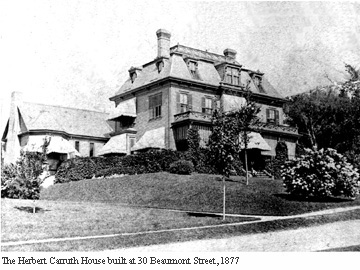
new house for his son and his son's new wife at 30 Beaumont Street
as a wedding present. Herbert's wife, Annie French Pope, was
born in San Francisco but came to Boston to live with her kin,
wealthy lumber merchants, on Pope's Hill in Dorchester. Herbert
fell in love with her and even though he'd been brought up as
a Congregationalist - and his father was leader of Second Church
in Dorchester in Codman Square - he converted to his fiancee's
Roman Catholic faith before marrying her in 1877. They had three
children, Nathan, Herbert Pope and a daughter who died shortly
after childbirth.
-
- Herbert, educated at Phillips Andover and Amherst Agricultural
College (now UMass Amherst), started off in his father's business,
but he soon went out on his own, opening a bookstore and publishing
house at 340 Washington St. near the Old South Church with a
partner, called W.B. Clarke and Carruth, in an area of famous
booksellers like Estes and Lauriat, Little & Brown, Burnham's
and the only survivor of that period, the Old Corner Book Store.
The publishing division put out many books on Boston history
and geneaology while the bookstore grew to be the largest retail
bookseller in the U.S., according to the King's Handbook of Boston.
-
- He gave up his interest in the business in 1889 to concentrate
on real estate development and public service. Nathan Carruth
had died the year before and it fell to his son Herbert to develop
the property. He hired Dorchester native and architect Luther
Briggs to lay out the streets and lots, but he was determined
to do something different.
-
- Herbert, like his father, was an avid horticulturalist, but
he had also been exposed to many progressive building ideas such
as the garden suburb in Bedford Park, England. He had also formed
friendships with architects and artists, as well as Charles Eliot.
He decided against building great houses side by side as George
Derby Welles was doing on nearby Ashmont Hill, and instead envisioned
a master-planned development with the idea of terracing houses
up Carruth's Hill - smaller houses on smaller lots on Fairfax
Street, then a small-scaled near cul de sac, and along Randolph
Terrace and Weyanoke Park and grander houses with wider vistas,
streets and open spaces along Carruth Street and up Beaumont
Street overlooking the Blue Hills.
-
- Carruth also instituted setback requirements and a deed restriction
that prevented the stabling of horses on his house lots. He built
a separate community stable behind the development for that purpose.
-
- Carruth hired some of the leading Boston architects of the
time, including Whitney Lewis, Edwin J. Lewis and John A. Fox,
who designed some of the most notable Queen Anne and shingle-style
houses in New England. The first houses Carruth built on Fairfax
Street are influenced by Bedford Park and the Queen Anne designs
of architect Whitney Lewis and are considered local masterpieces.
Fairfax Street was a narrow lane and the clapboard and brick
houses along it were built to resemble an English village. The
vista widens out as it turns left and up to Beaumont Street,
which is 40 feet wide with 40- foot setbacks, and here was where
the largest houses were built.
-
- The development caught on, and Carruth built and sold more
than 40 individually designed homes within five years, some in
the emerging shingle style. The Carruth Street area attracted
not only wealthy businessmen who chose to live in Ashmont over
Brookline and Newton, but also artists like Edmund Tarbell, the
leader of the Boston School, and noted Arts and Crafts designer
William Grueby.
-
- Carruth was elected an alderman from District 12 during this
time and was a tireless advocate of Dorchester infrastructure
improvements, heading committees on sewers, electrical poles,
railroad crossings and street widenings and paving. He rose to
become head of the Board of Aldermen and used his political power
to benefit his own development and the surrounding Ashmont area,
managing to keep Beaumont Street a private way. But he also worked
to obtain more funding for public schools and libraries and founded
the Codman Club, the first club in Boston that was open to women
as well as men.
-
- But even as he became a wealthy and successful developer,
Carruth spent more time in public service, becoming the first
executive officer of the Metropolitan Parks Commission.
-
- Carruth was not a Brahmin nor was he obviously anti-Catholic,
but as a merchant and developer he was part of the business establishment
that feared the rise of Irish political power in the city, which
threatened to end the progressive Yankee leadership of the city.
The election of John L. Fitzgerald as mayor in 1905 brought these
fears to a head, with allegations of corruption and political
cronyism.
-
- Carruth was a close friend of Republican George Albee Hibbard,
a former postmaster to whom he had rented a house on Rowena Street
and for whom he later built a house next door to his own. Carruth
helped engineer Hibbard's successful run for mayor in 1907, a
defeat that so stung the brash Fitzgerald that his neighbor became
an object of his wrath.
-
- While Hibbard was in office, Carruth worked with him to reform
city government with new checks and balances and change the city
charter, abolishing the party system in the mayoral election
and extending the mayor's term to four years. Carruth also successfully
replaced the Common Council and Board of Aldermen with a nine-member
city council, putting himself out of political power.
-
- For the pivotal election of 1910, Carruth switched his party
allegiance to the Democrats and was a major operative for James
Storrow, a progressive whom he saw as the only hope of holding
back the reelection of Fitzgerald. But Fitzgerald won the election
that was the beginning of the Irish hegemony in Boston politics.
-
- A vengeful Fitzgerald moved quickly, as one newspaper account
said, to "cut off Carruth's political head." Depressed
both by a major political defeat and the death of his mother
in the same year, Herbert decided in 1911, at age 55, to sell
off all his holdings in Dorchester and move his family to his
old college town of Amherst. He was one of many Yankees who left
Ashmont during this period, as their carefully tended garden
suburb was becoming a streetcar suburb, with trolleys and dozens
of three-deckers on narrow lots that filled in the open space
and brought in hundreds of new residents.
-
- Carruth spent the last seven years of his life in Amherst,
retired but a volunteer land surveyor who suffered from heart
trouble. He was buried at Cedar Grove, the Dorchester cemetery
of which he had been a trustee. His wife died seven months before
he did, but his sister lived in the old family house until her
death in 1923. Herbert's sons did not go into real estate, but
Henry Pope Carruth became a distinguished chemist at MIT.
-
- Many of the grand houses Carruth built fell into neglect
until the 1980s, when the area was rediscovered by middle-class
homeowners. Most of the homes have now been restored, although
the cul de sacs long ago became through streets and the uninterrupted
lawns are bordered by fences and bushes, although many owners
have planted maples, magnolia bushes and other foliage common
to the garden suburb period.
-
- Carruth's own family home at 30 Beaumont is today being operated
as a guest house by owner and interior designer Heidi Kieffer,
but much work remains ahead to bring the exterior, interior and
grounds of Carruth House back to the way it looked in the 1870s.
Kieffer has restored the living room, and its fireplace topped
with a shelf of ornamental balustrades and Chelsea tile, as a
guest suite. Her next project is to open the oak library wing,
with its vaulted ceiling and trusses, as a living/meeting room
for her guests.
-
- "This house has always had a good feeling about it,"
says Kieffer, who bought it 19 years ago when it was broken up
into two units (and before that had been a rooming house).
-
- "My dream is to restore it as close to the original
Carruth vision as I can."
-
- Anthony Mitchell Sammarco provided some research information
for this article. Some material also came from "Ashmont,"
a guide published by the Dorchester Historical Society, with
the expressed permission of its author.
- Caption: PICTURES OF SUCCESS: The Beaumont Street home, circa
1877, of Herbert Carruth, right, was one of more than 40 architecturally
significant homes he developed in the Ashmont area of Dorchester.
TOP PHOTO COURTESY ANTHONY MITCHELL SAMMARCO; RIGHT PHOTO COURTESY
THE BOSTONIAN SOCIETY/OLD STATE HOUSE
- Caption: NATHAN CARRUTH
- Reproduced with permission of the copyright owner. Further
reproduction or distribution is prohibited without permission.
People: Carruth, Herbert, Carruth, Nathan, Sammarco, Anthony
Mitchell, Fitzgerald, John, Hibbard, George Albee
Author(s): PAUL RESTUCCIA
Section: REAL ESTATE
Publication title: Boston Herald. Boston, Mass.: Mar 1, 2002.
pg. 042
Source Type: Newspaper
ISSN/ISBN: 07385854
ProQuest document ID: 109983299
Text Word Count 2077
-
- MAIN PAGE | THE GUEST ROOMS |
OUR BREAKFAST
| COMMON
AREAS | MORE
ABOUT US | IMPORTANT
NOTES | DIRECTIONS
- RESERVATIONS AND PAYMENT
- A
BRIEF HISTORY OF THE CARRUTH'S CONTRIBUTIONS TO DORCHESTER AND
BOSTON
- MAKE A RESERVATION