 |
||||||||
Site of Bob |
||||||||
|
|
||||||||
Professional |
||||||||
|
|
||||||||
| send email to Bob |
||||||||
|
||||||||
By Robert van de Walle
I've been kicking around an idea for as long as I've known about the linear aerospike engine, and I've decided that posting it and hoping it comes to something is warranted. I'm certain that in the hands of a competent development crew, this could be worth billions of dollars.
The genesis of my idea begins with the fact that jet engines can be made to function well at altitudes over 40,000 feet and at speeds of over mach 2, but not much more. This leaves an airplane firmly embedded in Earth's gravity.
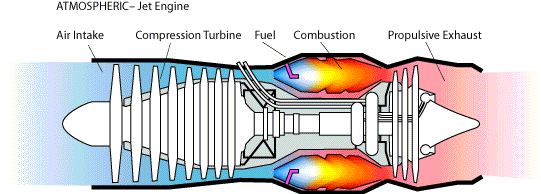
So how to add thrust? Afterburners add considerable thrust, but still require atmospheric oxygen. It occurred to me that the internal part of the exit cone of a traditional jet turbine looks very much like an aerospike ramp. I wondered about designing an engine having a second thrust chamber there, a toroidal combustion chamber at the outer circumference of this cone. By using the spinning turbine as a centrifugal pump, some of the engine mass can be re-purposed to move propellants- and at very high pressures, too, possibly without the need for gas generators and turbopumps.
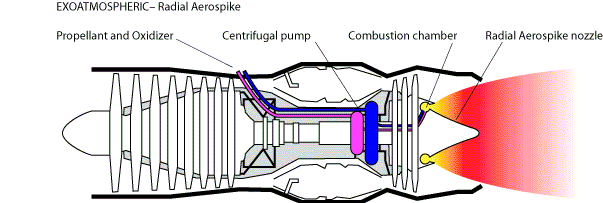
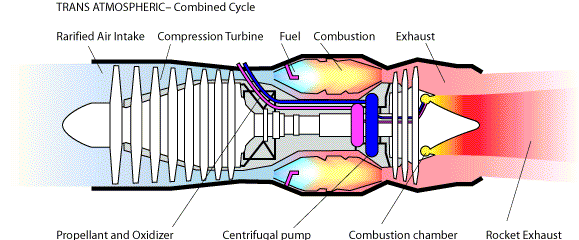
In the transitional realm, above the airframe's "normal" operating regime but before leaving the atmosphere, the engine could be run using both modes. The thrust from the aerospike, if directed against some thrust-vectoring vanes, will maintain or increase the engine rpm, enabling the engine to compress and combust even rarified air.
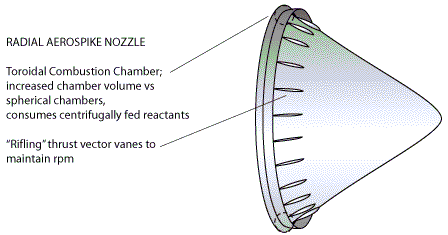
Here's an illustration of the pertinent component, the toroidal combustion chamber and conical aerospike thrust ramp. It could be built and installed in any number of appropriate commercial engines, for testing.
Is this a viable idea? The first step would be to determine whether accelerating the "unused" engine mass (most of the turbine components) from 2000 mph to 18000 mph is worth the mass of LOX that the vehicle doesn't have to carry, as it climbs to somewhere around 40 to 50 thousand feet. Since many vertical lift-off vehicles consume most of their propellants within the first few minutes of "flight," I have a hunch that it's at least an even trade-off. But, since these engine components would become essentially "payload" (mass delivered to orbit), it's certainly the primary focus of a strawman study.
And perhaps the solution to that mass equation (LOX vs idle engine components) is unfavorable, leaving one with the impression that it's better to carry all the propellants internally. Now the question can be asked, "what is gained by starting an orbital flight plan at high altitude and 2 or 3 times the speed of sound?" A quick answer is that the vehicle could abort its orbital run at any point during its flight, and fly back to its base using only the jet engine configuration.
And the last thing to consider, is that this sort of idea allows a single-vehicle system, rather than a mated or stacked vehicle- which could result in quicker turn-around times between flights.
I'm fully aware that this is the 1% inspiration part of this development plan. I do not have the resources to pursue it. I sincerely hope that if some clever propulsion group is willing to assume the 99% perspiration part of this effort, that they do so- I would dearly love to see the development (to have contributed!) of a vehicle that lowers the cost of earth orbit access, and I firmly believe that a combined-cycle engine similar to this will play a large role in accomplishing that.
©2001 Robert van de Walle