 |
To Terraform Mars
by Robert van de Walle (first posted 1996)
There is talk in both serious and pseudo-scientific circles about "terraforming" Mars. So far, no one I've read has suggested how to simulate Earth's carbon cycle. If I dwell upon the problem of evolving life, plate tectonics seems to play a very important role in this matter. It is postulated that poor Mars is too small to support plate tectonics. I say, "fiddlesticks!" because the problem, as I see it, is that Mars doesn't have a large enough satellite to drive plate tectonics.
I further see this as a solvable problem.
Pluto/Charon is a tailor made solution. What I propose is that we drop Pluto into a transfer orbit and through a series of gravity maneuvers put it into a tight orbit around Mars. The procedure I envision is this:
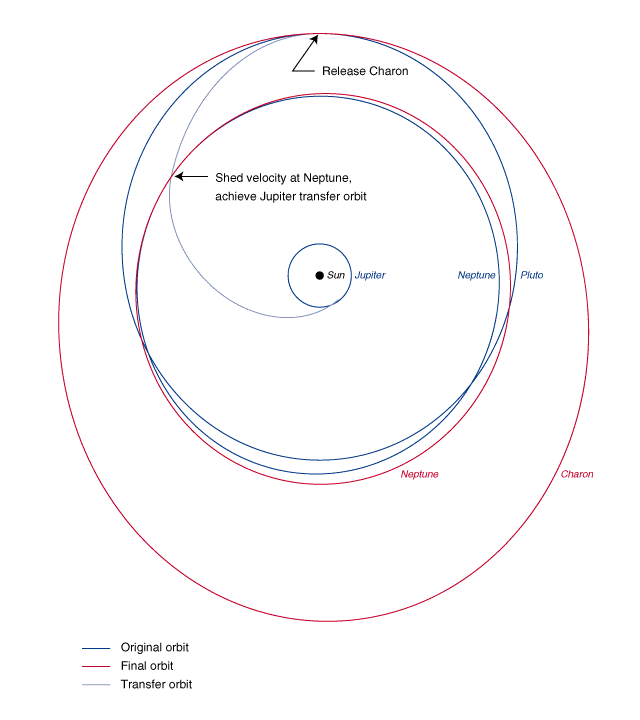
Tether Pluto to Charon and spin them up like a giant bolos
Sever the tether, ejecting Charon (see ya!) and dropping Pluto towards the inner solar system.
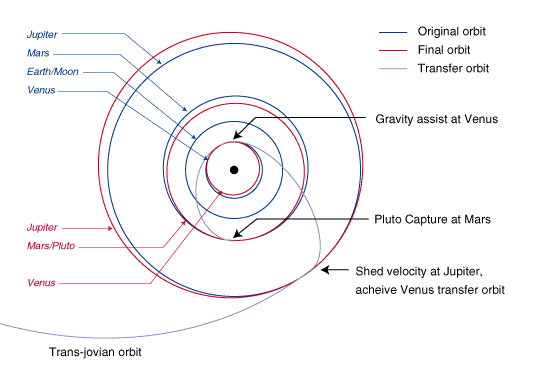
Use mighty Jupiter to slow Pluto down enough to keep it in the inner solar system.
Capture Pluto at Mars.
I do not know what sort of tensile strength can be expected of the 20,000 km Pluto/Charon tether, so I do not know how much delta-v is available from this maneuver. Velocity shedding might be required at Neptune or Uranus. Also, the maneuver at Jupiter will be well within the Roche limit, and Pluto might be ripped to shreds unless velocity can be shed over successive interactions with the giant planet. Jupiter is 100,000 times more massive than Pluto, so only a slight eccentricity is likely to be introduced, and if we do end up performing multiple passes, we might have the opportunity to circularize it over time.
To capture Pluto at Mars, it might be necessary to get an assist from Venus. Venus is 240 times the mass of Pluto, so we can expect to be moving Venus only slightly. Dropping Pluto in this close to the Sun scares me somewhat, because it will become the biggest, brightest comet the human race has ever seen, and I despair of trying to effectively steer it as it begins out gassing. But it seems the only other option is to have Mars capture Pluto in a retrograde orbit, and while that might help kick-start the motion of Mars' crust, I dislike it for aesthetic reasons.
There would be a little clean-up and some added benefits. After Pluto is in orbit around Mars, we can further circularize Mars' orbit by ejecting Diemos and/or Phobos at appropriate times. Pluto is now being warmed not only by the Sun but also from intense tidal interactions with Mars, and soon becomes a water-world. If we succeed in placing it in a tight enough orbit, Mars will capture a significant amount of the volatiles outgassing from Pluto. Jupiter and Mars, in their slightly new orbits, perturb asteroids out of their resonant orbits and there would be some chaos in the inner solar system for several hundred years, but perhaps the new crop of Earth-crossing asteroids would be of great enough commercial value that no one would mind the added risk.
You'll note that I omit the Earth/Moon system from any of these gravity maneuvers. I do not know how precise the Earth's orbit needs to be to sustain the life it carries, and so I'd rather not mess with it. What I'd really like to do is have Pluto knock a moon like Callisto or Titan out of their gravity wells, and then to have one of those bodies swing in and replace the Moon, which would then swing out to be captured by Mars. This scenario gets me even more of what I want: either a wet, warm world or a petro-chemical company's dream world right at our doorstep, while jump-starting Mars' plate tectonics as well. If Mars has lots of permafrost, this scenario creates lots of new real estate for humans to play with.
Moving Pluto towards Jupiter
Moving Pluto to Mars
Recently, while participating in a forum on Space.com, someone made the brilliant suggestion of moving an iron meteorite into orbit around Mars and simply energizing it to provide a magnetosphere. I'll bet Kim Stanley Robinson wishes he'd thought of that!
|
|