Previous Events
June 6, 2000
The Chestnut Blight is Alive and Well in the George Washington National Forest, Shenandoah County, Virginia
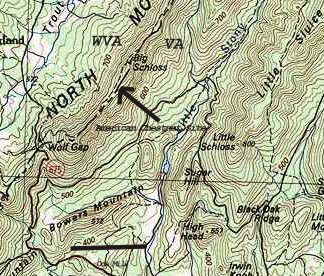
The George Washington National Forest west of Woodstock, Virginia (see image at the bottom of this page) is accessible to hikers by a number of trails. The mountains here are part of the Valley and Ridge Province of the central Appalachians. To the east lies the North Fork of the Shenandoah River meandering its way through the Shenandoah Valley.
Hiking on the east side of Great North Mountain led to a startling discovery on New Year's Day, 1997. Along our trail between Wolf Gap and Big Schloss Larry Bradford noticed abundant furry nuts on the ground. He thought these were American chestnuts. A quick look at the tree from which they had fallen confirmed that these were indeed the fruit of an American Chestnut with a trunk 8 1/4" inches in diameter.
The American Chestnut (Castenea dentata) is abundant as small trees or shoots that rarely reach such thickness before being killed above ground by the chestnut blight, only to sprout again, and die again. The roots survive indefinitely but so far futilely.
The American chestnut was killed by one of the worst blights to infest American forests- the fungus Endorhia parasitica. It was first detected in a grove of chestnuts at the New York Botanical garden in 1904. It had reached North America in imported Chinese chestnut trees, which have a natural resistance to the fungus. By 1935, the American chestnut was gone from American forests. Trees that could reach 100 feet high, with abundant tasteful edible nuts, fine resistant timber, and bark rich in tannin, disappeared.
Maximum diameters at breast height reached before destruction by the blight are typically given as four inches. Had we found a resistant strain that had come into being through natural genetic variability and natural selection?
We returned to view the unusually large Chestnut on June 11, 2000, in the morning of what would be a hot muggy day, with temperatures headed for the nineties. We were saddened to find that it was dead. It had followed the inevitable fate of it's numerous and much smaller predecessors. A small gypsy-moth caterpillar infested shoot near the base of the trunk was still alive.
We were disturbed and surprised to find so much leaf destruction by the Gypsy Moth all along the trail from Wolf Gap to Big Schloss. Big Schloss is an outcrop of the Silurian Tuscarora sandstone at the north end of the ridge that gives a vista of the surrounding landscape. The oaks at the southern end of the ridge crest had lost most of their leaves. To the north, destruction was less but still underway. The hickory, striped maples, sassafras and a few other shrubs and trees were unaffected. This was the first serious outbreak we had seen in the area since the devastating mid-nineties.
Reviews
About the American Chestnut
The American Chestnut Society: (http:/www.acf.org/)
The detailed information provided by the American Chestnut Society is easy to navigate and very informative. Especially useful are descriptions of the diagnostic characteristics of the American chestnut. In the dry woodlands of Shenandoah County, VA, the Chestnut oak is the easiest to confuse with the American chestnut by the novice. The site also accesses a wealth of technical and lay information through the Journal of the American Chestnut.
One article by Pat Chamberlain describes an American chestnut in Erie County, Pennsylvania, that reaches 25 inches DBH (diameter at breast height). Its resistance is attributed to a less virulent (hypovirulent) form of the fungus blight Endorhia parasitica.
I recommend that you have a look at the site, and even to join the Society to help in its important work of reestablishing the American chestnut.
A Fungus Beats the Chestnut Blight at its Own Game
Rudolph Chelminski published this article in 1979 (The Smithsonian Magazine, v. 10, no. 3, p. 96-107) describing how a less virulent form of the Endorhia parasitica can dominate and lessen the damage of the more virulent form. This research is by the French agronomist Jean Grente working on the European chestnut Castanea sativa. The American chestnut does not seem to have responded strongly to this promising cure..
The Dying of the Trees: the Pandemic in America's Forests
Charles E. Little, 1996, Viking Press, Penguin Books, N.Y. At times a detective story-like treatment of many of the assaults on American trees by various pests and pollution, starting with the alarming infestation of the Eastern Flowering dogwood, Cornus florida, by a fungal infection termed anthracnose. This book is a must for those who wish to learn about the many changes affecting American forests.
About the Gypsy Moth
Michigan's Gypsy Moth Education Program site provides an informative summary of many aspects of the gypsy moth (http://www.ent.msu.edu/gypsyed/) . I found the section on the "3 Ps" of control (parasites. parasitoids, and pathogens) especially important. Of these, the virus Neucleopolyhederosos is identified as the major cause of collapse of gypsy moth outbreaks such as we saw near Big Schloss. Especially fascinating was how the use of pesticides inhibited the natural course of this disease, which becomes a controlling factor only when the caterpillar population is large. The Virginia Tech site and U.S. Forest Service site include maps, outstanding photos and a wealth of other information on the gypsy moth.
Site Reviews
There are many fine sites on the subjects of the Chestnut blight and the gypsy moth: I have reviewed only a few, and cite those especially suited for the lay reader.
Note 061200 . Published June 12, 2000, with occasional corrections/improvements after that.
 Click on Image to See Location Details