 |
|
 |
 |
 |
 |
 |
 |
LOG |
 |
| August 3rd, 1999 I decided to make a list of the equipment I needed. But first, what I have: 34 gallon tank, overflow / prefilter, aquarium, some undergravel plates, thre air pumps, two small power heads, thre 3.5 gallon water cooler jugs, some flexible tubing, PVC pipe and fittings. I wanted to use as many parts that I already had. |
| What I designed required the following additional equipment: Sump, Pump, Lights, Protein skimmer (foam fractioner), Dosing system w/ water top off (RO filter or just a really good water filter to make -up for evaporation.t August 6, 1999 The first item I purchased (August 5th 1999) on my list was a big surprise. While visiting my local pet store (idea hunting) I found a used CPR Bak Pak for only $25! I couldn�t believe it either! It is old and VERY dirty but with some cleaning it will work. That just saved me $100! This has made me enthusiastic about checking some garage sales and swap meets for the rest of my stuff. September 6, 1999 In my research, since purchasing the CPR Bak Pak, I have found that the most efficient use of a protein skimmer is in the skimming of the oily sludge off the surface of the water. This is why most systems with a sump place the protein skimmer in the sump where all the water comes from the surface skimmer. The CPR Bak Pak I purchased takes water from inside the tank, well below the surface. If I cannot modify the sump to the Bak Pak skimmer or the Bak Pak to the sump then I�ll have to sell this and get one that will work in the sump.� CONSTRUCTION BEGINS October 10, 1999 I�ve made some decisions about the tank�s layout based on further research : First of all the CPR Bak Pak will work with my sump if I elevate the sump (10 gallon glass aquarium) 2 inches to allow the Bak Pak to hang on the side.I am not going to drill the tank. I will use the surface skimmer box / �C� siphon / overflow prefilter as it was designed. If I had not bought this piece of equipment 8 years ago I would just drill the tank to save money. But, since I have this overflow/ "C"siphon it would be a waste of money NOT to use it.���From the pre-filter water will travel down a 1-1/2 inch clear plastic tube to a 10 gallon tank in the cabinet that will be used as a sump. I will put a RIO 2500 power head in the sump for the return to the tank. The sump will have a refugium with caulerpa macro algae.� This means there will be no �algae scrubber� using micro algae. I decided against the algae scrubber after reading more about Sy Lengs Miracle Mud and the EcoSystem aquarium method. This way there will be a naturally replenished food source from all the critters living and reproducing in the mud for fish and invertebrates. But, there should not be any yellowing of the water, but there will be macro algae to absorb the excessive nutrientsI have tried to find a way to buy Sy Leng�s Miracle Mud but all I get from him (or his company) are requests for the name and address of my L.P.S. I�m not comfortable with getting someone on a �sales call list�. I�ve emailed some of the mail-order pet stores that I�ve dealt with in the past and they were less than enthusiastic about this product. I�ll probably just use live sand with some refugium critters.�Two or three power heads will be placed in the main tank (on timers) to circulate the water. The return from the sump will come from a spray bar behind the live rock submerged inches from the sub strain. This should keep the water circulating through the backside of the live rock, as the power heads keep up the circulation in the front. |
| October 30, 1999 Today I am ready to test the system. There is no sand, gravel or live rock. This is only a test. So far this month I have built the partitions in the sump, built the 2 inch platform for the sump tank, cleaned and hung the CPR Bak Pak, installed the main pump (Rio 2500), installed the overflow / skimmer box and plumbed all the necessary PVC pipes and flexible tubing. The 35-gallon tank and circulation system are mounted in the oak cabinet on a concrete pad on the side of the garage. If this thing leaks, the water will do no damage out here. So far, so good it is full of water and all the power is on. It is so exiting to see the water move through the system. Cascading, draining, pumping, all the way I thought it would. But now it is a reality. Oops. Bubbles�tiny bubbles�in the water. There are micro bubbles coating the inside of the tank. This is not good. Finally, I see that the cascade into the �pump chamber� of the sump is producing a lot of bubble that are being sucked into the pump and are then turned into micro bubbles. The solution is simple: a couple of pieces of filter foam break the water�s fall eliminating the bubbles. Problem solved. November 8, 1999 I�m ending my test and draining the system and moving it back into the garage were it will be dried out and stored until after Christmas. My wife and I agreed that this would be the best time to set it up as we plan to use the space in the living room for the Christmas tree. Besides, Christmas is no time to be spending money on this tank. November 26, 1999 I�ve been dabbling with the idea of building a calcium reactor. I found a few plans for D.I.Y reactors on the net, but the biggest hurtle has been the $175 CO2 system to make it work. Then over Thanksgiving holiday my brother-in-law shows me his homemade keg refrigerator complete with a CO2 system. He got the parts for free from a friend of his. Along with an extra CO2 tank! I couldn�t believe my luck. I explained my plans and he gladly handed over the CO2 tank for my cause. I figure the rest of the parts (4�PVC and fittings, flow regulator, backflow preventer) are going to cost between $75 and $100 unless I find another deal. But, hey compare that to a KNOPS or any other commercially built calcium reactor: $280 for the reactor and $179 for the CO2 system. January 23, 2000 The new millennium has come with a great deal of fanfare. While everyone else is busy returning the generators they didn�t need and selling their fortified bunkers in the mountain to the 2001 doomsayers I was getting back to work on my tank. �Plenum or not to plenum?� that is the question. A plenum is a �dead zone� (like an under gravel plate) under the gravel of an aquarium for the purpose of creating an environment for anaerobic bacteria for denitrification. It is also known as the Jaubert Method or NNR (Natural Nitrate Reduction). There has been a great deal written about this method as well as a monthly column in FAMA (Fresh Water and Marine Aquarium magazine). And I for one have been convinced of is role in a healthy reef aquarium. However, a recent article by Rob Toonen (UC, Davis Department of Evolutonary Biology): �Are Plenums Obsolete? Another Viewpoint� (FAMA Jan. 2000 and Feb. 2000) has argued for Refugiums and a less publicized method known as Deep Sand Bed. This method does the same thing, supposedly better, with less hassle. Though the process of all this combined methodology had no name, it seems to be some form of a �natural method� similar to Sy Leng�s Miracle Mud and the EcoSystem aquarium method. The only difference was in Toonen�s use of �sugar fine� sand rather than �mud� and the encouragement of a substrate in the main tank as opposed to Leng�s frequently vacuumed bare bottom tanks.Toonen pointed out that reefs occur close to sea grass and mangrove habitats. This happens because they are dependent on each other. Therefore, any successful reef aquarium should include this added diversity (somehow) to keep the aquarium�s captured ecosystem in balanced. This is a rather simplified explanation of this lengthy two-part article but I�m sure points from that article will surface in future logs.Also during this time I made another modification. I�ve added an air pump so I can put an air stone in the overflow / prefilter box. I read this will help the redox (oxygen potential) level of the water. |
| February 1, 2000 I found a great deal on a Hamilton 2X55 watt PC retrofit in FAMA magazine from Advanced Aquatics. It�s on order now. The magazine advertised price was better than the stores own website price. In fact it beat the best price I�ve ever seen by nearly $20.Right now I�m building the lighting mount for inside the hood. Kind of a hood-within-a-hood complete with fan, lens and an additional normal fluorescent actinic bulb for dusk-to-dawn. JUST ADD WATER..... February 10, 2000 Today I finally brought the tank into the house and spent the afternoon fetching water from the RO water machine at the grocery store. Boy, adding the Instant Ocean sea salt s-l-o-w-l-y is time consuming work. I have a few clumps swirling around the bottom of the tank. The most amazing thing to me is the protein skimmer. When I was testing it in fresh water the ventri and additional wood-block bubbler only made regular chunky bubbles. I was afraid there was something wrong with my CPR Bak Pak. But, as the water became saltier the bubbles became smaller and smaller until the skimmers reaction chamber became milky with bubbles. I was so relieved, and embarrassed by my ignorant fear. What a "newbie". Now I�ll just let the sea salt mix (and replace evaporative water) until my LPS gets some live rock. February 21, 2000 There is a problem with the �C� siphon. I came home today and the siphon between the surface skimmer and the overflow prefilter had nearly broken. As a result, the main pump was sucking air due to the lack of water getting to the sump.I had to put an airline tube up into the �C� siphon in order to suck the air out and get the flow rate up. But what could be causing the air to seep into the �C� siphon? At first I thought the acrylic seams must have been leaking. But it would have been causing this problem during the original test of the system back in November. Then I noticed a lot of micro bubbles in the tank (again). In fact the underside of the "C" siphon's surface skimmer was one giant bubble. If that much air could sit under the flat surface of the skimmer, then imagine how much was being sucked up into the �C� siphon to create the huge air bubble that was nearly breaking the siphon.I�m going to have to look into someway of preventing bubbles from getting into the pump chamber. Remember I�m hoping to get some natural food for the main tank inhabitants from the refugium in the sump. So, there will be no �sponge filter solutions� to this problem. A sponge filter would filter-out the plankton bi-products of my refugium. I�m thinking of using wiffel-ball type practice golf balls I saw at Wal Mart. They look like an inexpensive alternative to Bio-Balls but I don�t know how safe they are. Another idea would be to make a labyrinth like the one in CPR Bak Pak (Berlin method bubble eliminator in the bio chamber). March 2, 2000 I decided to go with the wiffle-balls. I bought 4 bags, there are 8 in each bag. It has cut down on the problem of bubbles passing through to the pump, but some are still getting through. But, at the rate the bubbles are coming through it would take a few weeks to break the siphoned. I'm going to have to leave the air line tube inside the "C" siphon. I tried to attach the air line tube to the ventri inlet of one of my power heads, but it isn't sucking hard enough. Another task to add to my weekly maintenance schedule. March 15, 2000 I was hoping to be telling you about the new live rock in my tank, but my LPS didn't get their shipment again. |
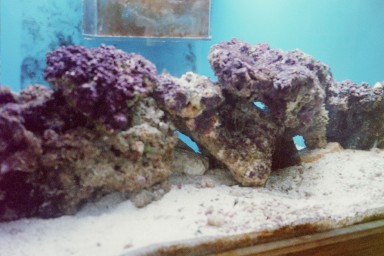
| I WANNA ROCK March 28, 2000 IT'S HERE!!!! live rock. They were just unloading it when I got to the store, so I got the first pick. I bought 2 large (11 lbs and 10 lbs) pieces and 2 small (5 lbs and 2 lbs). I could hardly see any coraline algae on the rocks in the bin. I think I got the most encrusted ones (that's sad) and they are only 40% encrusted. "They" say to smell the rock before you buy. It should smell fishy, but not like foul rotting fish. Mine just smells like seawater and dirt. Is that good or bad? I also added 20lbs of Aragonite sea-bed grade substrate (crushed coral sand). April 3, 2000 I'm letting the rock cure and in the process it is cycling the tank. The lights are off to keep hair algae from forming. I'm going to change 25% of the water in response to high nitrate tests (36 ppm). OK, that's not really high when your cycling, but I'm changing the water anyway. I guess I feel the need to do something. I'm running the normal floresant light for 4 hours per day to help the coraline algae along April 4, 2000 I just found a new reef aquarium shop Advanced Tanks and instead of being across town, it's just down the street from me! They also have new live rock every Monday. And its 100% encrusted with purple coraline algae! All hand-picked primo stuff! For nearly $1.00 less per pound!!! I'm kicking myself, why couldn't I've found this place a week or two ago before I bought this other overpriced, and over-glorified, one-step-away-from-being base-rock! Anyway, the owner / operator of Advanced Tanks, Darrell (or "Dr. D" as he's called, even though I suspect he's not a doctor ;) told me not to do anymore water changes while I'm cycling. Water changes will make the cycling process take longer. Makes sense to me, besides this guy has set up a heck of a lot more reef tanks than I have. |
| April 7, 2000 I bought two more small HEAVILY encrusted rocks. Though they are only 3 pounds a piece, they have 5 times more coraline than my initial 10 pounders. I put one in the sump to help liven-up the sand. I decided to add some sugar-fine aragonite to my tank and sump. This is to be a substitute for Miracle Mud in my EcoSystem-like tank. The idea is for the live rock to turn the sand live. Well, that could take a long time and some authors I've been reading say this will never happen to any degree of satisfaction. So, I'm going to seek out a source of some inexpensive mud of live sand. Something like G.A.R.F. Grunge. I'm trying to find something local. One thing to keep in mind when you add sugar-fine aragonite: FOLLOW THE INSTRUCTIONS. The instructions say (basically): put the sand, or a portion of it, in a bucket. Add water. The water will look like milk. When the dust settles to the point that it looks like cloudy water (2 or 3 inches of visibility) then dump the water. Now your sand is washed and your tank won't look like it's full of milk for 12 hours and then you spend the next week siphoning out the fine particles that get stirred into a cloud every time the power heads come on. Get it. SIGNS OF LIFE? April 10, 2000 I'm a little freaked out right now. There are long "kite-string" looking things growing out of my new rocks. What are they ? Some kind of fungus? April 12, 2000 As it turns out these are some kind of tube worms. When I turn on the lights I can see two little tentacle flailing in the current April 18, 2000 I bought 20 lbs of "live aragonite" sand factory pre-packaged by Nature's Ocean. It contains live bacteria. Not exactly what I had in mind when I was looking for "live sand" but I need something to make my sand ready for sand stirring critters. Nitrates, nitrites and ammonia are all at zero April 22, 2000 I just got back from the weekend. I have diatoms. There are "brown algae" spots all over the sides of the tank. Time to break out the cleaning magnet. Diatoms aren't actually algae, diatoms are micro-scopic critters who eat phosphates (some aragonite sands and some tap water contains phosphates) and then die when the food source starts running out for the number of diatoms in the tank. When you SEE the outbreak you're actually seeing the tail end of the event. I still freaked, this is the first "bad" thing that has happened to my aquarium. After talking to some people, I found that this is just part of the cycling stage and nothing to worry about. Later, a green algae infestation should come and then all should go well as long as I don't see "red algae I should be OK. Still big coincidence: add aragonite, get diatoms; some aragonite sands can contain phosphates (diatoms favorite food). |
| FIRST (ADDED) INHABITANTS May 26 , 2000 I don't like just sitting around looking at diatoms taking over my tank. So I emailed G.A.R.F. and ordered some reef janitors (snails who love eating diatoms and algae) and some Grunge to kick start my live sand June 1, 2000 I just got my snails and Grunge from GARF. A day earlier than they said. Fine with me. And I'm sure the snails were fine with that too. Put it all in the tank. Well, 1/2 the Grunge went in the tank and 1/2 in the sump. Sure are a lot of little live rock chunks. I guess if your buying the scrapings off the bottom of an aquarium that's what you get June 6, 2000 I can't believe what I'm seeing: Live Sand in my tank! I've only seen these little sand dwelling critters in 2-3 year old tanks. They look like little glass grains of sand and a few worms. It happened in just a week after adding the GARF Grunge. This Grunge stuff is great!!!� When the sub-strate has more worms it'll be time to add sand stirrers. In the mean time I going to track down some lights for the sump and some red seaweed or sea grass to put in the refugium/sump. June 10, 2000 Today I added 2 tbls of kalkwasser (by Kent Marine) to the fresh make-up water. Then I dumped the last little bit (1/4 cup) into the sump. DON'T DO THIS!!!!! The ph of my tank water shot up (8.0 to 8.4) in a matter of seconds. If I had inverts in there, they'd probably be stressed to the hilt or dead! What was I thinking? June 13, 2000 My water ph has retuned to normal. Well, just slightly higher than it was before I started to add the kalkwasser, but probably at it's new normal (8.2). Alkalinity is only 1.1 mil.eq. Sea water is 2.5 mil.eq. I need to work on that. Nitrate, Nitrite and ammonia are all at "zero". Yah!!!! July 12, 2000 Today, I added my first fish to the aquarium. Actually, I added two percula clown anemone fish (Amphiprion Percula) named "This" and "That", after the two kitten in a children's story book by Julia Sykes that my kids love. I also added a Long-Tentacle anemone (Macrodactyla doreenis, as far as I can tell). My wife named it "Thing" After a thirty minute acclamation period, for temperature and then water chemistry, I plopped them all in the tank together. The owner of my LPS said the best way to help the anemone find a good spot is to put it in a corner where there is slow water movement. But, not so far in the corner that it will not receive strong lighting (long tentacle anemones need strong light or they will wither away).� This worked perfectly, the anemone rolled around on it's side for a little bit then sat up and began inflating it's base. It scared the heck out of me, I had read that if the salinity was to low they would take on water in to their cells and not be able to expel it. I wondered if this behavior was some kind of death- throw. As it turned out, the anemone was so happy with where I put him that it began digging it's hole to sit in. Long-tentacle anemones like to bury their base in the sand so only their tentacles are sticking out. If they are threatened, they pull all their tentacles in so they look like part of the sea floor. After the main lights went off (giving way to the single floresant bulb used for day/night) the percula came out of their hiding place and found the anemone. They began acclimating themselves to it. Diving at it and nipping at the tips, it is believed that they are sucking the venom from the anemone so they can build immunities to it. I'm going to feed them in a day or two, and look into building a brine shrimp hatchery. Next I want to add some corals. After I'm sure the water is stable and waste products are being handled by the system.tem. |
| August 18, 2000 OK, I know I said I was going to add corals next, but I wanted something to eat all the hair algae in my tank.�� I got a Kole Tang (ctenochaetus strigosus). It is said they compliment the Yellow Tang because they both eat different types of algae. �I should find the source of my algae problem. But, just like the diatom (brown algae) problem I had a month ago, I believe (and have been told) this is just a cycle in the tank's maturing process. My next "problem" should be uncontrollable coraline algae. September 1, 2000 I'm getting very angry with my "c" syphon overflow. 3 times in this last week it has collapsed. Once because the auto water top-off ran dry but, the other times are unexplained. Once I was leaving for work and just happened to check. If I had left without checking, there would have been a big mess when I got home. It's stressing me out! I've designed an overflow based on the silent stand-pipe overflow I talked about on the equipment page �September 21, 2000 I�ve had a terrible problem with nuisance algae growing on the surface of my substrate. A couple of days ago I decided to change my 2 year old �dusk to dawn� light, a normal florescent that comes on before the 110 watt power compacts and stay on for an hour afterwards. I didn�t think this bulb was making such a difference in my tank but it apparently was. When I replaced the old Gro Lite with a blue actinic the algae disappeared in two days. � Now I have a bad side-effect from the change of light temperature: my anemone is not happy with the new lighting conditions and has moved to the back of the tank behind the rocks. He isn�t very easy to see in this new location and he is right next to one of my powerheads. I had to turn that powerhead off because he was getting sucked into it. There are 5 small anemone tips scattered around the tank. Great save by my wife who called me at work to tell me the anemone was �attacking� the powerhead. � October 1, 2000 I changed the actinic bulb to a daylight in the hope of drawing the anemone out from behind the rock. So far: nothing. � October 2, 2000 I added a new inhabitant to the tank. A �red tree� sponge. My only concern is in it�s placement: it is suppose to be in low light and high water flow. The only place in my tank that fits that description is behind the rocks were the anemone is now sitting. I had always planned to put a sponge there. So, I put the sponge in a medium light high flow area. All test show �0� nitrates, nitrites and ammonia. � October 10, 2000 I have amphipods! Thousands of them! All over the glass (in the evening before the lights go out)! This is great! I have an eco system! On another note: I have counted 12 different types of micro algae in the display tank. In a related topic: I just bought one of those Kent Marine glass scrapers. It works better than any algae scraper I�ve ever used. |
 |
|
| October 28, 2000 It has been one year since I finnished primary construction and first put water into my reef aquarium and watched it work. I had hoped to have more inhabitants by now, but money has been tight. Things will pick-up soon. |
 |
| From this point forward, the second year of the log will be kept on the "View Tank" page. The log will correspond with the picture for that month. |
| The First Year |
 |