 |
|
 |
 |
 |
 |
 |
 |
INHABITANTS |
 |
| Live Rock |
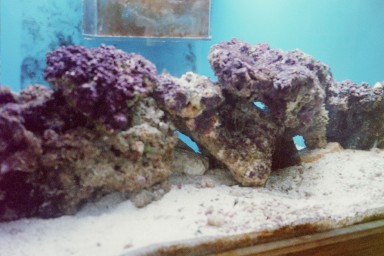 |
| Three month old Live Rock |
| The first inhabitant in the Big Reef Project were the live rocks. It may seem odd to refer to "rocks" as inhabitants, but if you sat back and watched all the life grow from these broken pieces of coral reef you would think differently. True, the most important function of the live rock is biological filtration (the best bio-filter the aquarium hobby has ever seen), but the bio deversity contribution is seemingly endless. |
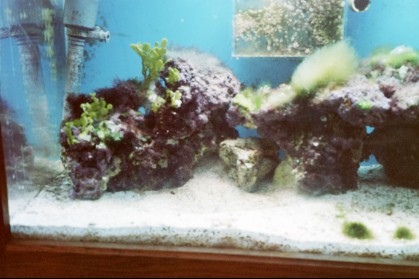 |
| 6 months old |
| In just 6 months, without adding anything (except an anemone and two clowns), I had 12 different macro algaes, 5 polyps, 6 small feather duster worms, some sponges and thousands of amphipods. These beautiful hand-picked rocks came to me from my LFS narly and dropping with purple coraline algae. I still have not seen rock like this anywhere in town. |
| Cleaning Crew |
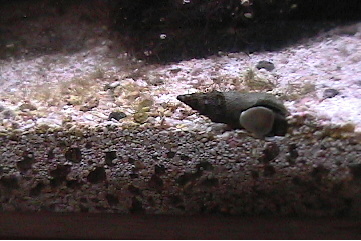 |
| The next inhabitants I needed for my reef were the clean-up crew. When I ordered my GARF Grunge to boost my live sand I had them throw in some snails to deal with my diatom (brown algae) problem. Later, they were used to eat hair algae. The only problem was in my desire to cut cost by ordering fewer snails than was recommended by the guys at GARF. Listen to then they know their stuff!!! Trust them!!! Oh, and the GARF Grunge works great. I had no visible life in my sand untill 3 days after adding the Grunge. Look at the picture above. Those dark spots in the sand are living organisms. |
 |
 |
 |
 |
| Anemone & Percula Clowns |
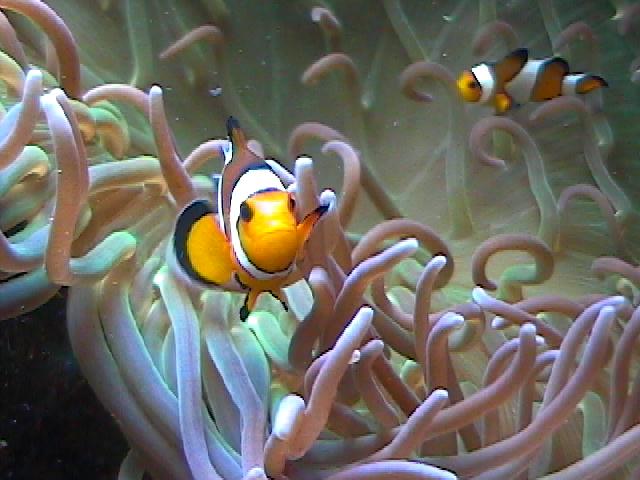
| I added three creatures at the same time: 2 Percula Clown anemone fish (amphiprion percula) and one Long Tentacled Anemone (macrodactyla doreensis ?). The Perculas were originally identified as False clowns (Amphiprion ocellaris) because the line dividing their orange and white areas was so thin when new that I could hardly see it. But, as time has passed that line has become thicker. Clearly identifying them as Perculas. They have also grown to be different sizes. This indicates they have chosen which is to be male and which is to be female. Yes, they choose their gender. So, I could have spawning Perculas someday. I'm kicking myself now for not taking pictures of the anemone during the first few months that I had it. Because, when I changed my "dusk to dawn" transitional light from an old Gro Lux to an Actinic 03 it got up and moved to the back of the tank behind the rocks. Hold on I know what some of you are thinking: "And then it died, right?". Nope it's happier than it ever was before with an 11 inch tentacle span. For those of you not familiar with anemones: there is a "death ritual" associated with anemones in which they retreat to the back of the tank, where there is very little light, and waste away. I was going to drag it out from behind the rocks because it's chosen home was to be an area of branch rock or ginaporas. but, if this helps him live a longer happier life than se la vi. |
| Red tree sponge |
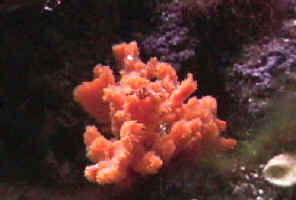
| I have always loved the colors that sponges add to the captured reef environment, but fears of bubbles in the tank destoying these creatures always kept me away from considering them for my reef. When I saw this one at my LFS I desided it would be worth the risk. After all, everything I have done so far has worked. Unfortunately, this sponge has been waisting away from it's original glory since the day I got it. I think too many bubbles blowing around in the tank have been getting to it. I think I'm going to move it to the sump to see how it does there. |
| Yellow Scroll Coral |
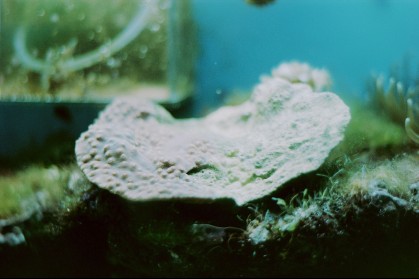
| This is my first coral: a Yellow Scroll (SPS I think). It was given to me by a fellow reefer I met at the LFS. He had a huge 200 gallon reef that took up nearly a quarter of his small living room. Anyway, he was adding some more corals and didn't have room for the scroll any more. As you'll notice, it's not in the best condition. The "skin" has pulled away from the skeleton. I see this alot with scrolls. My hope has been to get it to grow back over it's skeleton, but this may be hopeless. I had been noticing the size of the scroll increasing but the "skin" had not covered any of the exposed skeleton. Then I looked at the back and noticed all the new growth that had been happening. I guess the skin will never grow back over. That's just the way it is. |
| Red Open Brain |
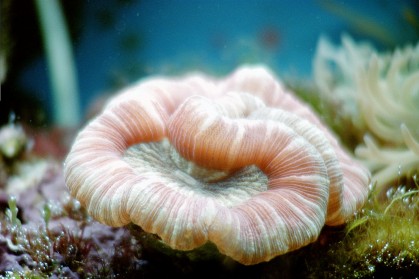
| This is the first coral I bought: a Red Open Brain. The pictures I've always seen of these corals repulsed me, as any picture of a real open brain would. But, in the flesh open brains are as beautiful as a clams. |
| Anchor (Hammer) Coral |
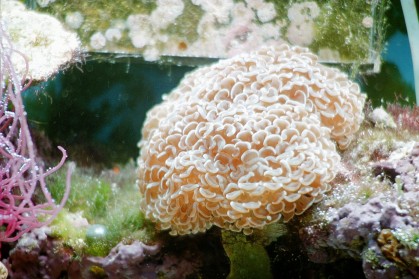
| This has always been one of the corals I had plannd for the Big Reef Project. I love watching the little hammers (or anchors) wave in the current. It has grown some since this picture was taken. |
| Purple Tang |
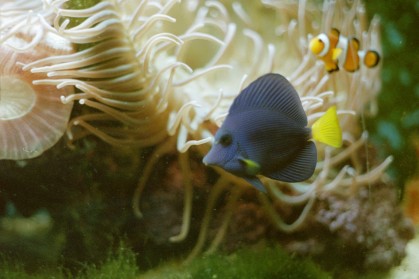
| I was going through my LFS one day looking for a lawnmower blenny or a cleaner shrimp when I saw this Purple Tang (Zebrasoma xanthurum). I had just read the day or two before that these were rare in the aquarium trade and I had not seen one in a LFS before today. The price was good and it appeared to be a juvinile. This is good because adult species are harder to acclamate to aquarium life, they could stress or starve to death. These fish are not captively bred. The deal looked good all around so I bought him (her?).Right away he started eating algae in the tank - a good sign. The next day I hung some nori (dried seaweed) in the tank and he deoured it and has appeared to be well adjusted to life in the Big Reef Project. |
| Lawnmower Blenny |
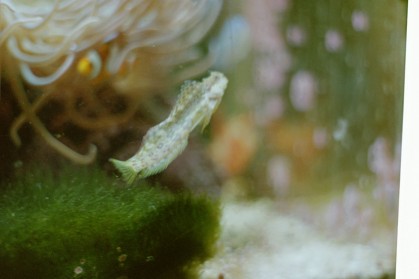
| Back when my tank was cycling, I was visiting my LFS on a regular basis, continuing my education, when I saw a fish ripping algae from the rocks in the display tank. "What kind of fish is that ?!" I asked the owner. "Oh, that's a Lawnmower Blenny," he informed me. Any fish that enthsiastic about eating algae off rocks is a friend of mine. But, sadly after my tank finished cycling, I could not find a Lawnmower Blenny anywhere. The LFSs eather just sold one that they got in yesterday or had one on order. Then, the planets aligned or something because me, my money, and the lawnmower blenny were finally all in the same place at the same time. His name is Lenny. Lenny the Blenny. My rocks have not been this algae free since I first put them in my tank. I whole- heartedly endorse a Lawnmower Blenny for a reef tank. Unlike urchins, blennys eat just the algae and leave the coraline intact. |
| Cleaner Shrimp |
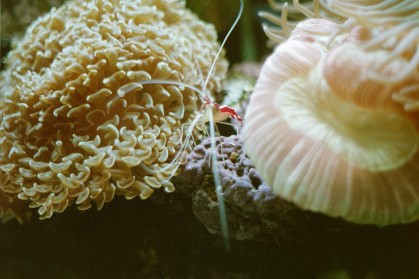
| I have wanteer Shrimps will set up a "cleanning station" were the fish learn to go when they feel a paracite bothering them. This may have saved my Kole Tang, who I had to trasfer into a hospital tank for treatment. I think this additional stress killed him. So far he has saved my Lawnmower Blenny from a nasty parasitic infection next to his gill. My wife said, "Your shrinp is attacking that Lawnmower guy!" Just as I lookd the shrimp pulled back and the blenny twiched in pain. When the blenny came out of his hiding place later, the lump (that I had been suspecting was a parasite), was gone. In it's place was a red raw area that healed after a day or two. The shrimp has already earned his keep. When it come to food these srimps can be little stinkers. I've seen him try to take food out of the anemone's mouth. I use to just drop in a frozen cube of food if I was in a hurry, but not anymore. The shrimp will steal the cube and take it away to his home behind some rocks. |
| Plate Coral |
| Lavender Finger Leather |
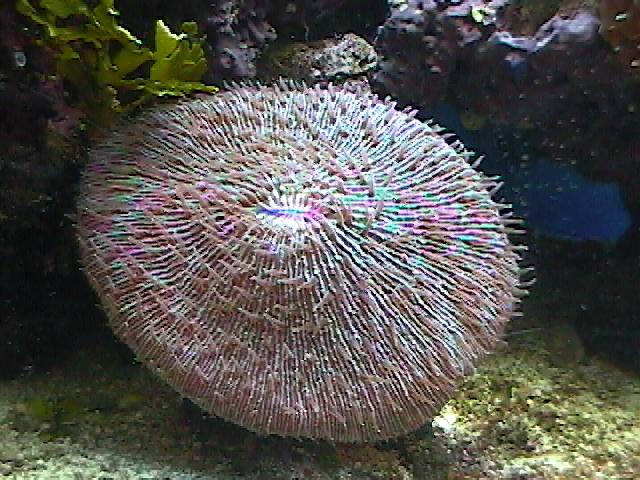
| This Plate Coral (fungia sp) was the first one I had ever noticed. It's beautiful pink and purple coloring caught my eye right away. After talking with the LFS owner and a customer in the store at the time (this is a upscale reef store - everyone who walks through the door knows more than me) about care and feeding, I bought it. When I got home I did some research and found that these are solitary corals that lay on the sand and can even move. I've seen it catch food with it's little tentacles and then pass the food from tentacle to tentacle untill it reaches the mouth in the center. Right now I have this fungia coral laying on a rock. But, when I get a coral (hopefully a sarcophiton) to take it's place I'm going to move it to the sand. |
| This is one of the easiest corals to keep, so I'm told. I like how it branches-out. It had been sitting around at the LFS for months, so I figured it must be OK. My wife says it looks like a dead hand. "Dead mans Hand", I believe, is another common name for this coral |
 |
 |
 |
| Blue Green Chromis |
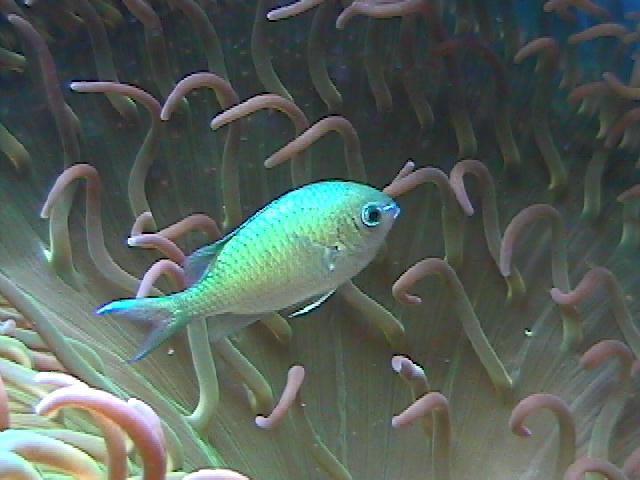
| (Chromis viridis) I have seen Blue Green Chromises in large reef tanks before, usually in schools. These fish are great for giving the "coast is clear" thumbs-up to shy fish. In a small tank, like mine, you have to limit their numbers because you'd like to have a variety of fish, not a species tank. That becomes a problem. You have to have one or five, minimum. If you have two of them, as I tried, one becomes the "bully" and the other becomes the "target fish" (whipping boy). I had two. One was getting his butt whooped every 5 minutes so I scooped the net into the tank and whichever one I caught went back to the LFS. I caught the "whipp'n boy". Now I have one. |
 |
 |
 |
 |
| Sorry no picture yet. |