 |
|
 |
 |
 |
 |
 |
 |
Equipment |
 |
 |
 |
 |
 |
 |
 |
 |
 |
 |
 |
 |
 |
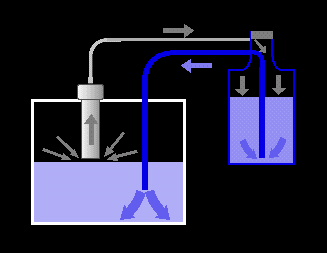 |
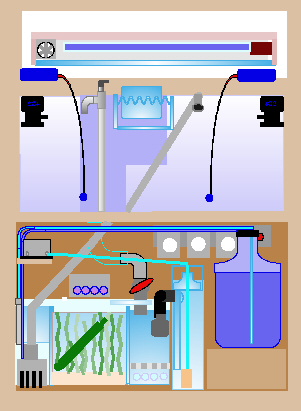
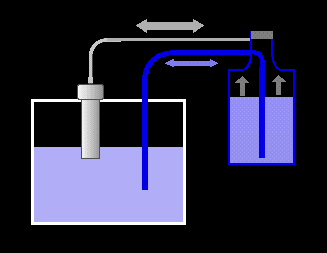
| Vacuum-Controlled Siphon for Freshwater Top-Off |
| Sump / Refugium |
| Tank / Overflow |
| Lights / Hood |
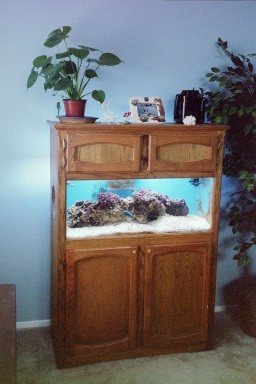
| Aquarium Cabinet |
| Oak Cabinet (particle board w/ oak veneer and oak trim) Finished in a light oak stain / semi gloss finish Antique brass hardware Cabinet Locks were recently added to keep my 2 year-old daughter out of the Sump when we found she had mastered the baby-proof plastic latches. |
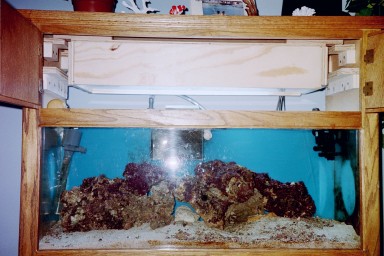
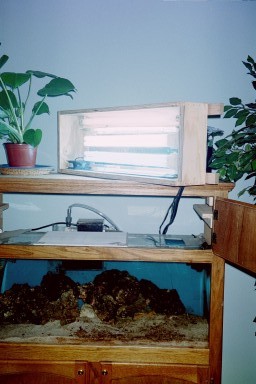
| The Light box was designed to: 1) Make Light bulbs easy to replace. 2) Keep heat away from Aquarium. 3) Filter harmful UV rays. 4) Raise and lower lights for more or less intensity. |
| 5) Accommodate both the main lights (110 watts of Power Compacts) and the transitional day to night light (24" daylight normal fluorescent). 6) Keep light from glowing though the cabinet doors and from behind the cabinet on to the wall. |
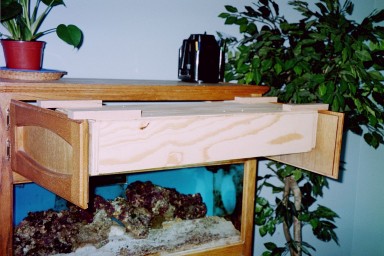
| The Lights sit on ledges on either side of the light cabinet above the tank. Above, you can see the supports demonstrated on the doors of the light cabinet. If I had a really good picture of the box you could see what a sloppy job I did on it. But, it works. The Light Box can be placed on top of the Cabinet in order to gain access to the Aquarium and the light bulbs. The cords are just barely long enough for this maneuver. Currently, the Muffin Fan is too loud (it's viberating against the wood). I need to find a different set of bolts. secure it. |
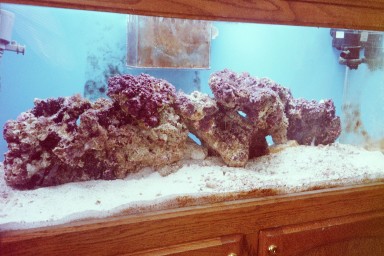
| The Aquarium is a acrylic light-blue back 34 gallon SeaVue The overflow uses a "C" siphon to move water from the surface skimmer in the tank to the pre filter box behind the tank. Two Powerheads are controled by appliance timers for circulation |
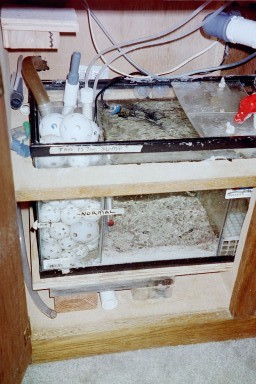
| I made a modification to the Pre Filter. The filter media was removed and in is place I built a "Durso" silent stand pipe design with a T-joint and elbow joint that makes a quiet stand pipe. I made a modification to the design described by Richard Durso on his web site: Instead of an air line size hole to break to siphon effect, I used a 1/2 inch nipple and hose. The hose is routed inside the cabinet to help muffle the noise. The "pin hole" design gets clogged with salt creep really quickly. I increased the size of the hole for ease of construction, but I believe the pleasent side effect is a more maintainance-free device. This stand pipe design really works! It is significantly quieter. |
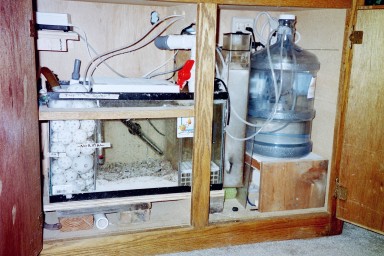
| The Sump/ Refugium is based on the EcoSystem Method developed by Leng Si. The Sump is divided into three parts: 1) Recieving, where the water comes down from the tank. In my Sump I have a CPR Bak Pak protein skimmer drawing water from here. The EcoSystem Method does not use a protein skimmer. |
| 2) Refugium, where macro algaes are grown under 24/7 lighting (not shown) to denutrify the water and grow flora and fauna (live food for corals and fish). The EcoSystem Method uses "Miracle Mud". I'm using very fine grade live sand with G.A.R.F. Grunge 3) Pump/ top-off area is filled with bio-balls to de-bubble the water so not to fill the tank with micro bubbles. The D.I.Y. top-off is a vacuum controled siphon from a 3 gallon water cooler bottle (5 gallon wouldn't fit in the cabinet). The siphon is explained in more detail below. I use Kalkwasser for top-off as I have found it rids my tank of phosphates. When I first talked to experienced reefers about setting up a refugium in my sump all I heard was "Stick to the Berlin Method." But, now I feel I'm part of a large group of "Refugium Believers" who I see more of everyday. |
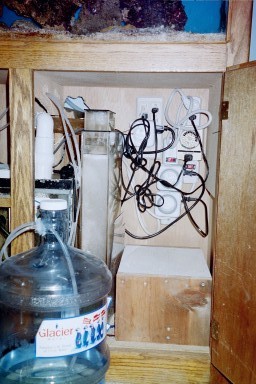
| When the fresh water reserve is removed, the electrical system is visible. Powerstrips and timers for the power heads inside the Aquarium (in place of a more expensive "wave maker") and the two sets of lights. The CPR Bak Pak is a perfect lttle skimmer for this size system. Not too much skimming, not too little. It came highly recommended. I added an air stone and air pump to increase the efficiency of the Bak Pak. UPDATE 8/20/2001: I have found, quite accidentally, that the corals look healthier without the skimmer operating as a skimmer. I raised the collector cup out of the water, so the skimmer does little more than add oxygen to the water. |
|

|