|
Andrographis paniculata
plant extract is known to possess a variety of pharmacological activities.
Andrographolide, the major constituent of the extract is implicated towards
its pharmacological activity.
A study has been conducted on the
cellular processes and targets modulated by andrographolide treatment in
human cancer and immune cells. Andrographolide treatment inhibited the in
vitro proliferation of different tumor cell lines, representing various
types of cancers. The compound exerts direct anticancer activity on cancer
cells by cell cycle arrest at G0/G1 phase through induction of cell
cycle inhibitory protein p27 and decreased expression of cyclin
dependent kinase 4 (CDK4). Immunostimulatory activity of
andrographolide is evidenced by increased proliferation of lymphocytes and
production of interleukin 2.
Andrographolide also enhanced the tumor necrosis factor
α production and CD marker expression, resulting in increased
cytotoxic activity of lymphocytes against cancer cells, which may contribute
for its indirect anticancer activity. The in vivo anticancer activity of the
compound is further substantiated against B16F0 melanoma syngenic and HT
29 xenograft models. These results suggest that andrographolide is an
interesting pharmacophore with anticancer and immunomodulatory activities
and hence has the potential for being developed as a cancer therapeutic
agent. (Rajagopal et al 2003)
The herb is the well-known drug Kalmegh 'green chiretta', and forms the principal ingredient of a reputed
household medicine ('alui'), used as a bitter tonic
and febrifuge. It is official in I.P., and also
employed in
Ayurveda
and Homeopathy. The herb is reported to possess astringent, anodyne, tonic and
alexipharmic properties, and is helped in arresting dysentery, cholera,
diabetes, consumption, influenza, bronchitis, swellings and itches, piles and
gonorrhoea. A decoction of the plant is a blood-purifier. It is used as a cure
for torpid liver, and jaundice. It forms, the major constituents of the
Ayurvedic drug SG-I Switradilepa
which is effective in treating vitiligo- a
dermatological diseases. The macerated leaves and juice together with certain
spices, such as cardamom, clove and cinnamon, are made into pills and
prescribed for relief from gripe and other stomach ailments in infants. A
decoction or infusion of the leaves is useful in general debility and
dyspepsia. The leaves and roots are also used as febrifuge, tonic, stomachic, cholagogue and anthelmintic. A
tincture of the root is tonic, stimulant and aperient.
The high therapeutic value of Kalmegh is due to
its mechanism of action, which is perhaps by enzymes induction. The plant extract exhibits anti-typhoid activity against Salmonella
typhi (Shroter) and
anti-fungal activity against Helminthosoprium
sativum. The shoot extracts in saline and ether
showed antibiotic activity against Micrococcus pyogenes
var. aureus, and in dilute sulphuric acid,
acetate buffer and ether against Escherichia coli.
List of
biological activities of A. paniculata
Nees
|
No.
|
Biological
Activity
|
Reference
|
|
1.
|
Antiallergic
activity
|
Gupta et al.,
1994
|
|
2.
|
Antibiotic activity
|
Gupta et al.,
1993
|
|
3.
|
Antifertility
effects
|
Akbarsha
et al., 1990; Akbarsha
and Murugan, 2000
|
|
4.
|
Antifilarial
activity
|
Dutta
and Sukul, 1982
|
|
5.
|
Antifungal activity
|
Anonymous, 1985
|
|
6.
|
Antihepatitic
activity
|
Jayaram
et al., 1989; Ramfi
et al., 1992
|
|
7.
|
Antihepatotoxic
activity
|
Rana
and Avadhoot, 1991
|
|
8.
|
AntiHIV
activity
|
Shukla
et al., 1992; Otake
et al., 1995;
Calabrese et al., 2000
|
|
9.
|
Antiinflammatory
activity
|
Tajuddin
et al., 1983; Shen
et al., 2000
|
|
10.
|
Antimalarial
activity
|
Misra
et al., 1992
|
|
11.
|
Antiplatelet
aggreagation effects
|
Huo
and Junzlin, 1989
|
|
12.
|
Antisnakevenom
effects
|
Selvanayagam
et al., 1994
|
|
13.
|
Antityphoid
activity
|
Anonymous, 1985
|
|
14.
|
Antiulcer
activity
|
Viswanathan
et al., 1981
|
|
15.
|
Asthma
|
Rao,
1914
|
|
16.
|
Blood purification effects
|
Vohora,
1985
|
|
17.
|
Colic
|
Rao,
1914
|
|
18.
|
Diabetes
|
Ahmad and Asmawi, 1992;
Zhang and Tan, 2000
|
|
19.
|
Diarrhea
|
Gupta et
al., 1990
|
|
20.
|
Fever
|
Ahmed and Asmawi, 1992
|
|
21.
|
Gonorrhea
|
Rao,
1914
|
|
22.
|
Hepatostimulation
effects
|
Tripathi
and Tripathi, 1991
|
|
23.
|
Immunostimulation
effects
|
Sutarjadi
et al., 1991; Puri
et al., 1993
|
|
24.
|
Influenza
|
Dey,
1986
|
|
25.
|
Jaundice
|
Tomar
et al., 1983
|
|
26.
|
Loss of scalp hair
|
Home et al., 1992
|
|
27.
|
Piles
|
Rao,
1914
|
|
28.
|
Stomachic effects
|
Choudhury
and Poddar, 1985
|
|
29.
|
Leishmaniasis
|
Sinha
et al., 2000
|
List of ethnobotanical
uses of A. paniculata Nees
|
No.
|
Ethnobotanical use
|
Reference
|
|
1.
|
Blood purification
|
Rao,
1914
|
|
2.
|
Cancer
|
Mathew and Unnithan,
1992
|
|
3.
|
Colic
|
Jain et al.,
1973
|
|
4.
|
Diarrhoea
|
Aminuddin
and Girach, 1991
|
|
5.
|
Dysentry
and Dyspepsia
|
Sudhakar
and Rao, 1985
Bhalla
et al., 1982
|
|
6.
|
Fever
|
Gupta, 1990; Jain, 1963; Bhalla
et al., 1982
|
|
7.
|
Filariasis
|
Sudhakar
and Rao, 1985
|
|
8.
|
Gastric complaints
|
Gupta, 1990
|
|
9.
|
Jaundice
|
Hemadri
and Rao, 1984; Hemadri
and Rao, 1989
|
|
10.
|
Malaria
|
Reddy, 1988; Aminuddin et
al., 1993
|
|
11.
|
Snake bite
|
Gupta and Srivastava,
1994
|
|
12.
|
Stomach complaints
|
Kirtikar
and Basu, 1918; Goel and Mudgal, 1988
|
|
13.
|
Vermifuge
|
Gupta and Srivastava,
1994
|
|
14.
|
Whooping cough
|
Goel
and Mudgal, 1988
|
|
15.
|
Wounds and itches
|
Jain, 1963; Jain et al., 1973
|
Andrographis for the Treatment of Upper Respiratory Infection
Awareness is
growing in the medical community that there is a "need to reduce the rampant
overprescribing of antibiotic medications for upper respiratory infections
(URI)." Concurrently there is an increased need for other helpful therapies
for the treatment of URI. Andrographis (Andrographis paniculata) is one of
the herbal medicines that may be of use in this regard.
Read Full paper (PDF file)
Andrographis in Indonesian traditional herbal medicine (Jamu)
Jamu is the
Indonesian traditional herbal medicine that has been practiced for many
centuries in the Indonesian community to maintain good health and to treat
diseases. Although modern (western) medicine is becoming increasingly
important in Indonesia, jamu is still very popular in rural as well as in
urban areas. (Kligler et al 2006)
References
1. Sriram Rajagopal, R. Ajaya kumar, Dhanvanthri S.
Deevi, Chitkala Satyanarayana, R Rajagopalan 2003. Andrographolide, a
potential cancer therapeutic agent isolated from
Andrographis paniculata. Journal of Experimental Therapeutics and
Oncology 3, 147
Abstract or Full Paper
2. Kligler BK, Ulbricht C,
Basch E et al. Andrographis paniculata for the treatment of upper
respiratory infection: a systematic review by the natural standard research
collaboration. Explore. January 2006;2(1):25-29.
Read Full paper (PDF file)
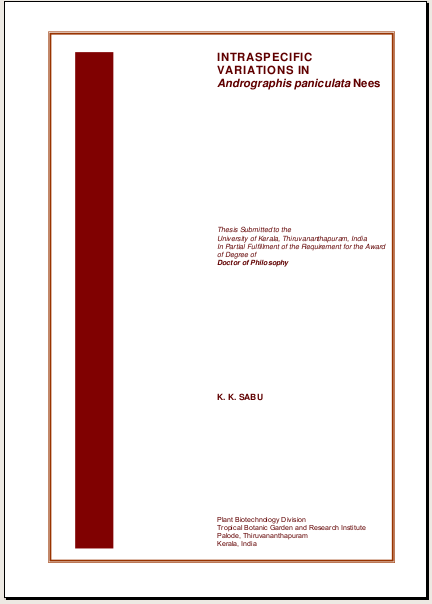
PhD Thesis on Andrographis paniculata
|