|
|
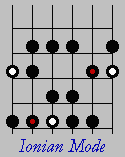
All right, you've got the ionian mode of the major scale, as shown below. The root of the scale is indicated by the white-filled circle. If you are playing in the key of G, this note must be a G. And as I told you in the lessons, to play this as the G major scale, you put that white-filled circle on the sixth string 3rd fret. As you should know, this note is a G. The higher modes continue from there; for example, A dorian starts on the fifth fret (which is an A).
OK, let's say you want to play this scale in the key of A. You need to put the white-filled circle on an A somewhere, and the way to do this is to play it at the fifth fret. The rest of the modes continue from there (B dorian starts on the seventh fret, etc.).
|