|
|
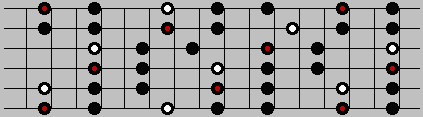
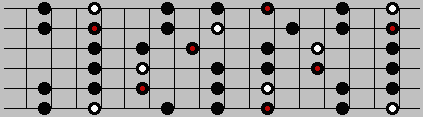
Every major scale has a relative minor scale. The root of this minor scale has its root 3 half steps below the root of the relative major scale. For example, the G major scale has a relative minor scale 3 half steps down: E minor. Look at the two examples shown below. They show the pentatonic major and minor scales. Notice how the exact same pattern appears in both, but the root and fifth have moved down 3 half steps:
Pentatonic Major Scale
Pentatonic Minor Scale Therefore, when you play the pentatonic major and minor scales, you are playing the same pattern with a different root. However, this doesn't work for all minor scales. Since the pentatonic minor scale has the same pattern of whole and 1� steps as pentatonic major, and the natural minor scale has the same pattern of whole and 1� steps as the major scale, then these scales have repeating pattern as shown above. Unfortunately, the harmonic minor and the melodic minor scales do not have the same pattern of whole and 1� steps as the major scale, and therefore do not have repetitive patterns. But since some of the scales do have repetitive patterns, your workload just shrank! I will be sure to mention when a certain minor mode has an analog in a major scale, so look for that on the mode pages.
|