|
|
The secret to playing solos is to keep your motion confined to a small number of frets but to use all the strings in that small area. This minimizes hand motion along the neck (which is very inaccurate and inefficient) and maximizes hand motion between strings (which is much more accurate and is extremely efficient). For example, play these examples fast and tell me which is easier. They are both playing the same notes (the G major scale).
 Notice how there are four frets used and you use all four fretting fingers to play them. This makes your solos much much faster because your hand is not moving up and down the neck, it is just moving between strings.
After you have learned all the modes, I will show you how they fit together. They go together end-to-end to make a network of boxes that contain every note on the fretboard where you play in a certain key. Once you have learned how to play the small boxes, and have practiced them over and over, you will be able to look at the fretboard and see how they fit together. The idea for solos, then, is to confine yourself to one box for a little while, then move to another, and play there for a while, and so on. As long as you play in a box you are not wasting hand motions, but you have to change boxes in order to make your solos interesting.
How do modes work? Well, let's take the key of G (my favorite key). In the key of G there are seven different pitches: G, A, B, C, D, E, and F#. Let's say you want to play the G major scale, but start and finish on A. You put the half steps in the same place as you did before (between B and C and between F# and G), but your scale sounds different. Play this and listen to the difference between it and the scale we just played:
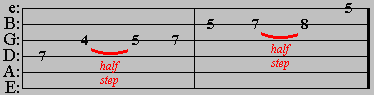
When you keep the same half steps but start on a different pitch in the scale, it is called a mode. This allows you to have solo boxes all the way up the fretboard. How do you name these modes? Well, you name your major scale by the note it starts on (the G major scale starts on G). Modes are named the same way. You will learn that the mode starting on the second note of the major scale is dorian mode, so what you just played was the A dorian mode. So in the key of G, the dorian mode is called A dorian. In the key of B, the dorian mode (second note of the scale) is called C# dorian.
|