 RECIPE:
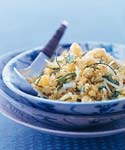
Penang Rice Salad
RECIPE:
Penang Rice Salad
RECIPE:
Penang Rice Salad
A storm had just passed over the island of Penang, lashing the sky with lightning, but now the night was still. Mist rose from the pavement in Georgetown, the island's capital city, as though the whole place were breathing a sigh of relief. To my left was an imposing Chinese temple guarded by two fierce stone lions. To my right, an elementary school, silent and shuttered for the night. I pulled out a map and studied the zigzagging streets. I was lost.
Not that being lost was such a bad thing. I was a 19-year-old college student a few weeks into my first trip to Malaysia, and I'd come to Penang in large part to experience the unknown. I heard the welcoming sound of people laughing in the distance and walked in that direction. Suddenly, I found myself in a bustling nighttime market. Under the glow of red paper lanterns, hundreds of vendors had set up shop. A young girl dished up rojak, a sweet and savory fruit salad. A smiling old man in a white skullcap sold deep-fried pisang raja, or king bananas, that looked as crisp as tempura. A big-bellied guy in a gingham dhoti stir-fried aromatic lo mein noodles. I was starving. But where was I to begin? Someone touched my arm. A handsome man in his sixties with almond-shaped eyes asked, "It's your first time in Penang?" I nodded.
"We have this pasar malam [night market] every Tuesday evening," he continued, in a proper British accent. He held out his hand. "My name is Mr. Goh. Would you care to join me for a bite?"
He led me deeper into the market to the stall of a lady intently focused on the wok in front of her. "Her specialty is char kway teow," Mr. Goh said. "Stir-fried fresh rice noodles with egg, spring onions, and shrimp. She makes it better than anyone." The cook splashed a ladleful of liquid red chile paste onto the noodles and vigorously stirred them around with a spatula. The wok coughed up a powerful cloud of spice-flecked smoke. I sneezed.
"I think this is the one for you," Mr. Goh said, with a laugh. We walked to a small table carrying our orders, which were packaged in neat banana-leaf bundles. The noodles were lush and light, spicy and bold, with hints of garlic and fresh shrimp. It was love at first bite.
Twenty-three years later, my passion for this island hadn't faded, even though I'd eaten my way through the world's great food metropolises, from Bangkok to Rome and back again. But small, tropical Penang, with its 600,000 residents, continued to stand out. I was long overdue for a return visit.
Almost everything was as I'd remembered, from the old Chinese shophouses covered in ceramic tiles to the towering green trees that lined the roadsides. But it was the street-food scene that had changed least. Vendors were down every alley, along every boulevard, and in every open-air market. They beckoned with signs hand-painted in neon colors: "Beng Huat Hainan Chicken Rice," "Penang Famous Kwei Teow Soup," "Food Master Fish Porridge," "Hussein's Muslim Meals."
I wanted my first stop to be a night market. The one I'd visited with Mr. Goh had closed, but a friend recommended another, the Taman Arowana pasar malam, a vast Friday-night affair that catered to Muslim locals. My cab pulled up to the entrance just as the sun was setting and the market was stirring to life. A village of vendors had staked out territories in an expanse as big as a football field. On one side, merchants hawked fresh vegetables laid out on rattan mats. On the other stood a brigade of women in brightly colored head scarves, each fanning a grill covered with tempting sticks of golden chicken sat�. "Hey, mat salleh!" a pretty woman called out in a singsong voice, referring to me with the local term for foreigner. "We have every food in the world in Penang � but my sat� is the best!"
Her claim about Penang was not without merit. The city of Georgetown (which, confusingly, is often referred to as simply "Penang"), was founded in 1786 by Francis Light, a British subject who'd been looking for a strategic trading port midway between Madras and Canton. The largely uninhabited island of Pinang (the Malay spelling of the word for "betel nut") proved an ideal location. The British brought indentured laborers from China and southern India to build the island's port and to farm the spice plantations they'd planted on its jungly outskirts. Many of these Chinese and Indian workers eventually put down roots, living side by side (and often intermarrying) with the few Muslim Malays who already called the island home. To this day, Penang's cultures can be a challenge to decode. Though the city is predominantly Chinese (Malays and people of Indian descent make up 20 percent of the population), its residents mingle happily � especially where food is concerned.
The sat� vendor handed me a bouquet of skewers. They smelled of lemongrass and smoke. I slid a piece of chicken into my mouth. It was juicy and sweet with palm sugar, fennel, and coriander. This, I thought, is what sat� is supposed to taste like.
Info to Visit Penang in Korean