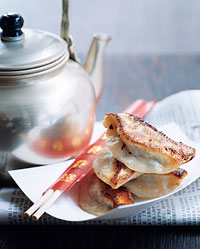
 In deference to the prohibition against pork of the Muslims who populate the area, pot stickers in Xian are generally made with beef.
-RECIPE:
Beef Pot Stickers
In deference to the prohibition against pork of the Muslims who populate the area, pot stickers in Xian are generally made with beef.
-RECIPE:
Beef Pot Stickers
Not far from the gray walls of the Drum Tower, the street vendors are doing a roaring trade. One man is racing to keep up with demand for his "eight-treasure mirror cakes," delicate confections of steamed glutinous rice meal, sprinkled with colored sugars and strands of candied peel. Farther down the tree-lined road that leads through the old Muslim quarter, a young man is frying pot stickers, and their irresistible aroma of beef, yellow chives, and spices fills the air. Nearby, another vendor cuts pieces from a cake of glutinous rice layered with dark, sweet bean paste. He piles the slices on a plate for a waiting customer and drizzles some rose-petal jam over them. People mill around the stalls, examining neat stacks of sweetmeats, eating dumplings, or tucking into bowlfuls of steaming noodle soup.
Xian (pronounced "shee-an"), the capital of Shaanxi province, is one of China's most historic cities, and its center still sits within high walls that date back to the Ming dynasty. Some 2,200 years ago, it was the administrative heart of the Qin dynasty, founded by the First Emperor. His tomb, and the extraordinary "terra-cotta army" with which he was buried, lie just outside the modern city. Xian enjoyed its heyday during the Tang dynasty (618�907), when it was a brilliant, cosmopolitan city, the point where the Silk Road met China and the East.
The street food of modern Xian reflects its location and its history. There are echoes of Central Asia and the Middle East in the shao bing and other flatbreads. The noodles and dumplings are similar to those eaten in Beijing to the east, and in the great desert region of Xinjiang, to the west. An emphasis on beef and mutton hints at the nomadic cultures of northern China, as well as the prohibition against pork of the Muslims who live in the area. Some rice is eaten in Shaanxi, but the staples are wheat, millet, buckwheat, and other grains, made into all kinds of dishes.
These days, the best place to hunt for street food is the area around the Great Mosque, just west of the city center. The roads retain their traditional character, and the Hui Muslims who live and work in them run countless small restaurants and stalls. The most celebrated Xian street snack, or "little eat" (xiao chi), is yang rou pao mo � literally "soaked bread with mutton" � a hearty mutton soup dense with small pieces of soaked flatbread. In the rough-and-ready snack shops, guests tear their flatbreads into tiny pieces; the bits are returned to the kitchen, where they are boiled up in a rich, aromatic broth and then served with a topping of sliced mutton and separate dishes of chopped cilantro, sweet pickled garlic, and chile sauce. (Food scholars trace the origins of this delicacy to a thick mutton soup mentioned in texts dating back some 3,000 years.)
"Yellow osmanthus persimmon cakes" are fried, flame-colored patties made from a dough of persimmons and wheat flour and stuffed with a sweet osmanthus filling. Legend has it that they were invented by farmers in a nearby region who offered them to the rebel army that overthrew the Ming dynasty in 1644. Another favorite is sao zi mian, spicy soup noodles topped with pork. You can also find sweet potatoes roasted in their skins, lamb kebabs sizzling away on grills, and cool ribbons of pasta made from pea starch.
Street food has even made its way into the city's specialty restaurants. On the ground floor of the Xian Fanzhuang hotel is a simple cafeteria devoted to local snacks, and in the square between the Drum Tower and the Bell Tower, the restaurant De Fa Chang takes the dumpling concept to ludicrous extremes.