


Next: Conclusion
Up: Fuzzy Equalization of Digital
Previous: Results
We have implemented both the filters based on RBF and that based on FBF on
a TMS-C30 chip. The results were obtained by cross compiling the C code
on a TMS-C30 cross compiler. The channel model selected was
H(z)=1+0.5z-1 and the output was mixed with additive white gaussian
noise (AWGN). The SNR was varied and all the different types of filters
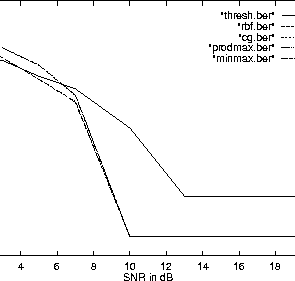
were applied. The BER for different filters are as shown in
fig. 3.
Figure 3:
BER of different equalizers with Channel 1.0 + 0.5z-1, and
varying SNR
 |
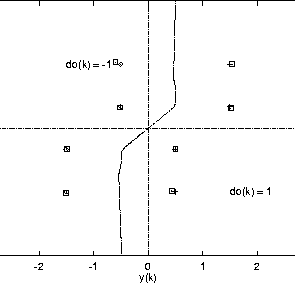
The decesion boundry for the case of RBF equalizer trained through the
clustering algorithm is obtained as shown in fig. 4.
Figure:
Channel 1.0 + 0.5z-1, co-channel
0.346(1.0+0.2z-1),m=2 and  =0.
=0.  and + : desired channel
states.
and + : desired channel
states.  :inter-channel interference centres, SIR = 10dB, SNR = 20
dB, SINR = 9.6 dB.
:inter-channel interference centres, SIR = 10dB, SNR = 20
dB, SINR = 9.6 dB.
 |
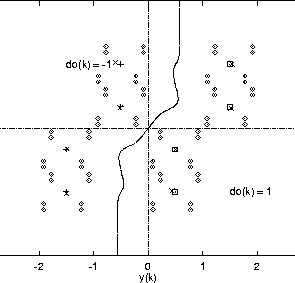
If the co-channel interference is also present then the ideal distribution
of states and the optimal boundry can be demonstrated as in fig. 5.
Figure:
Channel 1.0 + 0.5z-1, co-channel
0.346(1.0+0.2z-1),m=2 and =0.
and + : desired channel
states.
:co-channel interference centres, SIR = 10dB, SNR = 20
dB, SINR = 9.6 dB.
 |
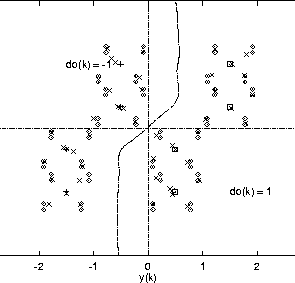
The RBF equalizer decesion function in the case of co-channel interference
after being trained is represented in fig. 6.
Figure:
Channel 1.0 + 0.5z-1, co-channel
0.346(1.0+0.2z-1),m=2 and =0.
and + : desired channel
states.
:ideal co-channel interference centres and x centres
after two phases of training, SIR = 10dB, SNR = 20
dB, SINR = 9.6 dB.
 |
The simulation was performed on a channel with severe distortion, with
transfer function
H(z)=0.1482+0.8704z-1+0.1483z-2, the typical
results obtained on the TMS-C30 chip are as follows.
| Algo. |
Data samples |
BER |
Clock cycle x 60ns |
|
| 1 |
400 |
0.1125 |
712175 |
|
| 2 |
400 |
0.0925 |
632260 |
|
| 3 |
400 |
0.1125 |
687256 |
|
| 4 |
400 |
0.1200 |
595126 |
|
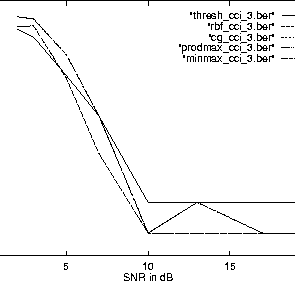
The simulation was also done on a severely distorted channel, with
transfer function
H(z)=0.1482+0.8704z-1+0.1483z-2 and a similar
co-channel, with SIR=10dB, The BER plots obtained are as shown in fig.
7
Figure:
Channel
0.1482+0.8704z-1+0.1483z-2, co-channel
0.346(H(z)=0.1482+0.8704z-1+0.1483z-2),m=3 and =1. SIR =
10dB, SNR = 20dB, SINR = 9.6 dB.
 |
Next: Conclusion
Up: Fuzzy Equalization of Digital
Previous: Results
Temp DNS admin
1999-02-04