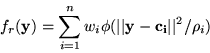
are the widths of the nodes,
  is the basis function and
wi are the weights. A different type of approach is also proposed in
[7].
is the basis function and
wi are the weights. A different type of approach is also proposed in
[7].
Comparing the network response with the optimal Bayesian
equalizer solution it has been shown [4] that both have an
identical structure. The RBF network is therefore an ideal structure for
implementing the optimal equalizer. Given channel, co-channel and
the noise statistics, it is known exactly how to specify all the
parameters of the RBF network. The number of hidden nodes n is equal to
number of noise free observation states and the RBF centres are placed at
these states. The non-linear function  is chosen as an exponential
function
is chosen as an exponential
function
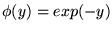 because it is a bounded and localized
function. All the widths have the same value
because it is a bounded and localized
function. All the widths have the same value
 ,
which
is twice as large as the noise variance. Each hidden node than implements
a component conditional density function and the weights are fixed
corresponding to
,
which
is twice as large as the noise variance. Each hidden node than implements
a component conditional density function and the weights are fixed
corresponding to  or
or  ,
where
is some small
constant. The RBF network then realizes precisely the optimal equalizer.
,
where
is some small
constant. The RBF network then realizes precisely the optimal equalizer.
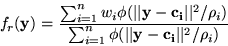
The equalizer decision function in (2) provides a localized
behavior. When the equalizer input is far from all the channel states the
equalizer may fail to provide a proper decision function. To overcome this
we propose a modification of (2) equation can be modified in the
normalized form to provide non-localized behavior providing the right
decision to all input vectors. The normalized equation would be
In practice the signals would be complex in nature so (3) has to
be modified to accommodate complex signals, thus we can write this as
The representation of a complex RBF is as shown in fig.3 [8][9]. From the figure we can easily conclude that a CRBF network (CRBFN) with N complex inputs and a complex output can be viewed alternatively as a real RBFN with 2N real inputs and two real outputs. In this regard the CRBFN is a straightforward extension of the real RBFN.
The estimation of the decision function needs in (2) and (3) needs the channel estimation for the evaluation of the equalizer decision function. The channel state estimation needs the channel information which in most cases is not available. Under these circumstances the channel states can be estimated during the training period. This can be achieved with the help of any adaptive algorithm like LMS or RLS, but this technique fails for non-linear channels. Algorithms like Orthogonal Least Squares (OLS) can also be used for this purpose [5], but they are not practical for on-line purpose. The channel states can also be calculated according to some clustering algorithm, like the k-means algorithm. The advantage of this is that there is no necessity of the channel model being known, and this model works well for practical channels. For complex signals, the clustering algorithm alone is not sufficient, one needs an adaptive mechanism, which will train it simultaneously, and so better output could be obtained. For this purpose we have used a combination of clustering algorithm and stochastic gradient (SG) algorithm. The SG algorithm provides an effective means to overcome poor network initialization and resultant performance degradation, which can be especially problematic for networks with localized basis functions. In this paper we have considered a combination of clustering and SG algorithm, for the training of CRBFN, and we have applied it in equalization of complex channels with QAM signals. We have carried out extensive simulations that justify the use of CRBFN's use for channel equalization.