


Next: About this document ...
Up: INTERFERENCE MITIGATION USING ADAPTIVE
Previous: CONCLUSION
- 1
- S.U.H.Qureshi, ``Adaptive Equalization,'' Proc.
IEEE, vol. 73, pp 1349-1387, 1985.
- 2
- S.Chen and B.Mulgrew, ``Overcoming Co-channel
interference using Adaptive Radial Basis Function Equalizer,'' Sig.
Proc. Elsevier, vol. 28, no. 1, pp.91-107, July 1992.
- 3
- I.Cha and S.Kassam, ``Interference cancellation using
radial basis function network,'' Sig. Proc., Elsevier, vol.47, no.9,
pp.247-268, Dec. 1995.
- 4
- B.Mulgrew, ``Applying Radial Basis Functions,'' IEEE
Signal Processing Magazine, pp.50-55, Mar. 1996.
- 5
- S.Chen, C.F.Cowan, and P.M.Grant, ``Orthogonal Least
Squares Learning Algorithms for Radial Basis Function Networks,''
IEEE Transactions on Neural Networks, vol. 2,pp. 302-309, March 1991.
- 6
- S.Chen, B.Mulgrew and P.M.Grant, ``A Clustering
Technique for Digital Communication Channel Equalization using Radial
Basis Function Networks,'' IEEE Transactions on Neural Networks,
vol.4, no.4, pp.570-579, July 1997.
- 7
- T.Poggio and F.Girosi, ``Networks for approximation and
learning,'' Proceedings of IEEE, vol.78, pp1481-1497, 1990.
- 8
- S.Chen, S.McLaughlin and B.Mulgrew, ``Complex-valued
radial basis function network, Part I: Network architecture and learning
algorithms,'' Signal Processing, Elsevier, vol. 35, pp. 19-31, 1994.
- 9
- S.Chen, S.McLaughlin and B.Mulgrew, ``Complex-valued
radial basis function network, Part II: Application to digital
communications channel equalization ,'' Signal Processing, Elsevier,
vol. 36, pp. 175-188, 1994.
- 10
- J.D.Laster and J.H.Reed, ``An Overview of the Advances
in Single-Channel Adaptive Filtering Techniques,'' IEEE Signal
Processing Magazine, pp. 37-62, May 1997.
- 11
- R.O.Duda and P.E.Hart, Pattern Classification and
Scene Analysis. Jhon Wiley and Sons, 1973.
- 12
- S.Chen, G.J.Gibson, C.F.N.Cowan, and P.M.Grant,
``Adaptive equalization of finite non-linear channels using multilayer
perceptrons,'' Signal Processing (Eurasip), vol. 20,pp. 107-119,
1990.
Figure 1:
Discrete time model of data transmission system.
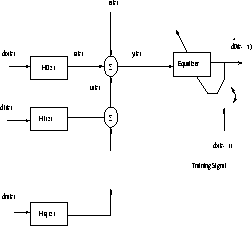 |
Figure 2:
Schematic of RBF network.
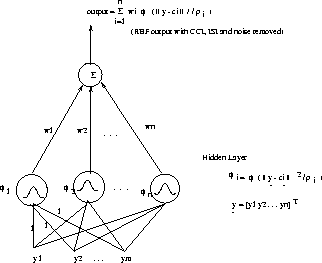 |
Figure 3:
Schematic of Complex RBF network.
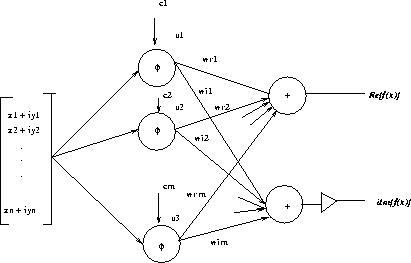 |
Figure:
Channel 1.0 + 0.5z-1, co-channel
0.346(1.0+0.2z-1),m=2 and  =0.
=0.  and + : desired channel
states.
and + : desired channel
states.  :inter-channel interference centres, SIR = 10dB, SNR =
20
dB, SINR = 9.6 dB.
:inter-channel interference centres, SIR = 10dB, SNR =
20
dB, SINR = 9.6 dB.
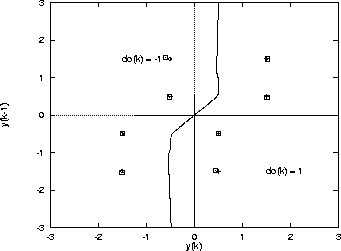 |
Figure:
Channel 1.0 + 0.5z-1, co-channel
0.346(1.0+0.2z-1),m=2 and =0.
and + : desired channel
states.
:ideal co-channel interference centres and x centres
after two phases of training, SIR = 10dB, SNR = 20
dB, SINR = 9.6 dB.
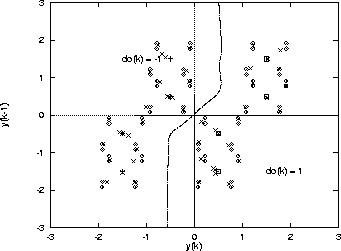 |
Figure:
Channel 1.0 + 0.5z-1, co-channel
0.346(1.0+0.2z-1),m=2 and =0.
and + : desired channel
states.
:co-channel interference centres, SIR = 10dB, SNR = 20
dB, SINR = 9.6 dB.
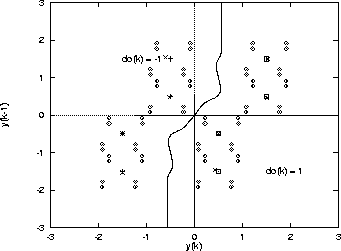 |
Figure 7:
Application of CRBF for equalization of channel corrupted by
ISI and second order non-linearity. The figure on left represents the
distorted signal and on the right represents recovered signal.
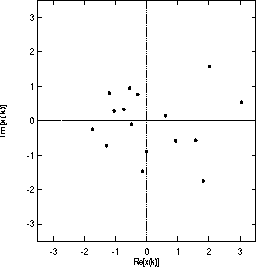
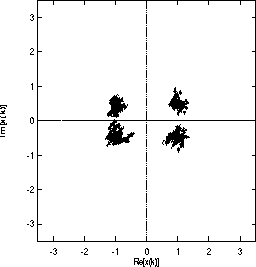
|
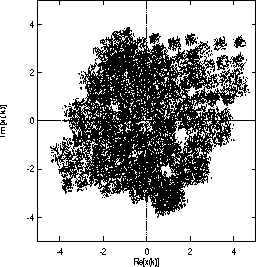
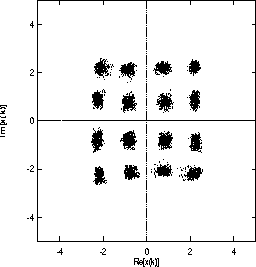
Figure 8:
Application of CRBF for equalization of channel corrupted by
ISI and second order non-linearity. The figure on left represents the
distorted signal and on the right represents recovered signal.
|
Next: About this document ...
Up: INTERFERENCE MITIGATION USING ADAPTIVE
Previous: CONCLUSION
Temp DNS admin
1999-02-04