


Next: CONCLUSION
Up: Adaptive Equalization of Non-linear
Previous: SIMULATION RESULTS
SIMULATION RESULTS
The complex radial basis function (CRBF) was tested on 64-QAM signal with
ISI and non-linear distortion and it was compared with the ordinary least
mean square (LMS) algorithm, to check its performance in non-linear
environment. To check how RBF performs in this environment and how it
compares to the performance of LMS equalizer, we take three examples :
Example 1: Here the linear channel was taken with only ISI and no
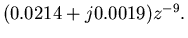
non-linear terms. The channel transfer function was given by :
| H(z)= |
(0.0485+j0.0194)+(0.0573+j0.0253)z-1+(0.0786+j0.0282)z-2+ |
|
|
| |
(0.0874+j0.0447)z-3+(0.9222+j0.3031)z-4+(0.1427+j0.0349)z-5+ |
|
|
| |
(0.0835+j0.0157)z-6+(0.0621+j0.0078)z-7+(0.0359+j0.0049)z-8+ |
|
|
| |
 |
|
|
The 64-QAM signal received after corrupting with ISI is as shown in Fig.
3. The total no. of symbols considered in each case is
20000. The SER which was obtained by using a complex sigmoid function
was 0.848. Then LMS was applied to it whose order was set to M=10 and
the learning rate mu=0.0001. The result using LMS for equalization is
shown in Fig. 4. The SER obtained with LMS is 0. Then
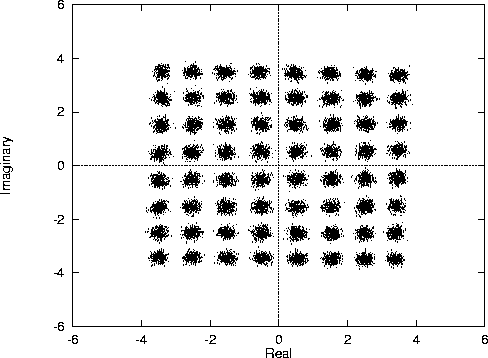
RBF equalizer was used on the same set of signals, and the result obtained
is as shown in Fig. 5. The SER in this case was also
0. The NCRBF used had no. of centers as 350 and order N=6. The width
was chosen as
 .
.
Figure 3:
64-QAM signal corrupted by ISI given in (10)
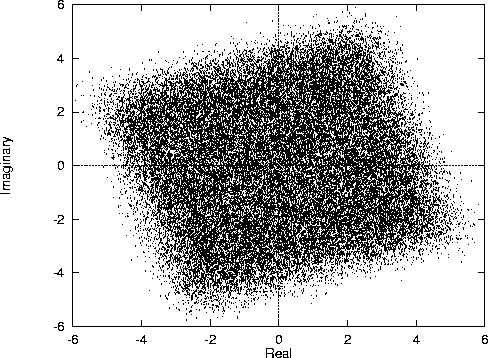 |
Figure 4:
The constellation of the 64-QAM after the complex LMS
equalizer
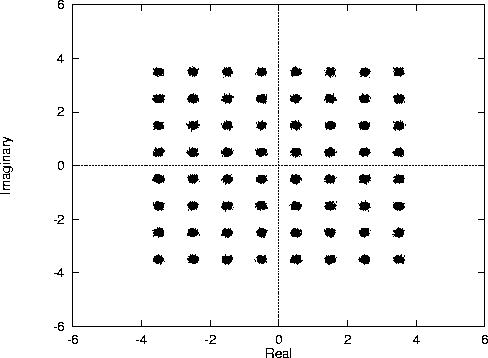 |
Figure 5:
The constellation of the 64-QAM after CRBF equalizer
 |
Example 2: In this case we retain all the ISI terms and make the
channel slightly non-linear, the ISI terms remain as in (10) but
along with that here non-linear terms are added which are
|
yn=on+0.02on2+0.005on3
|
(11) |
To see the real improvements in performance with complex RBF, this
nonlinear distortion was given. The SER with complex sigmoid function is
0.8275. The distortion in the channel is visible from Fig.
6. Fig. 7 shows the result after LMS
equalizer is applied to the same channel. The SER in this case was
0.1111, which is significantly high. This is not surprising because the
complex LMS equalizer can reduce only the linear channel distortion. When
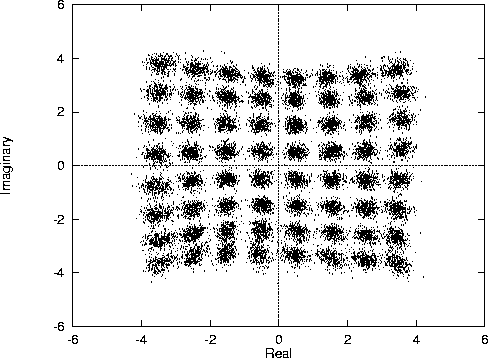
RBF is applied for the above channel, then the result is visible from Fig.
8. Here is we compare the results with that of LMS
equalizer we see a vast improvement. In this case the SER is reduced to
0.033. The parameters of CRBF is the same as that for example 1, but now
the width is
 .
.
Figure 6:
64-QAM signal corrupted by ISI (10) and nonlinearity
(11)
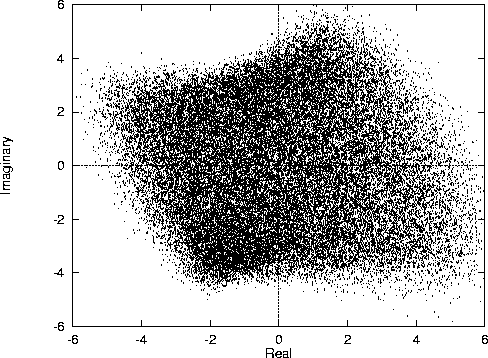 |
Figure 7:
The constellation of the 64-QAM after the complex LMS
equalizer
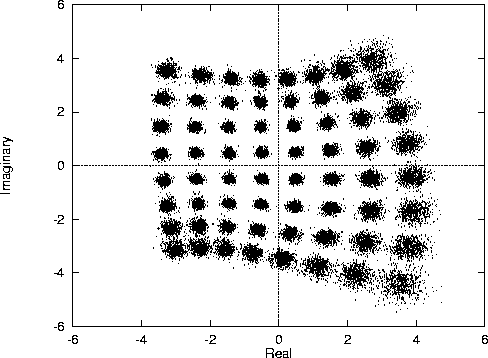 |
Figure 8:
The constellation of the 64-QAM after the CRBF Equalizer
 |
Example 3: In this case more emphasis is places on non-linearity as
compared to that of ISI, so the transfer function (TF) as well as the
nonlinearity has been modified. The TF is :
| H(z)= |
(0.0874+j0.0447)+(0.9222+j0.3031)z-1 |
|
|
| |
(0.1427+j0.0349)z-2+(0.0835+j0.0157)z-3 |
|
|
and
|
yn=on+0.05on2+0.01on3
|
(12) |
The SER due to complex sigmoid is 0.8, while that due to LMS with the
same parameters as in previous examples, is 0.45. The resultant due to
LMS equalization is shown in Fig. 10. Finally CRBF was
applied for this channel and the result can be seen from Fig.
11.
Figure 9:
64-QAM signal corrupted by ISI (12) and non-linearity
(13)
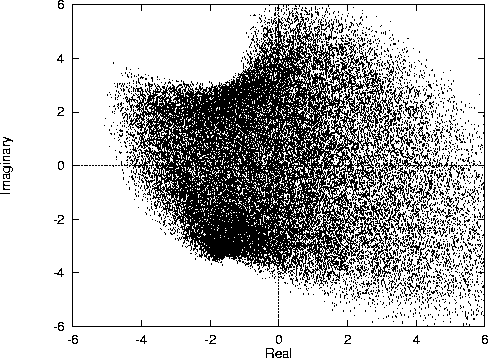 |
Figure 10:
The constellation of the 64-QAM after the complex LMS
equalizer
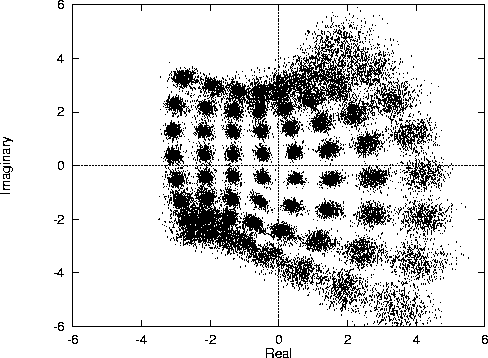 |
Figure 11:
The constellation of the 64-QAM after CRBF equalizer
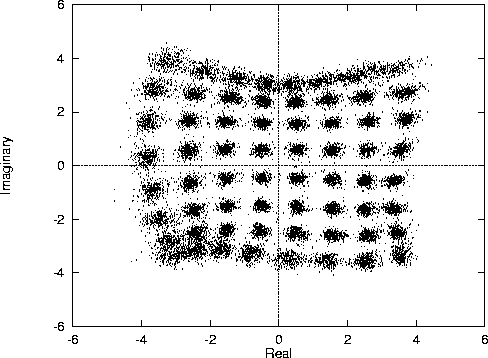 |
The parameters of the CRBF are the same as in previous examples, but the
width was kept 3.6. The SER obtained using this is 0.1077. From the
fig. itself we can see that CRBF performs quite better in non-linear
environments, as compared to linear algorithms like LMS.
Next: CONCLUSION
Up: Adaptive Equalization of Non-linear
Previous: SIMULATION RESULTS
Temp DNS admin
1999-02-03