as used
in previous section, so their processing has to be done in complex
multi-dimensional space. An example of such complex signal processing
scheme is quadrature amplitude modulation (QAM) or quadrature phase shift
keying (QPSK). For complex signal processing problems, many existing neural
nets cannot be directly applied. Although for certain applications it is
possible to reformulate a complex signal processing problem so that their
real valued network and learning algorithm can be used to solve the
problem, even though it may not always feasible to do so. Moreover it is
preferred to preserve the concise formulation and elegant structure of
complex signals.
as used
in previous section, so their processing has to be done in complex
multi-dimensional space. An example of such complex signal processing
scheme is quadrature amplitude modulation (QAM) or quadrature phase shift
keying (QPSK). For complex signal processing problems, many existing neural
nets cannot be directly applied. Although for certain applications it is
possible to reformulate a complex signal processing problem so that their
real valued network and learning algorithm can be used to solve the
problem, even though it may not always feasible to do so. Moreover it is
preferred to preserve the concise formulation and elegant structure of
complex signals.
Some researchers have proposed a complex multi layer perceptron (MLP) model and extended the back-propagation algorithm to a complex form [16]. LIke its real counterpart, the complex MLP is highly nonlinear in the parameters, and learning based on the backpropagation algorithm can result in slow convergence and unpredictable solutions. The Gauss-Newton or prediction error algorithm can be extended to a complex form, which offers better convergence performance over the backpropagation algorithm but does not solve the learning difficulty entirely. The root of the learning difficulty lies in the fact that the error surface of the MLP is often highly complicated and potential pitfalls exist for any gradient based learning algorithms. Other learning methods for the real MLP, such as the genetic algorithm, learning automata and simulated annealing are known to require extensive computation and their complex versions remain to be derived.
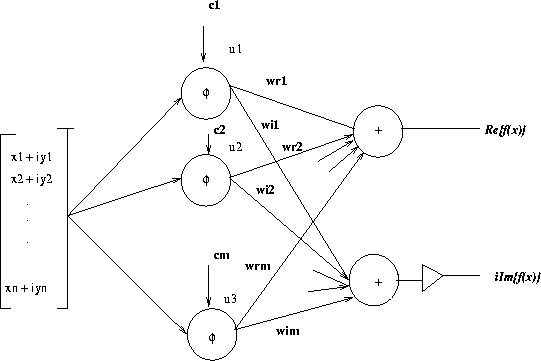
Now we look at what we call it as the complex radial basis function (CRBF) network. This is an extension of what we had used in previous chapters. The structure of CRBF can be seen from Fig. 2.
An advantage of this complex RBF netwrk is that linear learning laws can be derived as in real case. Two learning algorithms, the complex orthogonal least squares (OLS) algorithm and the complex hybrid clustering and least squares (LS) algorithms can be used [9]. The OLS algorithm is a batch learning algorithm and it constructs networks in a rational way until an adequate performance is achieved. The hybrid algorithm can conveniently be implemented as a recursive learning algorithm. It uses a complex version of the k-means clustering procedure to adjust the RBF centers and a complex LS or least mean square (LMS) algorithm to update the weights.
In this paper we will look at a hybrid algorithm with a difference. In this initially the centers are placed and adjusted with the help of k-means algorithm and then during the operation all the free parameters are updated or trained with the help of stochastic gradient (SG) algorithm. The SG algorithm provides an effective means to overcome poor network initialization and resultant performance degradation, which can be especially problematic for networks with localised basis functions. We have considered the application of SG for the training of CRBFN of complex channels with QAM signals. We have carried out extensive simulations that confirm the usefulness of CRBFN's in this application. The results indicate that the SG training algorithm can significantly enhance the performance of CRBFN's.