| Home
Problems
|
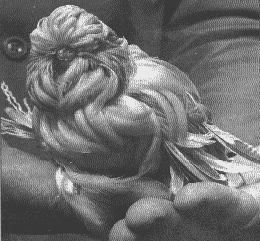
One of the worst things that can happen is to have a hen become egg bound. Being egg bound means not being able to lay a fully formed egg. There are several reasons that could possibly cause this condition. Lack of calcium is one. The hen uses the calcium to create the shell of the egg. Too little calcium and the shell and soft and merely elongates when she tries to lay it, instead of coming out. Another cause is also if the hen is too young to breed. Budgies are mature at six months but generally they are not bred until they are a year of age so that the hen's laying muscles are mature enough to handle the process of laying. A hen who has become egg bound will usually die unless the egg can be passed in some way. If your hen becomes egg bound then contact your vet or a fellow breeder. This happens when the hen, often one who has not bred before, sits too heavily on the chicks. When their legs are soft, it causes then to splay outwards leaving the chicks unable to stand or perch, leading to it having to be destroyed. If this is the case and it is caught early, the chicks legs can be tied into the normal position with a piece of string. They will initially appear awkward, but they get used to it. When they are about ten days old their legs will be hard enough and strong enough to continue growing normally on their own. The hen should eventually work out what is right. This can happen in a colony breeding situation. Hens fighting over the rights to a nesting box or cocks fighting over a hen. To attempt to prevent the hens from fighting over nesting boxes there should be at least 1.5 nesting boxes per pair. If there are cocks fighting over a hen, all but one of the cocks should be removed or the hen and a cock should be placed in a separate breeding cage or the hen should be returned to the main flight cage, away from the nesting boxes. This can also happen between hen and cock if they have been placed in a breeding cage. If this happens you have to split them up and possibly pair them up with other budgies. If, once the chicks are hatched, one of the parents dies, the other parent, be it the hen or the cock, should continue to feed the chicks. But a close watch needs to be kept. You need to keep an eye on the chicks, see that their crops are full. You also need to watch that the live parent doesn't over do it and starve, because it has fed all the food to the chicks and not kept enough for itself. If both parents die the chicks can be handreared or fostered. See Handrearing and Fostering This is a problem with feather growth in chicks. Occasionally the feathers of a chick grow in the wrong direction, causing them to stand out from the body and the chick looks like a feather duster. In severe cases the chicks will only live for about three months, but in milder cases the chicks can survive.
The picture is an example of a feather duster. This is also a feather problem. It is related to moulting in that the chicks lose their feathers, but unlike moulting it generally doesn't stop. In mild cases the primary wing and tail feathers are lost and grown back. In severe cases all the feathers are continually lost and regrown. Bleeding can result, as the feathers are dropped before ordinary moult, and this needs to be treated immediately (See Bleeding). In mild cases, where after a few months the primary feathers haven't been replaced permanently, and in severe cases, the best you can do for the chick is euthanasia. See Euthanasia. This is when the lower hook of the beak passes over, rather than under, the upper hook. It is caused by food getting caught under the upper hook, while the chicks are in the nesting box. If it is not caught in time and the food cleaned off, the lower hook has no where to go and grows out, over the upper hook. This causes great difficulty in cracking seed and so the lower hook must be trimmed regularly. See Trimming the beak. This is when the crop balloons up due to trapped gasses in the crop. It is thought to be caused by either poor feeding by the hen or fermented food in the crop or food that has covered the nostrils and the chick doesn’t know that it can breathe through it’s mouth. It needs to be treated immediately. If the nostrils are clogged then they need to be cleaned with a warm wet cloth. Then press gently at the bottom of the crop moving upwards. This forces the gas and sometimes a small amount of liquid out through the beak. Chicks that suffer from this need to be watched closely, because if it is poor feeding by the hen then this procedure will need to be repeated. Often the hen is new to breeding and will eventually get the feeding right. At some point in time you might notice that the chicks' feather are being pulled out. You need to keep and eye out to see which parent it is and then to remove the culprit. Feather pulling ranges from a few down feathers to stripping the back and wings. In the mild case an anti-pecking spray can be used on the chicks (or even strong perfume), but the chicks eyes need to be covered when applying this. Sometimes, once the chicks are out of the nesting box, the cock attacks them. If the chicks are not ready to be pulled from their parents then a good solution is to place a box somewhere in the corner of the cage where the chicks can hide. |