| Home |
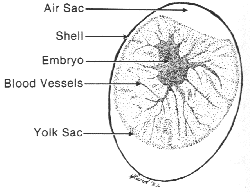
The nesting box should be 17 cm long by 17 cm high by 15cm wide, with a concave bottom and it should be made of a material that can be chewed without harm to the birds, preferably a non-toxic wood. The entrance hole should be circular with a diameter of 4 cm and below it there should be a perch of about 4 cm in length. To facilitate the checking of the eggs and the chicks it is best to have the lid able to lift up so that you can look in without disturbing the birds too much.. There is a debate as to whether budgies prefer it to be positioned as high as possible or not, but there have been documented cases of hens making their nests in hollows under loose stones, so generally the height of the box does not matter. In an aviary situation where the breeder is doing colony breeding there should be 1.5 nest boxes per pair. Then there will be ample nesting boxes and it reduces the chance of hens fighting over boxes. Budgies need extra minerals during breeding. The hen in particular needs extra calcium because she uses it for the production of eggs. A lack of calcium can cause her to become egg bound. See Egg Binding. Extra calcium can be given in the form of a cuttlefish, if one is not already available or extra grit mixed in the seed. Wild budgies breed prolifically during seasons when there is plenty of food and water available to ensure that the species will survive in times of drought, when they barely breed at all. The same thing happens with domesticated budgies. If there is not enough food or water for the adults they will either not breed, destroy their eggs or kill their chicks, because they think that it is a time of drought. So in order to ensure that the chicks survive the best is to have a large supply of food and water and to check it daily. Especially as the water can evaporate quickly. This was an experience I had with a pair, whose normal cage water bowl was emptied by evaporation approximately every six hours, in the warmth of the breeding room. Before I knew what was happening one clutch of eggs had been destroyed. So I gave that pair a larger water bowl for the duration of breeding. Handrearing and fostering are both alternatives when something happens and a chick can not remain with its parents. Fostering is the first choice of the alternatives. It involves removing the chick from its nesting box and placing it in the nesting box of another pair, preferably a pair that is reliable. The chick will need to be watched to ensure that the foster parents are accepting it and feeding it. A way to help the parents to accept the chick is to, if there is nesting material, rub the chick with some of it, or to hold the chick with the chicks from the new box, in your hands, so that they have the same scent. Handrearing is used as a second resort, because it requires patience and dedication. It involves keeping the chick in a warm environment (approximately 30oC in temperature) and feeding the chick. A young chick will require a feeding approximately every two hours, with several feedings during the night. A three week old chick will need a feeding approximately every four hours, with a late night and early morning feeding. To learn how to hand feed and to find out some recipes for feed you should visit your vet or another breeder. Candling is done to determine whether an egg is fertile or not. It should be done three or more days after incubation of the egg has begun. It involves holding the egg, with warm hands, between your eye and a light source. A penlight makes a good light source. The picture shows an egg at the 7th day of incubation. If the egg is infertile then it should be returned to the box until the entire clutch has been laid (and candled. If the entire clutch is infertile then the eggs can be removed and this will stimulate the hen to lay again.
|