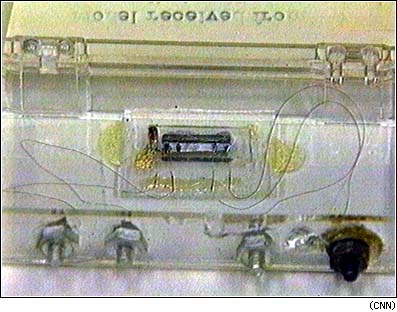
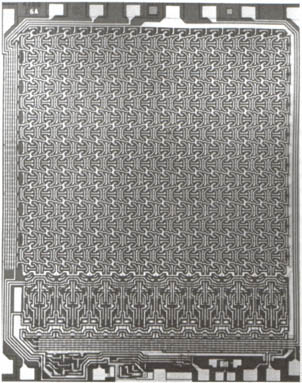
The first integrated circuits, or chips were developed in the late 1950's by Jack Kilby of Texas Instruments, and by Robert Noyce of Fairchild Semiconductor Corporation (who later founded Intel). These first chips were simplistic, with only one transistor, three resistors and one capacitor on a piece of silicon about the size of an adult's pinkie finger (see picture). Because of demand from NASA and the American military for more functionality and reliability in less space, chips became more and more small, and integrating more and more functions.
Eventually, in 1967 Jack Kilby produced the first handheld calculator. This calculator was as powerful as other computers of the time that filled rooms, but yet fit in your pocket. This calculator was a huge advancement, as it was mass-produced, compact, and was available for $2000 USD, much less than other computers of the era with comparable performance.
The idea of memory on a chip had been known for a great deal of time, but was not as economically feasible as the magnetic core memory of the time. Magnetic core memory was hugely expensive, but before 1970 was less expensive than Random Access Memory because production facilities already existed, and therefore, core memory could be produced for a relatively small amount of money.
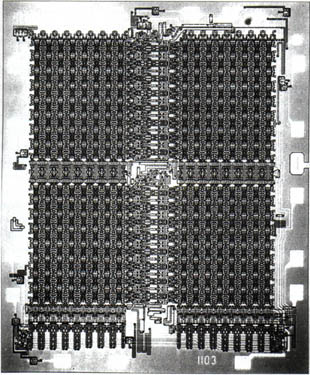
Random Access Memory first became feasible when in 1970, a large quantity of Fairchild RAM memory was chosen for a mainframe computer was called the Illiad IV. These memory chips stored only 256 bits of information, but were vastly quicker than the core memory of the time. With the success of this RAM, Robert Noyce and Gordon Moore founded a company called Intel with the initial idea of producing memory chips. In 1971, Intel released the 1103, a memory chip that had 1,024 bits of dynamic memory, and virtually ended the production of core memory.
In 1971, a Japanese calculator company called Busicom approached Intel, and asked for Intel to provide 12 chips for their new calculator. Intel then had an idea that they could put all of the functions to make the calculator work onto a single piece of silicon, reducing the size and price of the calculator. Busicom was enthralled by the idea, and agreed to incorporate this chip into their handheld calculator. On November 15, 1971, Intel introduced the world's first microprocessor on a chip, the 4004. The 4004 was used exclusively for Busicom calculators at first, but eventually Intel saw potential for wider use of their microprocessor, so they bought exclusive rights for this microprocessor back from Busicom, and sold it to the public at a price of $200. This chip had good performance for its time (as powerful as the ENIAC), but was much smaller and cost less money than any other solution available. Because of the good combination of performance, reliability, and small space, the 4004 was incorporated in NASA's Pioneer 10 probe, and continues to function to this date over 7 billion miles from the earth, while other parts of the satellite such as the power unit continue to decay, and will soon make it unusable. This chip led the way for more complex microprocessors, and the modern personal computer.