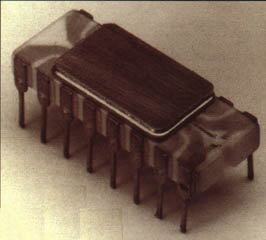

The Intel 4004 revolutionized the computer world. The 4004, the world's first microprocessor, contained all of the functions necessary for a calculator on a single integrated circuit. Prior to this invention, electronic devices functioned by having several chips working together to do all of the basic math functions. This method was more costly, and took up a vast amount more space than having all of the computational functions located on one chip. The invention of the microprocessor eventually lead to the invention of the microcomputer because of the decreased space, and money required.
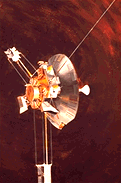
Compared to the computers of today, the Intel 4004 was not very powerful. It operated at a mere 108 kHz, had only a 4 bit bus size, and could only add and subtract. Although it was not very powerful by today's standards, the 4004 adopted many uses. The first use of the 4004 was in electronic calculators built by Busicom, a Japanese calculator company, who bought an exclusive rights to the chip from Intel. After this deal, Intel started to realize that there were other uses for this chip, and bought back the rights to the chip for $60,000. They then sold the chips commercially at a price of $200, and were adopted into many commercial devices, for example, in bottling machines. In 1972, NASA decided to use the Intel 4004 for it's probe, Pioneer 10. This microprocessor continues to function to this day, over 7 billion miles away from the earth.
| The Intel 4004 micro processing chip | The Pioneer 10 | Die shot of Intel 4004 |