Home
Long-term Implications
Treatment
Nursing Interventions
Links
Main
|

Decreased Self-respect
Most research indicated that individuals with ulcerative colitis experience a decrease in self-respect due to the physical effects of the disease. In a study done by Bryolf and Segesten it was found that the participants in their study had feelings of embarrassment and diminished self-respect due to the bouts of diarrhea and the fact that the subjects became more or less fecally incontinent. In many individuals urgent diarrhea occurs with such unpredictability that you are afraid to go out in case it happens when no toilet is around. When these patients are admitted to the hospital they have to share toilets with others and they can become very self-conscious of the frequency of their visits to the toilet as well as the lingering odours. It appears that frequent bowel movements accompanied by the threat of possible incontinence are the main contributing factors that diminish the self-respect that these individuals hold for themselves.

Decreased Self-esteem
The research done on the topic of ulcerative colitis suggests that self-esteem is negatively affected by the implications that the disease manifests. In a study done by Brydolf and Segesten it was found that most of the participants at one point in time during their illness experienced feelings of alienation which in turn lead to perceptions of not being accepted, valued, or appreciated by others. Some of the participants in the same study also expressed their anger at not having received enough support and they tended to view this as the reason contributing to their decreased self-esteem. The results of the study indicated that the most important factor for successful growth and development is an environment with significant others and a support team in which the adolescent is regarded as an independent human being with the ability to make adequate decisions. Overall, literature suggests that there is a need for the individual coping with the disease to be regarded as independently having the ability to make adequate decisions about the management of the disease, but it is also critical for the individual to feel supported throughout this process by their family, friends, and the health care team.
Colon Cancer Risk
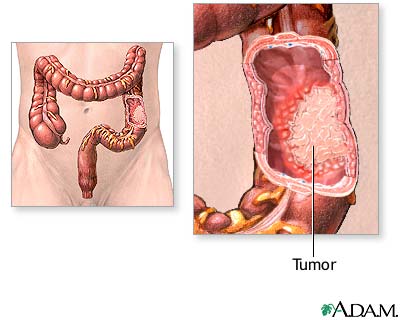
It was recognized in a majority of the literature that there is a significant risk for colon cancer associated with ulcerative colitis. The risk for developing colon cancer associated with ulcerative colitis is influenced by the severity and the duration of disease. It has been identified that having ulcerative colitis for more than eight years and disease that extends beyond the sigmoid colon are the two main determining factors of increased risk of cancer. In individuals who have had the disease for 35 years about 30 percent have developed colon cancer and for those who developed the disease before they were age 15 have a risk for cancer that reaches as high as 49 percent. For individuals who have had ulcerative colitis for numerous years of their life, this may be proving to be a source of great anxiety. It is recommended that colonoscopy for colon cancer screening begins eight years after diagnosis, then every one to two years thereafter. Patients must be informed about their cancer risk as well as the limitations of endoscopic surveillance and the availability of surgical alternatives. Due to the long term implications of ulcerative colitis, one can see that when individuals have to make decisions about their treatment it would be beneficial to provide these individuals with the support and resources that they need during this time, therefore helping these individuals to make informed decisions about their treatment.
References
Brydolf, M. & Segesten, K. (1996). Living with ulcerative colitis: experiences of adolescents and
young adults. Journal of Advanced Nursing, 23, (1), p.39.
Ghosh, S. Shand, A., & Ferguson, A. (2000). Ulcerative colitis. BMJ, 320, (7), p.1119.
Gremse, D. A. & Crissinger, K. D. (2002). Ulcerative colitis in children: medical management.
Pediatric Drugs, 4, (12), p. 807.
Levin, B., Lennard-Jones, J. Riddell, R. H., Sachar, D., & Winawer, S. J. (1991). Surveillance of
patients with chronic ulcerative colitis. Bulletin of the World Health Organization, 69, (1),
p. 121.
Shorten, A. (1995). A personal reflection on inflammatory bowel disease. Australian Nursing
Journal, 2, (10), p. 32.
This website was created by Melissa Nomura, BSN Nursing Student. April 11, 2003.
|