Home
Long-term Implications
Treatment
Nursing Interventions
Links
Main
|
 Introduction
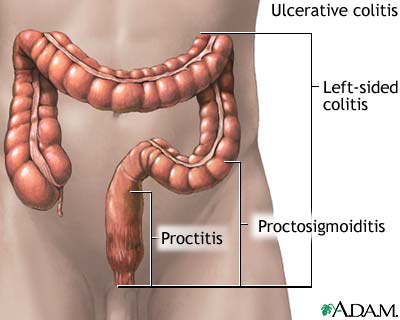
Ulcerative colitis is classified as an inflammatory bowel disease, which is the general name for diseases that cause inflammation of the intestines. The disease is characterized by periods of remission and exacerbation where at any point in time 50% of patients are asymptomatic, 30% have mild symptoms, and 20% have moderate to severe symptoms. Inflammation and ulcers form in the innermost layer of the sigmoid colon and in the rectum, but in severe cases this disease is also known to affect the entire colon.
The number of people suffering from ulcerative colitis in America is more than 500,000 and the disease accounts for 250,000 physician visits annually. Ulcerative colitis occurs worldwide in patients of all ethnic backgrounds but has been found to be more common in whites, with the highest incidence in northern Europe and North America. It equally affects both males and females and can affect people at any age in their life, but most people who are diagnosed fall into one of two age groups: 15 to 25 and 55 to 65.

Symptoms
The most common symptoms of ulcerative colitis are bloody diarrhea and abdominal pain, which result from inflammation and ulceration of the large intestine and rectum. Other symptoms include fever, weight loss, elevated heart rate, dehydration, urgency, rectal bleeding, malabsorption, nutritional deficiencies, loss of appetite, and fatigue. Ulcerative colitis may also cause problems such as arthritis, inflammation of the eye, liver disease, skin rashes, anemia, osteoporosis, and kidney stones. It is thought that these complications may occur when the immune system triggers inflammation in other parts of the body. Usually these problems are mild and go away when the colitis is treated. Depending on the severity of the disease, a person with ulcerative colitis can have as little as one to two semi formed stools with a small amount of blood, or in more extreme cases movements of bloody diarrhea, containing mucus up to 30 times a day.

Causes
The cause of ulcerative colitis continues to be unknown, despite the extensive ongoing research. It used to be thought that stress was the cause of ulcerative colitis, but this has proven false and it is now believed that stress is a result and is not the cause of the disorder. It is believed that genetic factors and a range of environmental influences are possible causes of the disease, but other factors continue to be researched. It is also thought that ulcerative colitis may be an autoimmune reaction in which ones body produces antibodies against one�s own tissues. What this theory implies is that a person with ulcerative colitis has a problem with their immune system, which causes cells in their body to attack the cells that line the digestive track causing inflammation and ulceration. This theory has been developed due to the fact that autoimmune disorders have a higher incidence in people with ulcerative colitis, but doctors don�t know whether these abnormalities are a cause or a result of the disease.
References
Faloon, W. (1998). Treating ulcerative colitis. Life Extension, 4, (5), p. 46.
Galper, C., Cerda, J., Hanauer, S. B., Peppercorn, M. A., & Wexner, S. D. (1998). Inflammatory
bowel disease: guidelines for management. Patient Care, 32, (5), p.81.
Ghosh, S. Shand, A., & Ferguson, A. (2000). Ulcerative colitis. BMJ, 320, (7), p.1119.
Gremse, D. A. & Crissinger, K. D. (2002). Ulcerative colitis in children: medical management.
Pediatric Drugs, 4, (12), p. 807.
Kennedy, A. P., Robinson, A. J., Thompson, D. G., & Wilkin, D. (1999). Development of
a guidebook to promote patient participation in the management of ulcerative colitis.
Health and Social Care in the Community, 7, (3), p. 177.
Lewis. S., Heitkemper, M., & Dirksen, S. (2000). Medical-Surgical Nursing: Assessment and
Management of Clinical Problems, (5th ed.). St. Louis: Mosby.
National Digestive Diseases Information Clearinghouse. (2000). Ulcerative Colitis. Retrieved
September 20,2001, from National Digestive Diseases Information Clearinghouse Web
site: http://www.niddk.nih.gov/health/digest/pubs/colitis/colitis.htm
Rayhorn, N & Rayhorn, D. J. (2002). An in depth look at inflammatory bowel disease. Nursing
2002, 32, (7), p. 37.
Shorten, A. (1995). A personal reflection on inflammatory bowel disease. Australian Nursing
Journal, 2, (10), p. 32.
This website was created by Melissa Nomura, BSN Nursing Student. April 11, 2003.
|