


Documents


Yes, where there is radioactive material you will be sure to find volumes of paperwork that go along with it.  But would you have it any other way?  Not only do we track radioactive material from "cradle to grave" we also ensure that personnel exposed to radiation have access to as much information as possible about the material and their personal exposure to that material.  This section will go over the most important of the documents and forms you should know about or should be using in your radiological work.

NRC Form 3

This form spells out your rights as a radiation worker.  It is posted at the outside of radiation labs and on common use bulletin boards.  At the research center, we have also added out local contact information and the location of important documents.  You are always entitled to review the NRC License and your personnel exposure records.  These are maintained in the Radiation Safety Offices and available to you upon request.  To review the information on the NRC's Form 3, click on the link below (or look outside your lab door).

Take Me To The Form 3


10 CFR 20 and Ames Health and Safety Manual

You should have already read through these, but if you have not, here are the links to these:


Ames Health & Safety Manual

10 CFR 20


NRC Byproduct Material License

This is available from the Radiation Safety Officer.  Copies are not distributed because it is a "living" document and as such is frequently amended.  To prevent outdated copies from being in the field, we keep the current copies in the Radiation Safety Office.

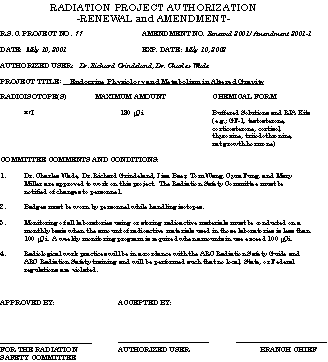
Radiation Project Approval

This is the laboratory's byproduct use license.  This document is the Radiation Safety Committee's approval for a radiation project including personnel on the project, isotopes to be used, areas  for use, techniques and methods of use, and chemical forms to be used. 

Path to Radiation Project Authorization

(follow the uranium brick road?)

Training

All personnel working with radioactive material at NASA Ames must meet the following training requirements:

Introductory (Authorized Users (AU) and Laboratory Technicians)– 6 hours web based or classroom with a 1 hour practical.

Introductory (Personnel from other institutions) - Personnel coming to the Center from other licensed facilities to work under the NASA Ames Nuclear Regulatory Commission (NRC) Byproduct Materials License whose radiation safety training is current within the last year from another institution will not be required to take the full 6 hour course and 1 hour practical. The Radiation Safety Officer (RSO) will review each individual's qualifications and make a determination as to what additional training will be needed prior to work at Ames. As a minimum, personnel will be required to read and understand the Center's Policies and Procedures (this chapter of the Ames Health and Safety Manual) and the NRC's requirements (10 CFR 20). Individuals who have not received training for over 1 year will be required to take the 6-hour Introductory class. The practical portion may be waived at the discretion of the RSO.

Refresher (Authorized Users and Laboratory Technicians)– 4 hours annually given in 20 minute monthly training assignments or a 4 hour annual classroom session at the discretion of the RSO.

Application Procedure

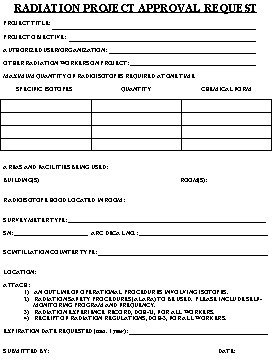
The prospective AU submits a request to the Radiation Safety Committee for approval to use radioisotopes in a specific project. The AU attaches the following forms to the application:

A QH-20, Radiation Project Approval Request, including a discussion of proposed operational steps and safety procedures.

The AU will also include specific steps to keep personal radiation exposures as low as reasonably achievable (ALARA).

Emergency Procedures, including call list.

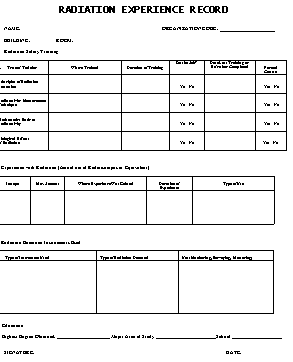
A QH-21, Radiation Experience Record, for the AU and each worker.

Calculations of Hazard Guide Values for all procedures using radioactive material (Appendix 7-B, NASA Radiation Safety Guide).

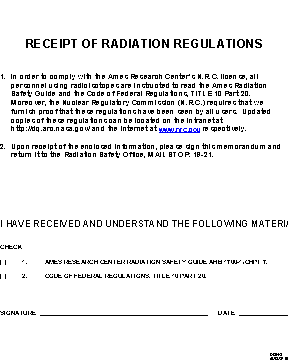
A QH-3, Receipt of Radiation Regulations, indicating that the AU has read and understood this chapter and the Code of Federal Regulations, Title 10, Part 20.

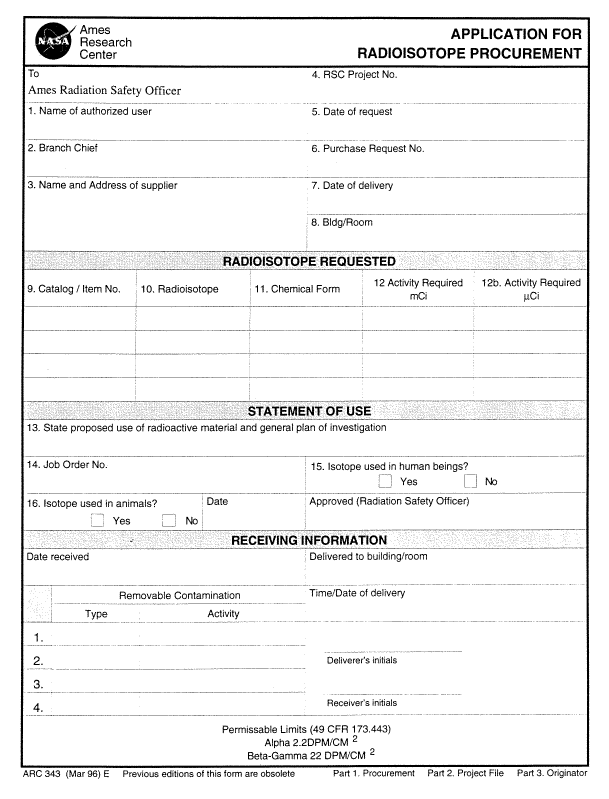
An Application for Radioisotope Procurement (ARC Form 343) for each shipment of radioactive material.

Radiation Safety Officer's Review

The RSO reviews the application and evaluates the following factors:

The qualifications of the AU and all persons who will be working with isotopes under the AU's supervision.

Personal exposure history of individual(s) (internal and external).

Chemical forms and amounts of the specific radionuclides to be used.

Adequacy of facilities for working with the proposed quantities of isotopes.

Adequacy of written operating procedures. If necessary, the RSO will provide appropriate modifications to the AU.

Provisions for ensuring the safety of personnel, including the use of hoods and special equipment, methods of monitoring the environment, appropriate dosimetry, and the AU's written ALARA program.

Radioisotope control records, including inventory, use, storage, and disposal.

Possibility of low-level contamination.

Emergency Response Procedures for spills and worst case accidents.

Radiation Safety Committee's Review

The Radiation Safety Committee reviews the application and the analysis of the project submitted by the RSO and approves or disapproves the project.

Project Authorization Form

The Committee completes a DOH-22 form, Radiation Project Authorization, setting out, among other things, any extraordinary conditions that need to be addressed, as well as the date the project expires. Copies of the form are to be sent to the AU and the AU's Branch Chief. This form needs to be signed by both the Branch Chief and the AU and sent back to the Radiation Safety Office including responses to any issue raised before the project is authorized.

Authorized User

DOH-22, Radiation Project Authorization, specifies the Authorized User. The responsibilities of the AU are detailed in Chapter 7, paragraph (7.2.5) of the Ames Health and Safety Manual.

Radioisotope Request, Inventory, and Waste

Request

Application form for Radioisotope Procurement ARC 343

Whenever you will be ordering radioactive material for your approved radiation project, the Authorized User for the project will initiate the completion of NRC Form 343.  This form is a request for the Radiation Safety Officer's approval to order radioactive material.  This is your way of communicating what you would like to order and when it will be expected.  This allows the Radiation Safety Officer to check that the material you are ordering has been approved and that it is within your and the research center's inventory limit.  This form also allows the RSO to anticipate the arrival of the material for expeditious processing. 


Inventory

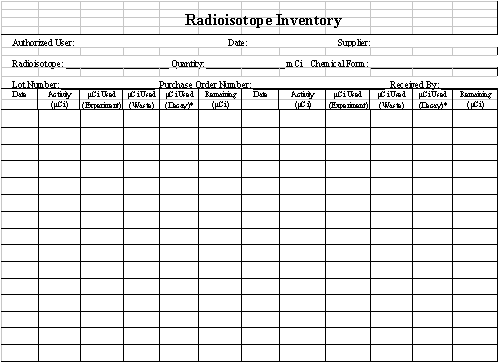
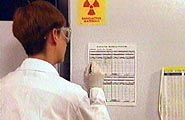
When the material is delivered to you by the Radiation Safety Officer, you will also be issued an inventory form.  You are required to maintain a current inventory of all radioactive material in your possession, whether it be in the vial, an experiment, or waste.


Waste

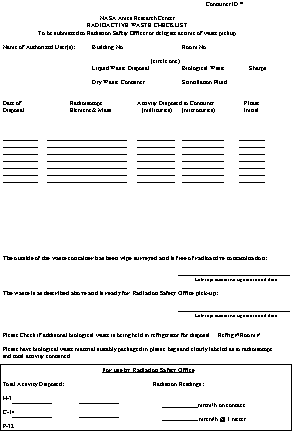
The Radiation Safety Officer will issue a "Radioactive Waste Checklist" with each waste container.  This form will need to be updated each time radioactive waste is added.  Only use radioactive waste containers for your project and only put the proper waste type and radionuclide in each container.  When the container is full or is no longer required, the researcher shall seal the inner bag, wipe test the box to ensure it is free from contamination, sign the form affirming that this has been completed, and then call the Radiation Safety Office personnel to have the waste removed.

Survey Forms

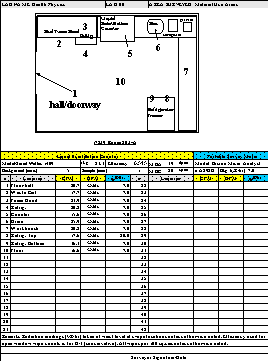
It is important to use survey forms to clearly record the laboratory's required surveys.  The form above is available from the radiation safety office in electronic format (MS Excel).  If you will not be using this form, you will need to have the form you will be using approved by the Radiation Safety Officer.


Dosimetry Report

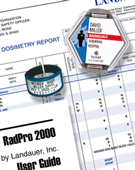
Your quarterly radiation exposure records are kept in the Radiation Safety Office.  The results will be sent to you each quarter and are available for your review at any time by contacting the Radiation Safety Officer.


hplogo2.jpg (16555 bytes)

Hosted by www.Geocities.ws

1