 |
Injection
| Housing
| Euthanatizing
| Clean-up and Waste Disposal |
|
Minimum PPE for this evolution will be protective gloves, lab coat or apron, and eye splash protection (preferably a face shield).
| Syringes containing certain radioisotopes (e.g.; P-32, Fe-59, Tc-99) will be significant radiation sources. Syringe shields, dry-run practice, and using the smallest dose necessary are methods to lower the radiation dose that the extremities will receive. Ring badges will be worn on the syringe hand or hand expected to receive the greatest dose.
| As with any chemical used in animal studies, it is not a good idea to inject yourself! With radioisotopes this will result in an internal as well as an external exposure. It will also cause an exposure to a wound, which is not desirable. Extra care should be taken to prevent needle sticks. The researcher should be familiar with injecting animals with non-radioactive substances before attempting an injection using radioisotope.
| Proper absorbent material must be laid out before injection to capture any radioactive spills, blood drops, or urine/feces spills that may occur.
| When clearing the needle, DO NOT spray the isotope into the air! If this needs to be performed, liquid will be directed into an absorbent or appropriate receptacle. |
|
Radioactive trash receptacles for dry, biological, and sharps waste should be positioned as close to the injection area as possible. These should be labeled with appropriate radioactive and biohazard labels (as applicable) and prepared to receive waste. Proper container inventories will be maintained to ensure the radioisotope and quantity of radioisotope in the container is recorded. DO NOT OVERFILL CONTAINERS – ESPECIALLY SHARPS CONTAINERS!
| If the radioisotope is volatile, or likely to become airborne, approved ventilation will be used. Consideration should be made and preparatory actions taken if the radioisotope will be exhaled by the animal in significant quantities.
| The room should be properly posted and controlled for radioactive material work.
| Spill clean-up supplies should be readily available and their location known by all personnel involved in the evolution.
| The area should be isolated and cages available to ensure no radioactive animal can escape and become a moving spill! |

|
Minimum PPE for this evolution will be protective gloves, lab coat or apron.
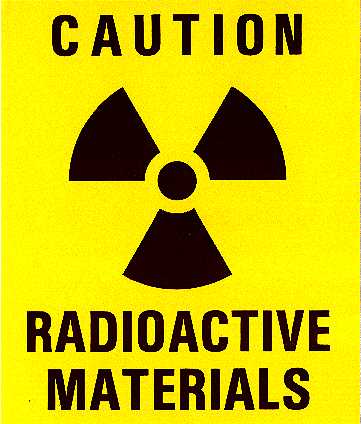
| The room where the animals will be caged will be posted with a "Radioactive Materials" label and will be locked or guarded at all times. |
|
The cages will be labeled with radioactive material labeling tape and the radioisotope and amount shall be posted on the cage.
| Cages will be lined with absorbent material and will be constructed such that material can not be spilled from the cage by the animal. Bedding, food, urine, and feces that fall from the cage will be considered radioactively contaminated. If the cages themselves cannot ensure containment, then the area surrounding the cages will need to be controlled and covered with appropriate absorbent material. Distinct borders will be established and marked with radioactive material tape to denote potentially contaminated areas. Appropriate anti-contamination clothing will need to be worn when coming in contact with these areas (e.g. gloves, shoe covers, lab coats, etc.). |

|
Spill clean-up supplies should be readily available and their location known by all personnel involved in the evolution.
| Controlled ventilation will be evaluated if the possibility exists for airborne radioactive contamination. An example of this evaluation would be if the airborne radioactivity is in the form of exhaled CO2. Prior to work, the room would be verified to be at negative pressure with respect to the outside areas, the ventilation rates for the room would be determined, the expired activity estimated, and, finally, the air concentrations calculated and compared to allowable limits for personnel exposure and discharge to the environment. This evaluation would determine if controlled ventilation is required or not.
| Only personnel who have radiation safety training specific to the activity they will perform will be allowed to handle animals that have been administered radioactive materials or the cages or bedding for these animals.
| If the bedding is to be changed during housing of the animals, it will be packaged as radioactive material and kept for Radiation Safety disposal.
| No potentially contaminated material (cages, feed trays, water bottles, etc.) may leave the controlled area without first being surveyed to ensure it is free from radioactive contamination. This survey will be performed by Radiation Safety personnel. |

|
Minimum PPE for this evolution will be protective gloves, lab coat or apron.
| All radioactively contaminated samples taken from the animal will be controlled under the rules and regulations regarding radioactive material.
| Radioactive carcasses and biological material will be bagged or packaged in leak-proof packaging that is labeled with radioactive material marking tape, labels, or tags. The radioisotope and the quantity of the radioactive material will be noted on the package.
| Radioactive carcasses and biological material will be frozen while awaiting disposal.
| Lime should be added to bags containing carcasses or biological material that is awaiting disposal, especially if the possibility exists for the material to thaw before disposal (loss of power with no back-up, aging freezer, etc.). |

|
Minimum PPE for this evolution will be protective gloves, lab coat or apron, and eye splash protection (preferably a face shield). More protection may be needed based on the evolution. Evaluate PPE thoroughly prior to beginning clean-up. If in doubt, contact the Radiation Safety Officer for assistance with protective equipment selection.
| As stated above, radioactive carcasses and biological material will be bagged or packaged in leak-proof packaging that is labeled with radioactive material marking tape, labels, or tags. The radioisotope and the quantity of the radioactive material will be noted on the package. Radioactive carcasses and biological material will be frozen while awaiting disposal. Lime should be added to bags containing carcasses or biological material, especially if the possibility exists for the material to thaw before disposal (loss of power with no back-up, aging freezer, etc.).
| Bedding will be carefully poured into radioactive waste bags and the bags sealed for pick-up by radiation safety.
| Cages will be wiped down with damp rags and mild detergent. All cleaning waste will be bagged as radioactive. Radioactive labeling will not be removed until radiation safety has surveyed the cages and verified that they are clean (free of radioactive contamination).
| Absorbent paper will be carefully folded into itself and disposed of as dry, radioactive waste.
| Sharps containers will be closed and labeled with the name of the isotope and an estimate of radioactive material quantity.
| All instruments should be wiped down with mild soap on damp rags similar to the decontamination of the cages. Special care should be taken to avoid injury if sharp instruments will be decontaminated. If the instruments are to be released from radiological controls, they should be set aside to await radiation safety surveys. If they are to be kept as radioactive material use only instruments, they should be marked with radioactive material tape and stored in a controlled area.
| Once all waste is packaged and all areas wiped-down, post-work wipe surveys should be taken. These surveys should be entered in the laboratory’s Radiation Safety Log Book. Areas found to be contaminated should be decontaminated with mild soap. If decontamination is unsuccessful, bag the item or cover the area and notify Radiation Safety.
| Update survey records, inventory records, and waste records.
| Once surveys are complete, schedule a waste pick-up and a time to release equipment with Radiation Safety. |