
 |
Dry Active Waste with >88 day half-life |
|
Dry Active Waste with <88 day half-life. |
|
Aqueous Liquid with >88 day half-life. |
|
Aqueous Liquid with <88 day half-life. |
|
Scintillation Vials containing Carbon-14 and Tritium. |
|
Scintillation Vials containing other isotopes approved for disposal. |
|
Animal carcasses with <65 day half-life. |
|
Animal carcasses with >65 day half-life. |
|
Vials containing aqueous liquids. |
|
Biological waste products. |
|
Mixed Waste other than scintillation vials. |
|
Waste will be packaged in yellow outer polyethylene bags with appropriate radioactive material markings. The only exception to this is material packaged in "sharps" containers or aqueous solutions in containers with tight fitting lids. "Radioactive Material" tape will be applied to the containers to identify them as radioactive. |
|
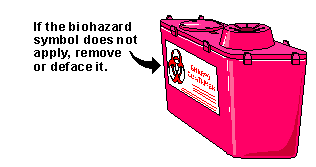
No infectious waste will be accepted. Do not use biohazard bags to package radioactive waste that is not a biohazard. Acceptance of biohazard radioactive waste is on a "by prior approval only" basis. |
|
No radioactive contamination is allowed on the outer packaging. |
|
A Radiation Safety Office approved waste checklist must be attached to each individual waste package. All required data will be filled out on the checklist. |
|
Aqueous liquids will only be accumulated in containers approved by the Radiation Safety Officer. |
|
Liquid waste containers will be stored in secondary spill containment at all times. |
|
Do not fill 5-gallon containers with more than 4 gallons of liquid. Other approved containers should not be filled greater than 3/4 full. |
|
Containers will be secured at all times to prevent tipping or falling. |
|
Isotopes with half-lives >88 days must be separated from isotopes with half-lives of <88 days whenever possible. |
|
The limit for isotopes of half-life >5 years (e.g. H-3, C-14, Cl-36, Ni-63, and Sr-90) is 5.0 millicuries per 5 gallon containers. Normally the quantity should be much less than this. |
|
Disposal of radioactive material to the sanitary sewage system is prohibited at the research center. |

|
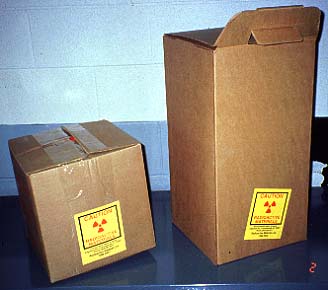
Dry waste consists of paper, plastic, glass, etc., that is believed to contain radioactive contamination. |
|
The amounts of this type of waste generated should be minimized by using good radiological controls, keeping radioisotope work areas as small as possible, and by using common sense to minimize materials that will come in contact with the radioisotope work area. |
|
No liquid waste is allowed in the dry waste (e.g. vials of liquid, dripping rags, etc.). Damp absorbent paper is acceptable as long as the liquid could not be reasonably separated from the paper. |
|
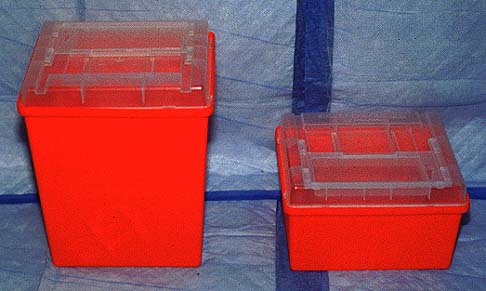
Sharp objects and objects that could easily puncture a plastic bag must be placed in a "sharps" container for disposal. This is to prevent a spread of radioactive contamination from a torn bag and also to prevent injury to the waste handler when processing the bag. |
|
Vials containing only Carbon-14 or Tritium must be segregated and packaged separately from vials containing other isotopes. |
|
Only de-regulated quantities (.05 microcuries per milliliter) of Carbon-14 and Tritium are acceptable. |
|
Only the isotopes listed below are acceptable for disposal. |
|
Insure the vials are tightly capped to prevent spilling inside the bags. Bags with spilled liquid inside the bag will not be picked-up. |
|
Use bags of a size such that the bag will not be overly heavy. This prevents breaking of the vials inside the bag, tearing the bag itself, or injury to the personnel handling the bag. |
|
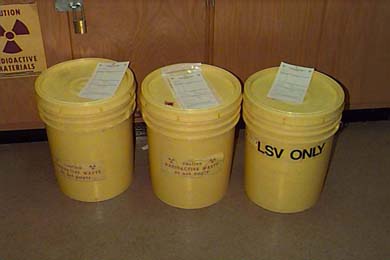
No gloves, boxes, papers, pipette tips, or other trash is allowed in the scintillation vial bags. An absorbent paper pad is allowed, but should not be taped around the vials as this makes it difficult to dump the vials into a drum. |
Iodine 125 |
Chlorine 36 |
Chromium 51 |
Mercury 203 |
Iron 59 |
Iodine 131 |
Sulfur 35 |
Selenium 75 |
Phosphorous 32 & 33 |
Tin 113 |
Calcium 45 |
Geranium 68 |
Sodium 22 |
Cadmium 109 |
Cobalt 57 |
Cerium 141 |
Tin 119 |
Scandium 46 |
Zinc 65 |
Copper 64 |
Rubidium 86 |
Gold 195 |
Gallium 67 |
Technetium 99 |
Indium 111 |
Gadolinium 153 |
|
Biological wastes are products such as tissue, blood, feces, and other non-carcass animal waste. |
|
Liquids, such as blood, should be absorbed in paper or sorbent prior to bagging. |
|
This category of waste is expensive to dispose of. Therefore, any means to minimize biological waste will be beneficial. |
|
Formaldehyde is prohibited from bags for disposal. |
|
Animal carcasses and biological waste will be placed in an approved freezer. Biological waste and carcasses containing isotopes with half-lives of >65 days should be minimized whenever possible. |
|
Animal carcasses with half-lives <65 days should be segregated and bagged separately from animal carcasses with half-lives >65 days. |
|
Animal carcasses should be wrapped in foil and bagged in yellow polyethylene radioactive material bags and kept frozen. |
|
Large animals, such as pigs, should be placed directly in a prepared (liner, lime, and sorbent in drum) 30 gallon drum and placed into a freezer (prior approval is required for pigs). |
|
No other waste is allowed to be mixed with carcasses. |
|
Once again, formaldehyde is forbidden |
|
No hazardous organic solutions or petroleum based oils are allowed. |
|
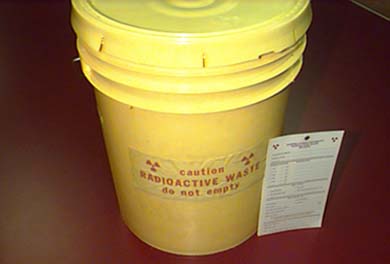
Vials will be deposited in appropriate leak-proof containers, or if picked up, bagged similar to scintillation vials, and appropriately tagged. Leaking or broken vials are unacceptable, so care should be taken when packaging. |
|
Radioactive aqueous vials are limited to 50 ml or less. |
|
Disposal of radioactive material to the sanitary sewage system is prohibited at the research center. |
|
Mixed waste is waste that contains both a hazardous component and a radioactive component. There a few options for disposal of this category of waste. | ||||||||
|
This waste is prohibited from being generated at the research center unless:
| ||||||||
|
Any fees, fines, or other costs will be the sole responsibility of the person generating the a mixed waste except as stated above. |
|
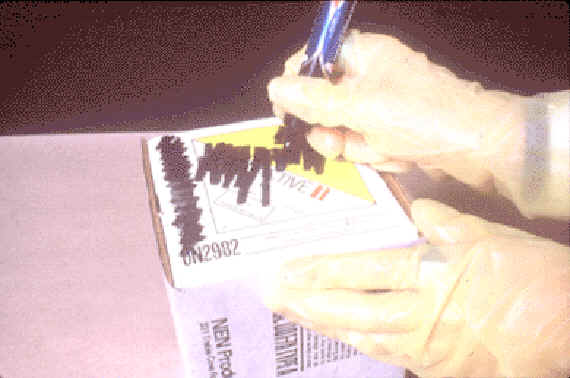
Prior to disposal of packaging of radioactive materials, the packaging will be surveyed to insure it is free of radioactive material, then any radioactive markings will be removed or obliterated. |
|
Lead pigs/shields from radioisotopes will be collected by the radiation safety office after the laboratory has surveyed the pigs/shields, attached a copy of the survey to the pigs/shields, and obliterated or removed any radioactive markings. |