
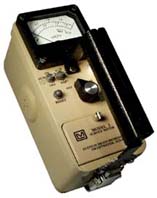
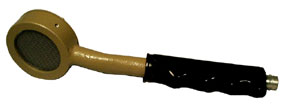
 |
Check the Battery |
|
Check the Wires for Damage or Shorts (if moving the wire causes meter response with no radiation present, the wire is damaged) |
|
Check the Meter for Obvious Signs of Damage |
|
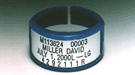
Ensure the Instrument is in Calibration (date found on instrument sticker) |
|
Check the Instrument Response to a Known Source of Radiation |
|
Radiation - When we measure radiation, we are measuring the dose rate from a radioactive source in order to locate the source and also to establish boundaries. We use this information to keep our personnel doses as low as reasonably achievable and to protect the public. Typical units and instrument scales for radiation measurement would be - mR/h, R/h, rad/h, mrad/hr, rem/hr, and mrem/hr. Remember, for gamma, x-ray, and beta radiation we say: |
|
Radioactive Contamination - When we measure contamination, we are determining how much radioactive material has spilled or is in a location where we do not want it. Contamination gives off radiation, but is not radiation. In other words, you can get contamination on your shoe, but not radiation. Typical units would be counts per second (cps or c/s) or counts per minute (cpm or c/m). |
|
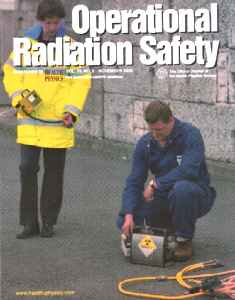
When looking for unknown radiation levels, walk in the direction of the highest reading until you find the source, or reach the pre-determined radiation reading. |
|
When looking for radiation area readings, hold the detector at waist level and slowly turn 360 degrees (all the way around). You are looking for the highest reading in an area to record. Ensure enough points are taken to give a good picture of the radiation gradients. If work is to be performed in an area, personnel will need to know the high areas to avoid and lower radiation areas where they can rest if they are not exiting. |
|
Listen to the audible response, it is faster than the meter response. |
|
If entering a high radiation field, it is important to understand that G-M meters, especially archaic ones, may fail to zero if in a field higher than full scale. It is important to be alert to changing radiation readings. Walk slowly, surveying as you go. Do not proceed directly to the survey area then turn the instrument on. |
|
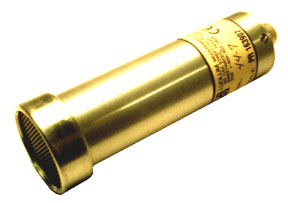
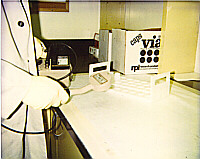
When looking for radioactive contamination, slowly scan the surface within 1/2" with the pancake probe. A slow scan shouldn't move faster than 2" per second (or 1 foot every six seconds). If the meter has a response setting, it should be set at the fastest response when looking for contamination. |
|
Listen to the audio and, when an increased count rate is heard, stop and hold the detector over the area of the highest count rate. |
|
The response setting should be turned to the slower setting to obtain a reading. |
|
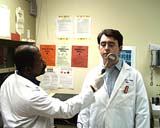
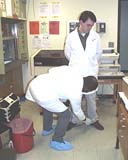
When surveying yourself, the basic procedure is the same. Be sure to survey all areas that may have been contaminated - hands, face, front of clothing, seat of pants or dress, and shoes. When surveying personnel out of an accident area, survey their entire body from the head down. |
|
Final personnel release surveys should always be performed in an area with low (normal) background levels. |
|
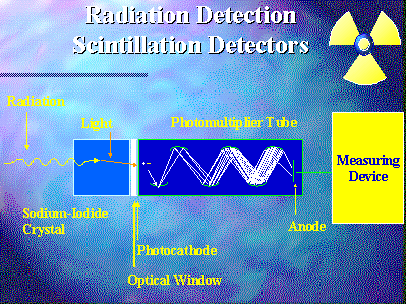
How efficient is your system at counting the emission your are measuring and |
|
Is your measurement statistically significant? |
|
Determine points to be surveyed. |
|
Sample an area known to be clean first. This will serve as your control, or background, sample. |
|
Choose order of sampling to sample areas of suspected lowest contamination first, moving to areas of highest contamination last. |
|
Sample boundary areas such as hallways for each survey as well as work areas. |
|
Wear gloves when performing surveys in suspected contaminated areas. |
|
Wipe the survey paper over an area of 100 square centimeters for each location. If this is impractical due to the size of what you are sampling, make a note of this with an estimated area surveyed. For a 1" wipe paper, a 16" (39.3 cm) "S" should be wiped or an area of 4" by 4" (10 by 10 cm). |
|
The samples should not be allowed to come in contact with each other to prevent cross contamination. |
|
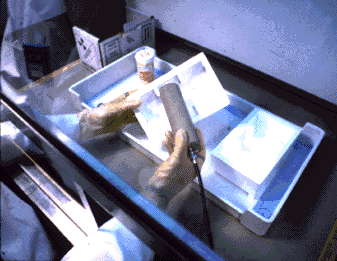
Wear gloves and load the samples into vials for counting. The order loaded should be the order taken (i.e. lowest contamination to highest). |
|
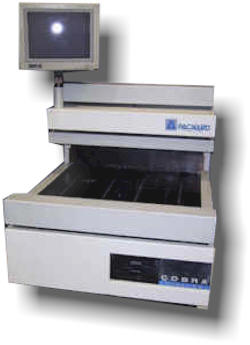
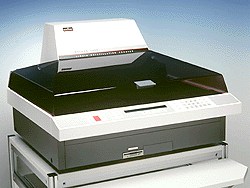
For liquid scintillation counting, liquid scintillation fluid will need to be added to each vial. For gamma scintillation counters it does not. |
|
Count the samples per the operating instructions of your counter. Record results on approved survey form. |
|
It is good work practice to decontaminate any area that has a count rate three times the background count rate. |
|
ALARA (As Low As Reasonably Achievable) limits for restricted area surface contamination for beta emitters is 550 dpm/100cm2 for floors and counter tops and 1100 dpm/100cm2 for radioisotope refrigerators, freezers, and fume hoods. |
|
Maximum contamination levels are listed in Chapter 7 of the Ames Health and Safety Manual, Section 7.4.2. If these limits are reached or exceeded, immediate decontamination is required. If work practices routinely cause levels at these limits, the Radiation Safety Officer should be asked to review work practices in order to reduce contamination levels to acceptable standards. |

|
They are issued to the individual and are not to be shared. |
|
They are to be worn at the collar, chest, or waist - whichever is suspected to receive the highest dose from the work area. |
|
When not in use they should be stored in an area away from radioisotopes. |