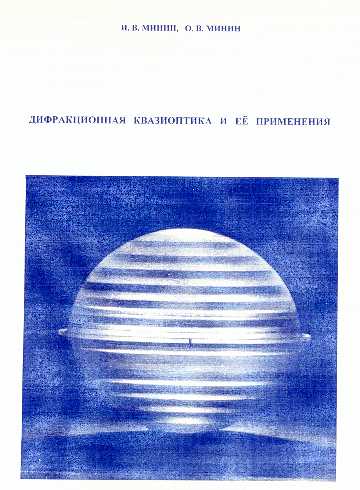
 As it was mentioned in the
book by Hristo D. Hristov. "Fresnel Zones in
wireless links, zone plate lenses and antennas", Artech House, Boston,
London, 2000 "The most substantial practical
progress in antennas with curved dielectric zone plates was made at the
Novosibirsk Institute of Applied Physics Problems, Russia, by Minin and
Minin. They developed and studied experimentally a whole nomenclature of
curvilinear Fresnel zone plates and antennas: spherical, parabolic,
conical, and so forth. They proposed and studied a lot of attractive
practical applications of the millimeter-wave zone plate lens, as for
example, in plasma diagnostics, quasioptical holography ("radiovision"),
shock-wave focusing, measurement instrumentation, and zone plate
antennas." (Chapter 5.6.3., p. 302).
As it was mentioned in the
book by Hristo D. Hristov. "Fresnel Zones in
wireless links, zone plate lenses and antennas", Artech House, Boston,
London, 2000 "The most substantial practical
progress in antennas with curved dielectric zone plates was made at the
Novosibirsk Institute of Applied Physics Problems, Russia, by Minin and
Minin. They developed and studied experimentally a whole nomenclature of
curvilinear Fresnel zone plates and antennas: spherical, parabolic,
conical, and so forth. They proposed and studied a lot of attractive
practical applications of the millimeter-wave zone plate lens, as for
example, in plasma diagnostics, quasioptical holography ("radiovision"),
shock-wave focusing, measurement instrumentation, and zone plate
antennas." (Chapter 5.6.3., p. 302).
From Dr. James C. Wiltse, USA
Dear Drs. Minin:
... I feel that the two of you have made important contributions to the fields of Fresnel zone plate antenna technology and millimeter wave techniques. I particularly like the fact that you have performed many experiments and measurements to corroborate your analytical and theoretical research. Your two books are extensive, detailed, and thorough, and are a strong contribution to the field. Because they are written in Russian, they are not widely used in the United States, soBest wishes,
09.09.2000
From Prof. Dr. Toshio Onodera, Japan
Dear Prof. Igor V. Minin,
...I read your mail on the new book and will be sure to buy it. I hope you will be successful in your book.Sincerely yours,
14.09.2000
From Prof. G.I.Greisukh, Penza, Russia
...Comparison with your first book (let even fluent) speaks about doubtless successes both in the theory, and in practical sphere. Introduction of new techniques today, as is known, are most difficult and are undoubtedly more significant....
With respect,
7-8-2000.
Greisukh G.I. - Prof., Dr. of science, the author of some books on diffractional optics, including: " S.T.Bobrov, G.I.Greisukh, J.G.Turkevich. Optics of diffractional elements and systems. - Leningrad, " Mechanical engineering ", 1986. - 224 P. "
Minin I.V., Minin O.V. Diffractional Optics of Millimetre Waves. - IOP Publisher, Sept. 2004.
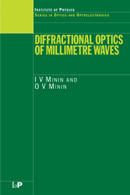
ISBN: 0750309075
Series
This international series includes books on all aspects of theoretical and applied optics and optoelectronics, including geometrical and wave optics, nonlinear optics, optical materials, lasers, quantum and atom optics, imaging and information processing, optical data storage and communication, fabrication technologies, and optical and optoelectronic device physics. Titles in the series range in level from advanced textbooks for graduate students, to research monographs on specialized topics designed to meet the requirements of scientists and engineers working in the optics and optoelectronics industry.
Synopsis
This book combines those elements of diffraction theory normally associated with optics (Gaussian beams, lenses, mirrors, etc.) and extends them into the micro and millimetre wavelength range. In this regime there are a number of applications in devices such as automobile proximity sensors, satellite-TV receiving antennae and non-destructive testing systems and researchers working in these areas would benefit from greater understanding of the diffraction phenomena involved.
Millimetre waves exhibit many of the properties usually associated with waves in the optical regime. They can provide excellent image identification and resolution, and their low attenuation in atmospheric conditions that would significantly affect optical transmission means that they can provide remote measurements while operating through smoke, dust, fog or rain. This versatility has resulted in millimetre wave devices finding increasing application throughout the industrial, commercial and military sectors, including terrorism struggle device.
Diffractional Optics of Millimetre Waves combines those elements of diffraction theory normally associated with optics and extends them into the micro and millimetre wavelength range. The first two chapters of the book offer a review of the theory of diffraction followed by a complete and in-depth treatment of zone plate lenses. Chapters 3 and 4 consider conventional and alternative methods of construction of elements of diffractive optics on arbitrary curvilinear surface, and chapter 5 describes diffractive antennas in the microwave range. Chapter 6 briefly discusses the main fields of application of elements of diffractive optics from optical and THz waveband up to microwave, and chapter 7 considers the use of man-made dielectrics in the fabrication of diffractive elements.
A translated and essentially updated version of the authors’ 1992 book “Diffraction Quasioptics”, this book presents results formerly unavailable in the general literature, which will be of great value to researchers working with devices in the millimetre wavelength regime.
Contents: Theory of diffraction.- Short focusing Fresnel zone plates.- Elements of diffraction quasioptics.- Synthesis of diffractional elements.- Diffractional antennae at millimetre wavelengths.- The influence of surface form on the structure of Fresnel zones.- Applications of diffractional optics and quasioptics.- Diffractional antennae.- Optical constants of meterials at submillimetris and millimetric wavelenghts.


