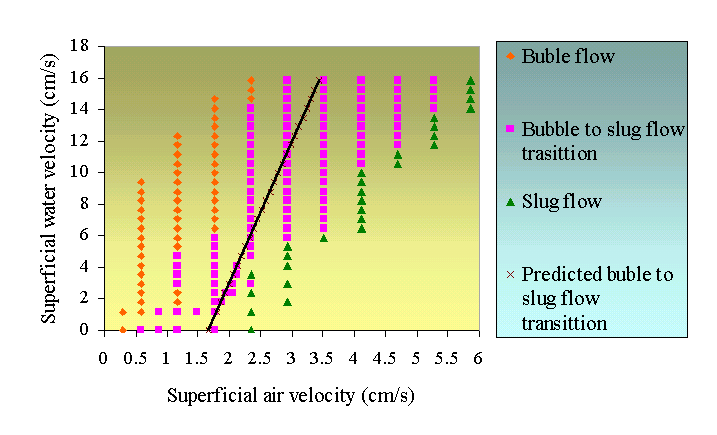
Figure 6 Flow pattern map generated from a 19 mm inside diameter tube.
Determination the Flow Regimes
In Figure 6, the superficial water velocities are plotted against the superficial air velocities for only bubble and slug flow because the research was directed especially to the slug flow regime. An Increase in the superficial air velocity, while the superficial water velocity was being held constant changed the flow pattern if the air velocity was adequate. A bubble to slug transition occurred over a small range of values, but not at a single point as well as a transition point predicted by Nicklin's model, Eqn. (4) with a void fraction equaled 0.1. Experiments of Nicklin indicate that if a void fraction equals 0.1 is somewhat arbitrarily taken for the bubble to slug transition, little significant error will arise in pressure-gradient and void fraction calculations. However the transition covered the point predicted by Nicklin's model.
Figure 6 Flow pattern map generated from a 19 mm inside diameter tube.
Figure 7 A video clip of bubble to slug flow transition generated from a 19 mm inside diameter tube.
Determination the Rise Velocities of a Single Slug (ub) and Their Slug Length
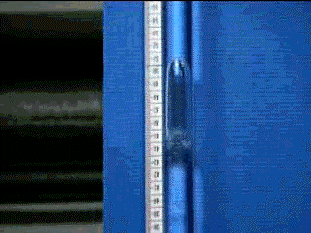
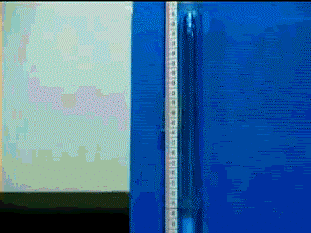
Three different size single slugs of thirty one slugs that I studied in the range of 3.00 to 42.14 cm slug length, which were tracked by a camcorder are shown in Figure 8. The length of slug was read from each picture by Adobe Photoshop program and slug velocities were measured.
The results are shown in Figure 9 in which the rising velocities are plotted as a function of the slug length for water at room temperature. It was evident that the rise velocities of all slugs were very close to those predicted by Eqn. (6), (ub=c(gD)1/2, c=0.35). They were independent of slug length.
In Figure 10, values of c in Eqn. (6) from an experiment are plotted as a function of slug length. The average value of c was 0.33, which was very close to the theoretical value (c=0.35).
 |
 |
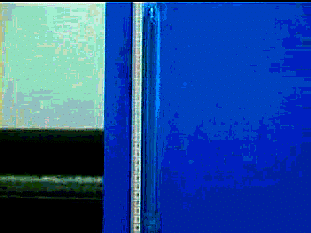 |
Figure 8 Single Slugs with 6.25, 19.73 and 26.88 cm slug length, respectively.
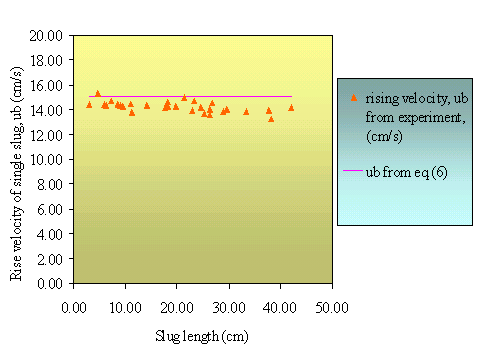
Figure 9 Relationship between the rise velocity of single slugs and slug length.
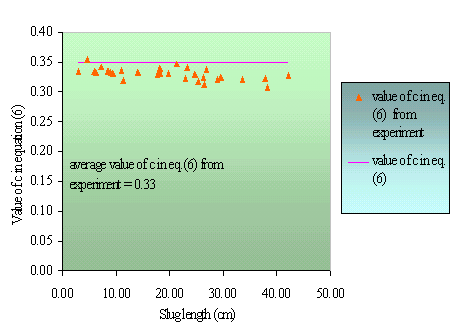
Figure 10 Experimental values of c in Eqn. (6) versus slug length.
Determination Void Fractions at a Variety of Air and Water Flow Rate Within Slug Flow
In Figures 11, the void fractions are plotted as a function of the superficial air velocities for constant superficial water velocities and an inside diameter. These data cover the superficial air and water velocities in the range of 2.93 to 70.42 cm/s and 0 to 14.70 cm/s, respectively. Increasing the superficial air velocity while the keeping a superficial water velocity and an inside diameter of tube constant made void fractions increase. The void fractions from experiments were close to those predicted by equation (9) and the trend was the same one predicted by the model. This model was satisfactory for predicting void fractions within an error 15%.
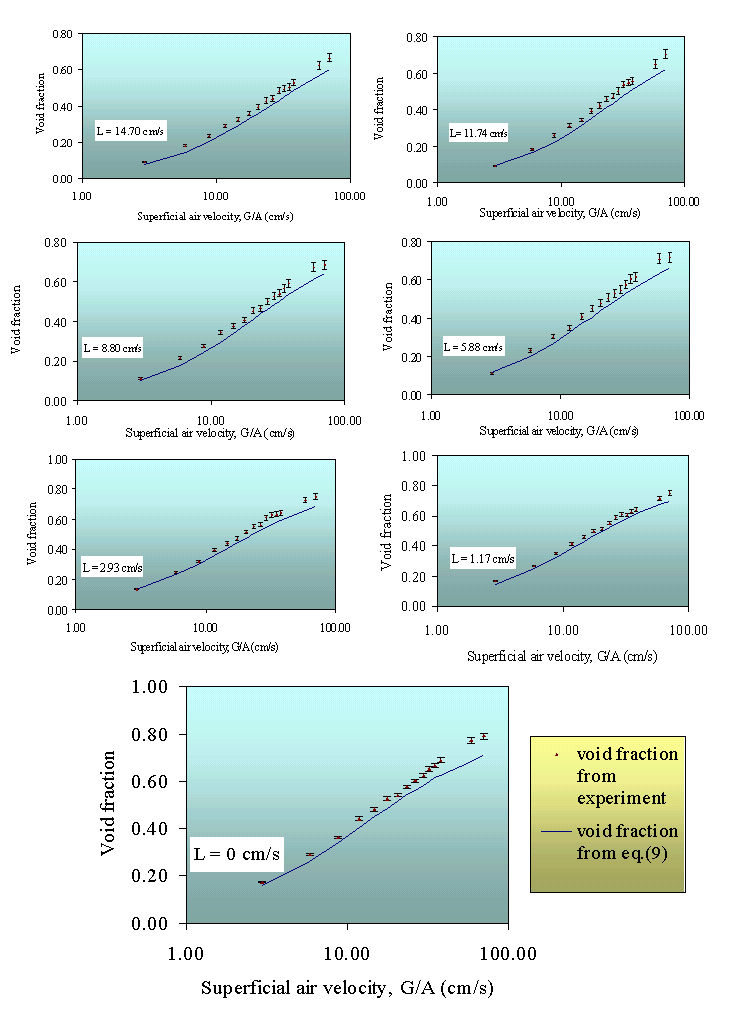
Figure 11 Comparison of void fraction calculated from equation (9) with that determined experimentally with a 19 mm inside diameter tube at a variety of water flow rates.
Determination Rise Velocities of Continuously Generated Slugs (us)
In Figures 12, the rise velocities of continuously generated slugs are plotted as a function of the superficial air velocities at a variety of water flow rates as same as flow rates of void fraction experiments. Increasing the superficial air velocity for a variety of water flow rates linearly increased the rise velocity of slugs. The data of this experiment showed excellent agreement (within 7%) with those predicted by Eqn. (7) for various air and water flow rates.
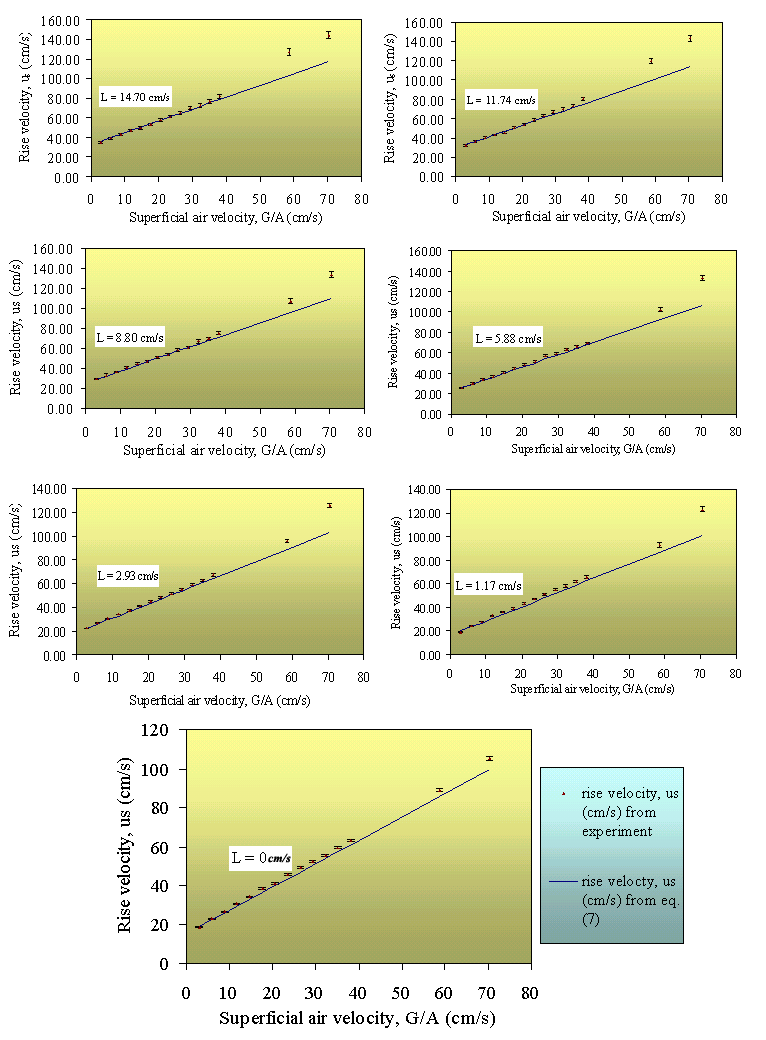
Figure 12 Comparison of rise velocity of continuously generated slugs from equation (7) with that determined experimentally at a variety of water flow rates.
Determination Air- Lift Pump Operation
In Figure 13, the superficial air velocities for incipient air-lift operation are plotted as a function of initial height of water in the main and reservoir columns. Decreasing the initial height of water in the main and reservoir columns increased the required a superficial air velocity for incipient air-lift pump operation. Average data were within 23.17% of values predicted by Eqn. (12) and the spread of individual values was within -56.12 to 1.44%. It was acceptable within 30% error. The predicted values for higher heights of water in the columns or lower required superficial air velocities for incipient air-lift pump operation showed better agreement with the data from an experiment.
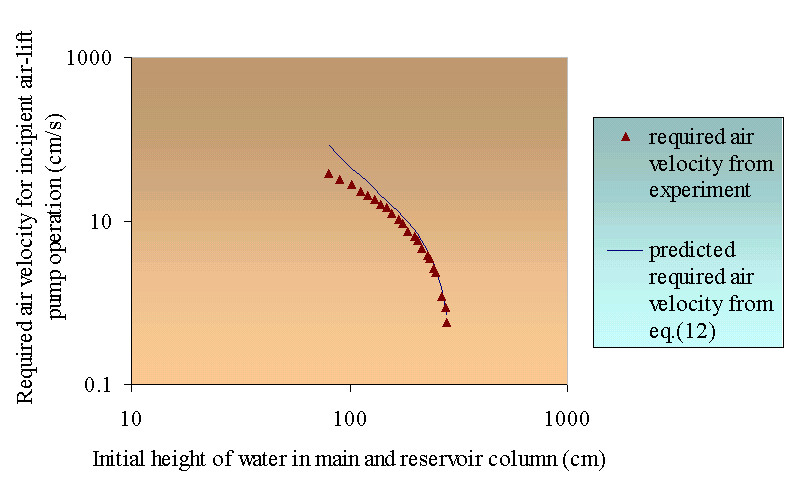
Figure 13 Investigation of the air-lift pump operation.