Materials
Equipment
Methodology
- Parameters
- Experimental Procedures
- Data Calculation and Analysis
Materials
1. Air from compressor at constant pressure 1 bar
2. Water from a tab not circulation.
go to top
Equipment
Design and Experiment Setup
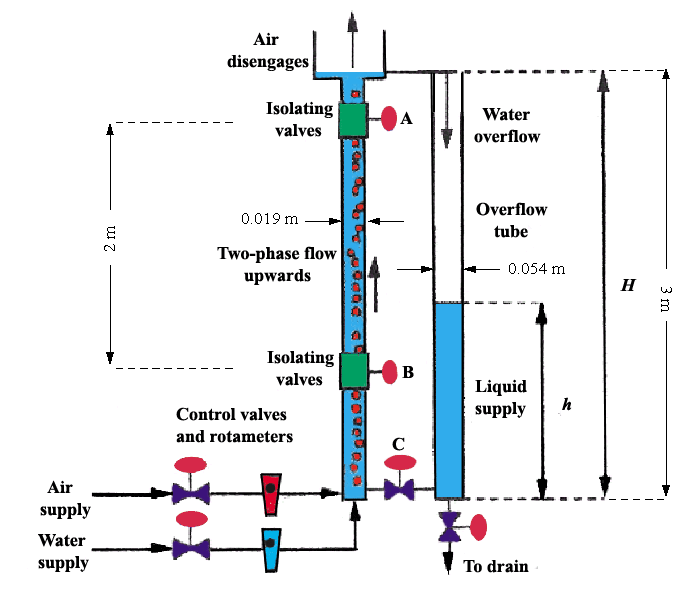
Figures 5a shows the apparatus diagram. Two different size three- meter-long acrylic tubes, which are 0.019 m and 0.054 m inside diameter, were installed with a base. The smaller tube was used to be a main column, and another was used to be a reservoir column. The main column was fed air and water. The air was drawn from a compressor with constant 1 bar and was measured by a calibrated rotameter. Water was from a water pipeline and flowed through a 1-inch ball valve and was measured by a calibrated rotameter. Air entered up from the base of the main column 10-cm above the water injection. The section, which is between isolating ball valve A and B, is 2 m. This section was used to measure a void fraction. Ball valve C was used to isolate two columns, but connect them while air-lift pump operation was being run.
Figure 5a Diagram of apparatus for investigating two-phase flow in a vertical tube.
go to top
Methodology
1.Parameters
- Controlled Parameters
-Dimension of both columns
-Types and properties of fluids (air and water)
-Height of water in the main column (H)
- Variable Parameters
-Volumetric flow rates of air and water (L, G)
-Height of water in the reservoir column (h)
-Slug length
- Measured Parameters
-Rise velocity
-Void fraction (e)
go to top
2.Experimental Procedures
- Determination the Flow Regimes
The volumetric flow rates of water (L) and air (G) were varied with valve C closed in the range of 0 to 15.85 cm/s and 0.29 to 5.87 cm/s, respectively. Air and water flow rates could be measured by rotameters and adjusted by valves. L and G were recorded at bubble to slug flow transitions, which were observed by a camcorder. The two-phase vertical flow regime map was constructed.
- Determination Rise Velocities of Single Slug (ub) and Slug Length
By turning the air on and off suddenly at different openings of valve C, and by timing slugs over know distances. The slugs lengths were studied in the range of 3.00 to 42.14 cm. The rise velocities ub of isolated single slugs of air in otherwise stagnant water (no net water flow, L=0) were determined. The slug lengths were also measured by picture from a camcorder.
- Determination Void Fractions at a Variety of Air and Water Flow Rates Within Slug Flow
Within the slug flow regime, shut valves A and B very quickly in order to isolate the water and air between them and hence to determine the void fraction. It needed two persons to shut both valves simultaneously. And air and water velocities were studied in the range of 2.93 to 70.42 cm/s and 0 to 14.70 cm/s, respectively.
- Determination Rise Velocities of Continuous Generated Slugs (us)
A steady continuous stream of air was operated, with valve C closed, so there was no net water flow rate (L=0). The air volumetric flow rates (G) were varied within the slug flow regime to make steady a continuous stream of air, and the volumetric flow rate of air (G), the slug rise velocity us, and (by quickly closing the two valves in the tube) the void fraction, e were measured.
- Determine Air-Lift Pump Operation
With the main column now free to communicate with the central reservoir (valve C opened), at a water level at height h that is significant be low the top, The air flow rate G that was needed just to start pumping the water out through the top of the tube and back into the reservoir was determined. The difference of height of water in the main column (H) and height of water in the reservoir column (h) was measured to calculate the void fraction by Eqn. (11) for the slug flow . A variety of water levels was repeated.
go to top
3.Data Calculation and Analysis
- A plot of G versus L, in which the bubble and slug flow regimes were shown, was constructed. The Bubble to slug transitions were calculated by Eqn. (4) with void fractions equaled 0.1.
- Eqn. (6) was investigated for predicting the rise velocity of a single slug, and finding the value of c.
- The relation between the rise velocity of a single slug to the slug length was investigated.
- Eqn. (9) was tested for predicting the void fraction at different air and water flow rates.
- The validity of Eqn. (7) was determined for predicting the rise velocity us of continuously generated slugs.
- The experimental values of G for incipient air-lift pump operation of the column were compared with those predicted by theory, Eqn. (12) by using the void fraction that calculated from Eqn. (11).
- Rise velocity of single slug, ub was determined by potential-flow theory. An observer traveling upwards with a gas slug was considered. The gas was apparently stationary, with water velocities could be deducted by a solution of Bessel's equation. However, the shape of the slug must then be adjusted so that the water velocity at a height h below the nose of the slug was given by (2gh)1/2 from Bernoulli's equation. The velocity ub could then be determined.
go to top
Go to: Introduction, Results and Discussion