
Figure 4 shows a gas-lift pump, in which the buoyant action of a volumetric flow rate G of gas serves to lift a volumetric flow rate L of liquid from a height H0 in a reservoir to a height H in a vertical pipe of diameter D and cross-sectional area A, in which slug flow may be assumed. Neglect liquid friction in both the supply pipe and in the vertical pipe.
Figure 4 Gas-lift pump.
From hydrostatics, the pressure at the base of the column is obtained in two ways:
 |
which gives:
 |
|
From equation (6) and (7) with L = 0:
 |
 |
 |
|
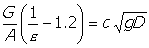
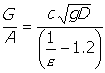
Substitute equation (11) in equation (12). It gives superficial velocity of gas, which then suffices to achieve the desired liquid flow rate.
Go to: Introduction, Back, Experimental