SLUG FLOW
The general situation is shown in Figure 3(a), in which the gas (air) and liquid (water) are traveling upwards together at individual volumetric flow rates G and L respectively, in a tube of internal diameter D. In general, there will be an upward liquid velocity uLm across a plane A-A just ahead of a gas slug. By applying continuity and considering the gas to be incompressible over short distances, the total upwards volumetric flow rate of liquid across A-A must be the combined gas and liquid flow rates entering at the bottom, namely, G + L. The mean liquid velocity at A-A is therefore ULm = (G + L)/A, where A is the cross-sectional area of the tube.
Next, consider Figure 3(b), which shows a somewhat different situation -that of a single bubble, which is moving steadily upwards with a rise velocity Ub in an otherwise stagnant liquid. For liquids such as water and light oils that are not very viscous, the situation is one of potential flow in the liquid. Under these circumstances, Davies and Taylor used an approximate analytical solution that gave a specific value for c in the equation:

|
(6)
|
in which g is the gravitational acceleration and c = 0.33. Experimental evidence shown that constant should be c = 0.35. The situation of Figure 3(a) is now shown enlarged, in Figure 3(c). The slug is no longer rising in a stagnant liquid, as in Figure 3(b), but in a liquid whose mean velocity just ahead of it is U
Lm. Further, near the nose O of the slug at the center of the tube, where the velocity is the highest ,the liquid velocity will be somewhat larger, namely, about 1.2U
Lm , as shown by Nicklin, et al., provided that the Reynolds number between slugs exceeds 8,000. Therefore, the actual rise velocity of the slug will be

|
(7)
|
Now, by conservation of the gas, we must have

|
(8)
|
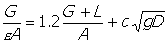
in which is the void fraction (the fraction of the total volume that is occupied by the gas). Hence, eliminating Us between equations (7) and (8), we obtain
|
(9)
|
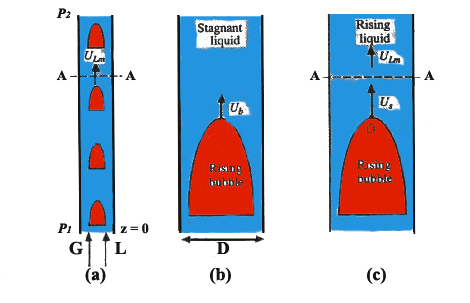
Figure 3 Two-phase flow in a vertical tube: (a) gas and liquid ascending, (b) bubble rising in stagnant liquid, (c) bubble rising in moving liquid.
If G and L are known, equation (9) gives the void fraction, which is very important in determining the pressure drop in a tube of height H. Also note that the weight of the liquid, which occupies a fraction (1-e ) of the total volume, is much greater than that of the gas. Therefore, the pressure drop is given to a first approximation by

|
(10)
|
A secondary correction to (10) would include the wall friction on the liquid pistons between successive gas slugs.
Go to: Introduction, Back, Next