|
|
|||
|
|||
|
|||
|
|||
|
Self Portraits
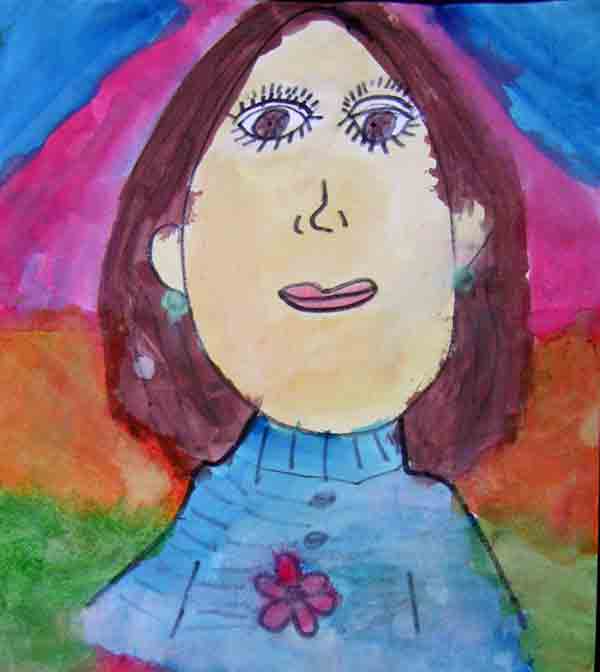 |
Karly Lawrence-- 1st grade
Project: Self Portraits
Grade level: Kindergarten and 1st grades
Self Portrait Art Galleries:
Materials: Water colors
(Prang oval set of 8)
Water buckets
Paper towel blotters
Paint brushes
Construction paper 12" x 18 " for young children (do not tape)
0r watercolor paper (taped down -- optional)
Black permanent markers to outline picture -- Extra fine tip Sharpie
Small hand mirror for each child
Color markers
Scratch paper
** Note, I use Prang oval water colors because I like the pigment colors for student work.
References to Drawing on the Right side of the Brain --
see resource section.
This book has an excellent section on drawing faces.
Objectives of lesson:
Observation of pictures by Renoir
Comparison of different portrait pictures
Learn about the use of colors and light
Learn about the technique the artist used.
Perceptual skills of observation
Questions to ask students
Does this picture look like you? Who does it look like? What do you
notice about the little girl? Is this picture realistic like a photograph?
What do you see in the background? What do you think this little girl
has been doing? Would you be dressed like this if you were watering
your Mom's flowers? How old do you think the young girl is?
Eslar Targets: #3 Understanding Our importance in God's creation and how we are fearfully and wonderfully Made
Scriptural Inspiration: Psalm 139: 13-15
You created my inmost being
You knit me together in my mother's womb,
I will give thanks to thee, for I am fearfully and wonderfully made:
Wonderful are thy works, and my soul knows it full well.
Activity: Discuss sample of Portraits
I love to Use Renoir, but Da Vinci Mona Lisa is also a
great example to observe.
Artist: Pierre Auguste Renoir (1841-1919)
Picture Title: Little girl and Watering Can ( I love this picture because
of its softness. Children try to touch the picture and always notice
this)
History of Artist: Pierre Renoir, the genius and traditionalist of the Impressionist movement, was born in Limoges France, the son of a tailor. Renoir began his career by painting porcelain plates, fans and window blinds, before entering the Academie Gleyre in 1862. He soon met with Monet and other Impressionists. These artist greatly influenced him to paint from nature and brought him into the heart of the Impressionist movement, although his paintings before 1870 were in the classical tradition. Between 1870 and 1880, Renoir was a pure Impressionist, painting with the characteristic touches of broken color and beautiful hues. He preferred figure painting to landscapes, unlike his companions. He created portraits and scenes of social life in a manner that is at once very alive and tender. In 1881, he went to Italy to study the frescos in Venice and Rome. He returned to France after this. His final style, in his latter years combines line and color and light. He had an optimistic outlook on life. His paintings show his love of women, their beauty, their gentleness, their laughter and their tenderness. This same understanding applies to his painting of children whom he painted with an eye for naturalness and simplicity. "The Girl and Watering Can" is a good example of this. Renoir's love of painting was so great that even in his final years, confined to bed and with brushes bound to his crippled arthritic wrist, he painted beautiful canvases of color.
Lesson on drawing faces:
1. Using scratch paper, we will begin to draw our faces.
We begin by looking in the mirror before each step. I also have the
students use permanent markers to eliminate the need to erase everything.
Have the students look at their image in the mirror. With young children
ask questions like "Is your face round like a ball, or oval, or
square like a box. Have them draw an oval shape.
2. Now we observe that the nose is in the middle of the face (measure this if needed), and demonstrate drawing a nose for the students. Have them repeat this step.
3. Eyes are located at the top of the nose -- observe this with the students-- and centered between the nose and temple. Draw shape of eye, "football " shape. Talk about the structure of the eye and draw in pupil, eyelid and lashes. (Kindergartners tend to put the eyes at the top of the head)
4. Mouth-- observe shape of mouth. Draw this shape open or closed (it's easier closed) The mouth is located half way between nose and chin.
5. Ears-- ears are located by following the eye around to the top of the ear. (Kindergartners tend to put ears all over the head)
6. Hair-- drawn in according to the individual.
7. Now we can add the neck, body, arms, legs,. . Many times the pictures have come out so large, that the students do not have room to draw these in. In this case, we draw the shoulders, or what ever would be most accurate for the size of paper and the size of the student's drawn picture.
Notes: I prefer to use permanent markers or colored markers so the students do not become preoccupied with erasing their work: "Something is not RIGHT!!" If this is drawn in pencil, the younger students cannot outline their own work. So I have found it best to use the permanent marker for the final drawing.
8. After the student's self portrait is complete, we review the use of water colors. Usually the water color lesson is on another day. The students complete their self portrait with watercolors. You may choose a different medium, as their teacher.
Other artists that would be nice to observe would be Mary
Cassat, Vincent Van Gogh, or Modigliani for studying self portraits.
Any ideas or suggestions write to:

|
|
|