
|
|||
 | |||
|
|
|||
| |||
|
|||
| |||
| |||
|
Contact Us 
| |||
| |||

| English Version | Versi B. Malaysia | 中文版 |
|
West Malaysia Click here to return to Marco Travel Homepage |
||
|
|
||
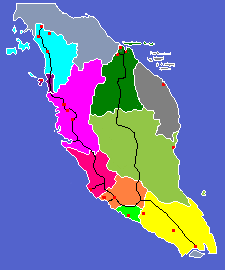
West Malaysia comprises of eleven states. They are:
|
||
| Perlis | ||
|
Perlis, the country's smallest state, lies at the north-western corner of the Malays Peninsular between the state of Kedah and neighbouring Thailand. The state's main appeal is its refreshing serenity; respite from the hustle and bustle of citylife. |
||
| Kedah | ||
|
Kedah, together with the neighbouring state
of Perlis are traditionally known as the"Rice
Bowl of Malaysia". Vast stretches of rice fields
dominate Kedah's panoramic landscape. |
||
| Penang | ||
|
|
||
| Perak | ||
|
Perak takes its name from the silvery colour of the rich tin deposits for which it is renowned. This mineral featured prominently in the history and economy of the state. |
||
| Selangor | ||
|
Selangor is centrally located on the west
coast of Peninsular Malaysia and is one of
the most prosperous and developed states in
the country.
|
||
| Negeri Sembilan | ||
|
Negeri Sembilan, translated literally as "nine states", is so called because it once consisted of nine seperate districts, each ruled by a Malay chieftan. Seremban, its capital is well-connected by road and rail to Kuala Lumpur, 50 Km away. |
||
| Malacca | ||
|
It is traditionally believed that the history of Malaysia began with the founding of Malacca in 1400 by Parameswara, a Sumetran prince. Thereafter, the state flourished under the Malacca Sultanate and eventually became the region's largest emporium attracting traders from as far as China, India, Arabia and Europe. |
||
| Johor | ||
|
Johor is the Southern gateway into Peninsular Malaysia and is linked to Singapore by road and rail. Its proximity to Singapore has made it a popular destination among Singaporeans as well as other international tourists visiting the island of republic. |
||
| Pahang | ||
|
With a landmass spread over 35,000 sq. Km, Pahang is the largest state in Peninsular Malaysia. Much of the state is still covered by extensive rainforest. The jungle in Taman Negara, the country's most well-known national park is estimated by scientists to be about 130 millions years old. |
||
| Terengganu | ||
|
Terengganu which overlooks the South China Sea on the east coast of Malaysia is another charming holiday destination. Its long coastline is endowed with truly magical beaches of white sand and washed by clear, warm waters. |
||
| Kelantan | ||
|
Kelantan is located on the north
eastern corner of Peninsular Malaysia
and shares a common border with Thailand
in the north.
|
||
| Kuala Lumpur | ||
|
Kuala Lumpur, meaning a muddy confluence,
had its origins as a shanty mining
outpost for the tin trade in the 1800's at
the confluence of the Gombak and Klang River.
|
||
| Putrajaya | ||
|
Putrajaya, the latest federal teritory of Malaysia, is located approximately 35 Km in the south of KL. It is built to be the center of administration for the central government. |
||
|
Related Information
Perlis ... the smallest state of Malaysia Kedah ... the Rice Bowl of Malaysia Penang ... Pearl of the Orient Perak ... The silver state Selangor Negeri Sembilan, Malacca Johor Pahang Terengganu Kelantan Kuala Lumpur Putrajaya |
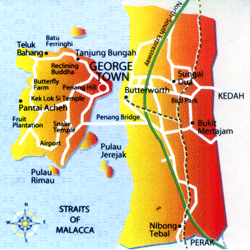 From its establishment as the first Bristish
trading post in the Far East
in 1786, Penang is today a bustling city with
unique blend of the East and West.
This is reflected in its heritage buildings
as well as in the lifestyles, food and customs
of the local people.
From its establishment as the first Bristish
trading post in the Far East
in 1786, Penang is today a bustling city with
unique blend of the East and West.
This is reflected in its heritage buildings
as well as in the lifestyles, food and customs
of the local people.
|
Copyright 2003 Modular Service and Trading Sdn Bhd. |
|
Modular Service and Trading Sdn Bhd 30 Jalan Indah 2/1, Taman Universiti Indah, Seri Kembangan, 43300 Selangor, Malaysia tel: 03-89484453 fax: 03-89484453 email: [email protected] |


Search Engine Optimization and Free Submission