
|
|||
 | |||
|
|
|||
| |||
|
|||
| |||
| |||
|
Contact Us 
| |||
| |||

| English Version | Versi B. Malaysia | 中文版 |
|
Johor The Southern Gateway to Malaysia |
Modular Homepage | |||||||||||||||||||||
| Geography and Climate | ||||||||||||||||||||||
|
The State covers an area of 18,986 sq km. Johor's highest point is Gunung Ledang. On the whole, Johor's climate is tropical monsoon. The temperature is relatively uniform within the range of 26°C to 27°C throughout the year. During the months of January to April, the weather is generally dry and warm. Humidity is consistently high on the lowlands ranging between 82% to 86% per annum. The average rainfall per year is 2,030 mm to 3,050 mm and the wettest months are from May to December. |
||||||||||||||||||||||
| Economy | ||||||||||||||||||||||
|
The economic activity of Johor is dominated by agriculture, manufacturing, commerce and tourism. It is also the nation's major producer of palm oil, rubber, pineapples and bananas. Around Johor Bahru and other major towns, one can find many industrial estates that produce electronic components, electrical appliances, furniture, textiles and petrochemical products. |
||||||||||||||||||||||
| Fast Fact | ||||||||||||||||||||||
|
|
||||||||||||||||||||||
| History of Johor State | ||||||||||||||||||||||
|
Johor history can be traced to the 16th century. It began in 1511 when Sultan Mahmud of the Malacca Sultanate, after losing Malacca to the Portuguese, fled to Johor and engaged in regular wars to try to recapture Malacca from the Portuguese. He did not succeed and died in Kampar, in Sumatra in 1528. Meanwhile, the Kingdom of Aceh on the northern part of Sumatra was steadily gaining its strength. The Acehnese was in constant conflict with the Portuguese in Malacca. The former tried to wrest control of the region. At the same time the Johor Sultanate did not give up its desire to recapture Malacca. This resulted in the Aceh-Malacca-Johor war. The Portuguese, after failing to gain control of Johor, eventually gave up and let the Malay rulers to rule from their capitals near the Johor River. The Acehnese continue to attack Johor. When the Dutch came to this region, they allied with Johor for a combined successful attack on the Portuguese. In return, Johor was conferred special trading rights on other states by the Dutch. By the end of 17th century, the Johor empire was among the strongest in the region. However, a war with the Bugis of Celebes in 1716 weakened Johor. The Dutch East India Company's control of Riau-Johor in 1784 ended the Bugis domination in Johor. In 1819, the squabble between the Malay and Bugis factions in Johor gave Stamford Raffles an opportunity to put Singapore under the British control. Mainland Johor was separated from the rest of the empire in Riau-Lingga Archipelago. Sultan Abu Bakar, who became the Sultan in 1885 was fondly remembered as the "Father of Modern Johor", as he has laid the foundation for developing Johor into a modern state. He first transformed Johor Baharu from a humble fishing village into a thriving new town. Thereafter, he extended the development to other parts of Johor, in particular the township of Muar and Batu Pahat.
These successes and his contacts with people in high places in London and Singapore convinced the British that his government was good and stable and thus, deferred the appointment of a British "advisor" to help him rule Johor. His successor Sultan Ibrahim tried to implement similar independent policies, but reigned at the time when the British power was at its height. In 1914, Sultan Ibrahim reluctantly accepted a British General Advisor, which effectively put Johor under British control. Throughout the period of British rule, Johor succeeded in maintaining a strong identity of its own. Its leaders played a major role in the post-1945 independence movement, including the formation of the United Malay National Organisation (UMNO) in 1946. Dato' Onn bin Jaafar, a former Menteri Besar (Chief Minister) of Johor was the founder of UMNO. |
||||||||||||||||||||||
| Related Information | ||||||||||||||||||||||
|
[
玻璃市Perlis
] [
吉打Kedah
] [
槟城Penang
] [
霹雳Perak
] [ 雪兰莪Selangor ] [ 森美兰Negeri Sembilan ] [ 马六甲Malacca ] [ 柔佛Johor ] [ 彭亨Pahang ] [ 登嘉楼Terengganu ] [ 吉兰丹Kelantan ] [ 沙巴Sabah ] [ 砂劳越Sarawak ] [ 吉隆坡Kuala Lumpur ] [ 纳闽Labuan ] [ 太子城Putrajaya ] |
||||||||||||||||||||||
| Please select a state on the left column and then select from the list of attactions for the selected state in the right column. | ||||||||||||||||||||||
|
玻璃市Perlis
吉打Kedah 槟城Penang 霹雳Perak 雪兰莪Selangor 森美兰Negeri Sembilan 马六甲Malacca 柔佛Johor 彭亨Pahang 登嘉楼Terengganu 吉兰丹Kelantan 沙巴Sabah 砂劳越Sarawak 吉隆坡Kuala Lumpur 纳闽Labuan 太子城Putrajaya |
||||||||||||||||||||||
 Johor is the southernmost State in the Peninsular Malaysia.
The State is bounded on the north by Malacca and Pahang,
on the west by the Straits of Malacca, on the east
by South China Sea and on the south by Singapore.
Johor is the southernmost State in the Peninsular Malaysia.
The State is bounded on the north by Malacca and Pahang,
on the west by the Straits of Malacca, on the east
by South China Sea and on the south by Singapore.


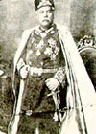 Sultan Abu Bakar was the first Malay ruler to visit England.
He became the personal friend of Queen Victoria.
He used western methods to manage Johor's internal
affairs and secured the personal services and advice
of British businessmen and professionals.
He introduced a modern public administration system,
known as Johor Civil Service and gave the State its first
constitution.
Sultan Abu Bakar was the first Malay ruler to visit England.
He became the personal friend of Queen Victoria.
He used western methods to manage Johor's internal
affairs and secured the personal services and advice
of British businessmen and professionals.
He introduced a modern public administration system,
known as Johor Civil Service and gave the State its first
constitution.
|
Copyright 2003 Modular Service and Trading Sdn Bhd. |
|
Modular Service and Trading Sdn Bhd 30 Jalan Indah 2/1, Taman Universiti Indah, Seri Kembangan, 43300 Selangor, Malaysia tel: 03-89484453 fax: 03-89484453 email: [email protected] |