Dive Patterns:
Navigation plays a major role when diving patterns.
But why would you want to swim a pattern? Isn't it enough to
navigate your way to a site and back to shore? We'll there are a
lot of reasons you may want to swim a pattern, rather than moving
randomly. Here's a few reasons:
- Search & Recovery - Pre-determined patterns are central to
searching for lost objects. They maximize the area you cover,
while minimizing overlap and eliminating missed area's.
- Avoiding Obstacles - It's not uncommon for obstacles to lie along
a bearing you are trying to follow. By using a simply pattern you
can go around these obstacles without moving off of your bearing.
- Maximizing What You See - Many divers will move randomly around
dive sites. But by using a pre-planned dive pattern you can
maximize the amount of a dive site you see, and at the same time return
you to your entry/start point.
- Prevent You From Getting Lost - at some dive sites getting lost
can be a real problem. Sometimes you may only have a small beach
as an entry/exit point. Sometimes there may be area's which you
need to avoid for safety. And some sites are simply hard to
navigate in. A pre-planned pattern can help you find your way
back to your entry point, avoid dangerous area's, or navigate through
complex environments.
Index:
Kick Cycles:
Before you can swim patterns you need to understand kick cycles.
A kick cycle is defined as a complete "rotation" of your fins (i.e. one
up and one down stroke = one kick cycle). Kick cycles are useful
as you can use them to estimate how far you have moved, and allow you
to swim regularly sized patterns. But before you can start
estimating distances you must first determine how far you move per kick
cycle. To do this you'll need two underwater markers a known
distance apart. The best way to do this is to stretch a 30m
(100') line across the bottom of a lake or bay. Start swimming
at one end of the line, counting the number of kick cycles it takes you
to get to the other end of the line. Repeat this three or four
times, and average the number of kick cycles it takes. Using this
information you can calculate how far you move per kick cycle.
For example:
- You swim the 30m (100') line 4 times. The first time it
takes you 20 kick cycles, the second 22, the third 18, and the fourth
21. So your average kick cycles per 30m (100') is:
(20+22+17+21)/4 = 80/4 = 20. So it takes you 20 kick cycles to
travel 30m (100'). So:
- You will move 1.5m (5') every kick cycle. This is
calculated by dividing the length of your rope by the number of kicks
cycles it took to swim it's length (30m/20 kick cycles = 1.5m/kick
cycle).
One thing to keep in mind is that this distance will change if you
change your gear configuration. Simply adding a small underwater
camera can change this number, as can using a different BCD, a thicker
wet suit, or a smaller tank. It can also change if you're feeling
tired, or your physical condition changes. So if estimating
distances is important it may be a good idea to re-measure you kick
cycles on a frequent basis.
The 'I' Pattern:
The easiest pattern to swim is the 'I' pattern, also know as the out-and-back.
This pattern basically takes you to a point and then returns you along the
same path. This pattern is easily done - simply swim out along the
desired bearing until you reach your goal. Once at the goal add or
subtract 180 degrees, and follow that bearing back. Assuming you swim a
straight line, and there is no current, this should return you to your point
of entry.
The 'U' Pattern:
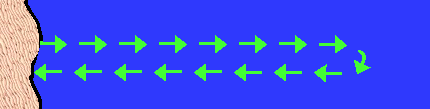
This is a much more useful pattern then the 'I" pattern,
especially for shore dives. This pattern allows you to explore
more of a site then the 'I' pattern, but still accurately returns you to
shore. This pattern is also easy - simply swim out along the
desired bearing until you reach you goal. Once you reach your
goal turn 90 degrees to your right or left. Swim along this new
bearing until you want to return to shore, and then make another 90
degree turn in the same
direction as your first turn. It is essential that if you
make your first turn to the right that your second turn also be to the
right, otherwise you'll end up swimming directly away from shore,
rather than towards it. If you make two 90 degree turns this dive
pattern will return you to shore at a different location then where you
start. If you want you can make your second turn slightly more
then 90 degrees (i.e. 100 or 110 degrees). This will return you
closer to where you entered the water.
The Square Pattern:
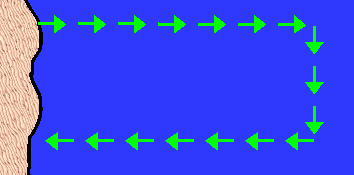
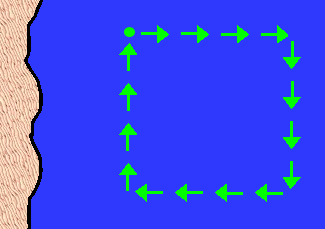
The square pattern is an important pattern for search and
recovery, and is also a good pattern if you are diving from a
stationary boat as it will return you to the ship without taking you
over the same parts of the dive site. In order to make this
pattern work you must count your kick cycles. The pattern itself
consists of four legs, each one an equal length, and each one at 90
degrees to the previous leg. To start swim along your initial
bearing, while counting your kick cycles. Once you've swam the
proper number of kick cycles (i.e. finished the first leg) turn 90
degrees to your right or left. Now swim the exact same number of
kick cycles along the new bearing (this is leg 2). When you
finish this set of kick cycles turn 90 degrees in the same direction as
your first turn, and swim the same number of kick cycles (leg 3).
Finally, turn 90 degrees (in the same direction as your first 2 turns),
and swim back to where you started (leg 4). For this pattern to
work you must use
the exact same number of kicks for each leg, you must turn 90 degrees at
each turn, and you must
always turn in the same direction (left or right).
The Box Pattern:
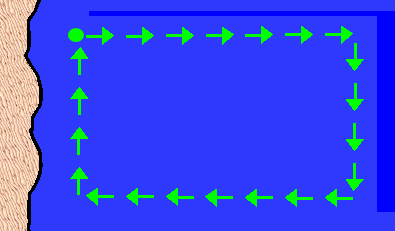
This pattern is essentially a modified square pattern. You
swim this pattern in the same manner as the square pattern, but instead
of each leg being the same lengths, legs 1&3 can be a different
length than legs 2&4. However, for this pattern to work legs
1&3 must be the same length, and legs 2&4 must also be the same
lengths. Or in other words you will have 2 short legs and 2 long
legs. The short legs will be parallel to each other, and the
long legs will be parallel to each other (but at right angles to the
short legs). Like in the square pattern it is essential that all
turns be in the same direction (left or right), and that each turn be
exactly 90 degrees.
The Linked-Box Pattern:
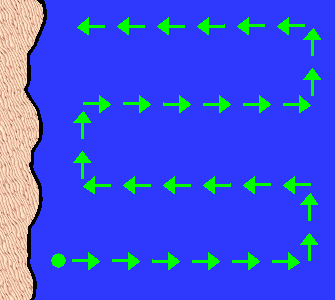
This pattern is used for search and recovery, or for a detailed
exploration of a site. This pattern is essentially a series of
box patterns linked together. The difference is that you
alternate the direction you turn so that instead of heading back to
your start point you instead move away from your start point.
Generally speaking you will alternate the direction you turn at the end
of each long leg. So to swim this pattern you would swim the long
leg and make your first turn (to your right for this example).
You then swim your short leg, and at the end of this leg turn to the
right again. You then swim the long leg, but instead of turning
right into the second short leg (like you would for the box pattern)
you instead turn to the left, swim the short leg, and turn to the left
a second time. For example, lets say you are searching alongside
a dock for the wallet you dropped overboard while tied up at the
dock. You weren't paying much attention, so you have to search the
whole length of the dock. Here's how you would use this pattern
to do this:
- You know the dock is 60m (200') long, and you know it takes you
20 kicks to swim 30m (100'), so it should take you 40 kick cycles to
swim the entire length of the dock. This will be the long leg of
the pattern.
- The dock itself is along a bearing due north (0 degrees), so your
long legs will be 40 kick cycles swam along a bearing of 0 degrees
(north) or 40 kick cycles swam along a bearing of 180 degrees (south).
- To make sure you don't miss any thing you decide you want your
long legs to be separated by 3m (10'). Since you swim 1.5m per
kick cycle, your short legs will be 2 kick cycles. Because of the
way this pattern works all of your short legs will be swam along a
bearing of 90 degrees (east).
- You start by swimming the first of the long legs, heading
directly north along the edge of the dock. When you reach 40 kick
cycles you turn 90 degrees to your right (you are now facing east) and
swim 2 kick cycles. You then turn right again (so you face
south), and start swimming the second long leg.
- When you reach the end of the second long leg you now want to
turn LEFT (not right like you did on the last two turns). This
turn will have you facing east. Now swim the short leg (two kick
cycles), and then make another left turn. You will now be facing
north. Assuming everything went right you should be exactly 4
kick cycles east of where you started. You can now swim your
third long leg (to the north).
- You keep following this pattern until you find your wallet or run
out of air...
Besides search and recovery this system can be used to explore an
area. If you are exploring a reef you don't even need to count
kick cycles - you simply follow the reef along a bearing until the reef
ends. When the reef ends turn 90 degrees, swim a short distance,
and then turn 90 degrees back towards the reef (i.e. swim a short
leg). Now swim along the entire length of the reef until, and
then do another short leg. By doing this you will ensure that you
don't go over the same part of the reef multiple times. This is a
practical way of doing a fish survey, as it will minimize the chance of
you double counting a fish. It's also useful if you are like me
and you prefer to maximize the things you see on a dive.
If extreme accuracy is required (i.e. for high accuracy mapping) you
can place markers along the legs. This can consist of ropes
strung along the long legs, pegs placed every 5 kick cycles, buoys
placed on each "corner" of the cycle, etc. The use of ropes and
other markers is central to site mapping and searching for small
objects (i.e. coins), but add another degree of complexity to the
dive. Ropes present an extra hazard as they can easily become
entangled, either on things lying on the bottom or on yourself.
We highly recommend that if you want to use ropes or other markers that
you practice these techniques in a controlled environment, ideally
under the supervision of divers who've done it before.
Navigating Around an Object:
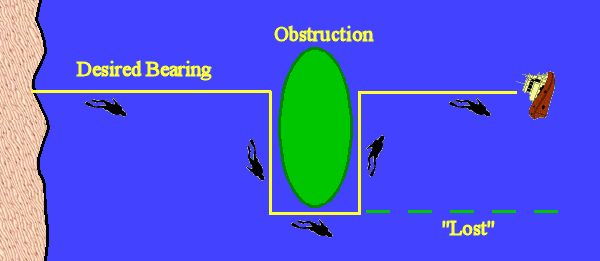
One important use of patterns is to avoid obstacles you run into while
trying to follow a bearing. This is a very important skill as there are
many times when you cannot go over or under an obstacle. If you simply
swim to one end and then follow your old course you will end up missing your
destination as you will no longer be on your original bearing. Basically
this pattern is a modified box pattern. You start by turning exactly 90
degrees to the right or left. You the swim the length of the obstacle,
counting your kick cycles as you swim. When you reach the end of the
obstacle you turn exactly 90 degrees back onto your original heading.
You now swim along the side of the object until you have cleared it.
Once you've cleared the object you'll turn exactly 90 degrees towards the
obstruction, so you are now swimming parallel to it. Swim the exact same
number of kick cycles as you did on the first leg of the pattern. When
you have swam this number of kick cycles you should be on the opposite side of
the obstruction, but in-line with your original bearing. The final stage
of this pattern is to turn 90 degrees back onto your original bearing.