If you use a compass underwater you'll eventually
run into a situation where you'll have to
calculate a bearing in your head while under
water. This can be very difficult - especially if
you're like me and are reallly bad at mental
math. Luckily there is an easy way to "cheat".
All you have to do is forget all of those numbers
on your compass!
The Basic Method:
Basically what we are going to do is replace the
numbers on your compass with a simpler system. Bt
don't worry, you won't have to alter your compass,
this is all in your head. If you look at your
compass you'll notice that there are "ticks" on
the magnetic disk. Depending on the model of the
compass the number of ticks will vary - some will
have a tick every 5 or 10 degrees, others only on
the 16 points of the compass. But no matter how
many ticks there are this system will work. To
keep things simple we'll pretend our compass has a
total of 16 ticks. Four of these ticks are your
cardinal points - going clockwise around the
compass they are: North (0 degrees), East (90
degrees), South (180 degrees) and West (270
degrees). On an compass with 16 points there will
be three points between each of the cardinal
points. Now technically these points all have
names and bearing between them - for example the
three ticks between north and east will be (going
clockwise) north-north-east (usually written NNE,
or 22.5 degrees), NE (45 degrees), and ENE (67.5
degrees). But instead we will call them N+1
(north + 1 tick) N+2 and N+3. Then there is East,
E+1, E+2 and E+3. Then it's South, S+1, S+2 and
S+3. Finally we have West, W+1, W+2 and W+3. To
make things even simpler we'll refer to north,
east south and west as N, E, S, and W
respectively.
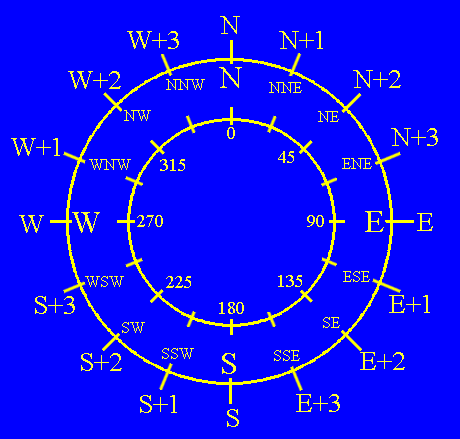
Figure 1: Points of the compass. Inner Circle:
Bearing in degrees. Middle circle: Cardinal
points (large text) as well as minor points
(small text). Outer Circle: "Cheater" numbering
system. Not points are all labelled in order
clockwise around the compass face.
So now our compass which originally had 360
degrees on it has 16 points. But how does this
simplify things? This simplifies things because
99% of the time all you want to do is make a 90
degree turn or a 180 degree turn, and this system
is designed to do just that. As I mentioned our
bearings are now described as a cardinal point
plus ticks. Lets say you are swimming north and
want to turn 90 degrees to the right. That's an
easy turn, as 90 degrees of north is east. But
what if you are swimming at N+1 and want to turn
90 degrees right. Well that is easy - 90 degrees
to the right of N+1 is E+1. Or in other words to
make a 90 degree turn to the right you simply move
one letter clockwise on the face of your compass,
but do not change the number of ticks. To turn
left we simply move counter-clockwise. So a 90
degree turn left of N+1 is W+1. To turn 180
degrees we move 2 letters around the compass. So
180 degrees from N+1 is S+1. Easy! For all of
your turns all you need to do is move the
appropriate number of letters clockwise or
counter-clockwise, but keep the same "tick"
number. Just remember - to turn right move
clockwise on the dial, to turn left move
counter-clockwise on the dial. Here's an example:
Example:
Let's say you are swimming towards a wreak, which
is located at a bearing of 22.5 degrees (in our
new system this is N+1). But along the way we
encounter a huge kelp forest we can't go through.
So in order to swim around it without loosing our
course we must use a special technique covered in
detail in the
navigation patterns page. Basically this
pattern consists of 4 90-degree turns. For this
pattern to work we'll have to make one turn to the
right (i.e. must add 90 degrees), two turns to the
left (during each one we must minus 90 degrees),
and then another turn to the right (add 90
degrees). By using this technique we'll end up on
the other side of the kelp forest along our
original bearing. Here's how this works out:
Old System:
Our first turn is to the right, meaning we add 90
degrees. This is 22.5 + 90 = 112.5 degrees. Not
too bad. Now we enter our second turn, where we
have to turn left (subtract) 90 degrees. That
112.5 - 90 = 22.5. OK, now we need to turn left
again, so we subtract another 90 degrees. So
22.5-90 = -67.5 degrees. Of course there isn't a
-67.5 on your compass, so now we must subtract
67.5 from 360. 360 - 67.5 = 292.5 degrees. Wow,
this is getting hard. But luckily there is only
one turn left. This turn is to the right, so we
add 90 degrees - that's 292.5 + 90, which is 382.5
degrees. But wait - there is only 360 degrees in
a circle, so we need to subtract 360 from the
382.5 degrees. When this is done we find our
desired bearing is 22.5. Wow, my head hurts!
"Cheater"
System: Now lets use our new system, which
is conveniently set up to do 90 degree turns. For
example 90 degrees to the right of north is east,
or in our new numbering system is E. Or in other
words to turn 90 degrees to the right we move one
letter clockwise on our compass (from N to E). 90
degrees right of N+1 is E+1. 90 degrees right of
E+3 is S+3. Even if we pass north (which is where
the math gets real hard) things are simple. For
example 90 degrees left of N+2 is W+2. Want to do
a 180-degree turn (i.e. go back the way you
came?) No problem - just move two letters around
the compass - so to go 180 from S+2 you simply
turn until your compass reads N+2. Nothing could
be easier.
So to follow the example we would start swimming
along our first bearing of N+1 until we hit the
kelp. Now a 90 degree turn to the right is
equivalent to moving to one letter clockwise,
which gives us E+1. So we turn until we face E+1
and start to swim. We reach the end of the kelp,
and now need to turn 90 degrees to the left.
Rather then subtracting 90 we simply move one
letter counter-clockwise, which brings us to N+1.
The third turn (where things got messy using the
old technique) is simply another letter
counter-clockwise - W+1. Finally we do our last
right hand turn (one letter clockwise) back to
N+1. Couldn't be easier!
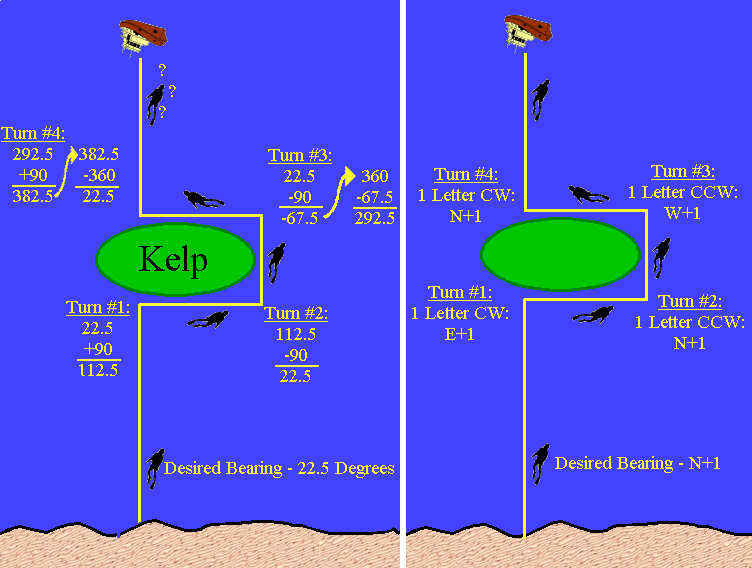
Figure 2: Comparison of the traditional
navigation technique (left) with the "cheater"
system (right). Note that the "cheater" system
is devoid of math, whereas the traditional
technique requires several complicated
calculations. CW = clockwise, CCW =
counter-clockwise
But What if There
Are More than 16 Ticks?
Most compasses have more then 16 ticks -
the average underwater compass has one tick for
every 10 degrees. This equals a total of 36
ticks, or 8 ticks between each of the cardinal
points. But never fear, our tick system still
works. But instead of only having N, N+1, N+2,
N+3, E, E+1, ... we now have N, N+1, N+2, N+...,
N+8, E, E+1... and so on. A 90 degree turn still
is nothing more then moving one letter clockwise
or counter-clockwise, while keeping the same
number of ticks. So if you are swimming at a
bearing of E+5 (140 degrees) a 90 degree turn to
the right will put you on a bearing of S+5. A 90
degree turn to the left puts you on a bearing of
N+5. A 180 degree turn from E+5 is W+5. Much
simpler then adding/subtracting 90 or 180 degrees!
Turns That Aren't 90 or 180 Degrees:
This system also simplifies turns which
aren't multiples of 90 degrees. Lets say we are
using a compass with ticks every ten degrees.
This means we can easily turn in units of ten
degrees. If you want to turn right by 10 degrees
you move one "tick" clockwise. To move 10 degrees
west you turn one "tick" counter-clockwise. So if
you are swimming at E+4 and you want to change you
bearing by 10 degrees to the east you at one tick,
giving you E+5.
Even if you pass one of the cardinal points things
stay simple. For example, lets say you are
swimming at N+3 and want to move 50 degrees (5
ticks) west. This is a bearing of W+6, but it is
also "N-2" or in other words two ticks left of N!
About as hard as things can get is turns greater
then 90 degrees. Lets say you are swimming at S+4
and want to turn 110 degrees to the right. That's
11 ticks clockwise, which is a bearing of W+6.
This may be hard to count, but it's easy to
calculate what the bearing would be. There is 9
ticks for every 90 degrees, so if we move our dial
to W+4 we have moved those 9 ticks (and turned 90
degrees). 11-9 is 2, meaning we have to move 2
more ticks in the same direction to get our full
110 degree turn. W+4 plus 2 ticks is W+6, our
desired bearing. Easy!
How Accurate is this System?
The obvious downside of this method is that
it is not as accurate as using degrees. Since
most compasses only have ticks for every 10 or 15
degrees your accuracy is limited to the angle
between ticks, which means that if you round off
your bearing correctly you can be out by as much
as 5 degrees for a compass with ticks every 10
degrees, or off by upto 7 degrees for a compass
with markings every 15 degrees. But how bad is
this? If we were navigating on land this would be
a real problem - over long distances being off by
5-7 degrees can result in you ending up a long
ways away from your target. But underwater this
is less of a problem for several reasons:
- We travel shorter distances underwater.
Most diver will swim less then 100m (330') on
any one bearing. It is almost unheard of for a
diver to travel much more then 500m (1650')
underwater, even with a diver propulsion
vehicle. The following table describes how far
off you would be if you were off by the maximum
possible angles (5 & 7 degrees). As you can see
you don't end that far off - on average less
than 10% of the distance you're swimming.
Although these errors seem large remember that
these are worst-case scenarios, and since it's
rare to travel over 100m (330') along one
bearing it is highly unlikely that you'll ever
be off by more then 8 or 9 meters. Or in other
words it will be rare to end up out of visual
range of your target.
Distance
|
5 Degree |
7 Degree
|
100m (330')
|
9m (30')
|
12m (40')
|
200m (660')
|
17m (55'')
|
25m (85')
|
300m (990')
|
25m (85')
|
35m (115')
|
400m (1320')
|
35m (115')
|
50m (165')
|
500m (1650')
|
45m (150')
|
60m (200')
|
- But how bad do the errors described in
part 1 compare to the accuracy of using true
bearings, rather than ticks? In reality
both systems are equivalent. Here's why:
- It is difficult to accurately set and
follow a bearing within a margin a 5
degrees, especially underwater.
- Wave action will move you off course.
- Currents will move you off course.
- Most divers will have one leg which is
stronger or longer then the other. As
such almost every diver will swim slightly
off course.
- Unless you hold your compass directly
in-line with your body your course will be
slightly off of the bearing on your
compass.
So in other words the errors induced by the
environment and by the way we swim will
probably exceed any error caused by using
ticks in place of degrees. As such there is
no disadvantage to using the "ticks" system
while diving, unless you consider missing some
metal math a disadvantage.