IB Philosophy Programme - Year 1
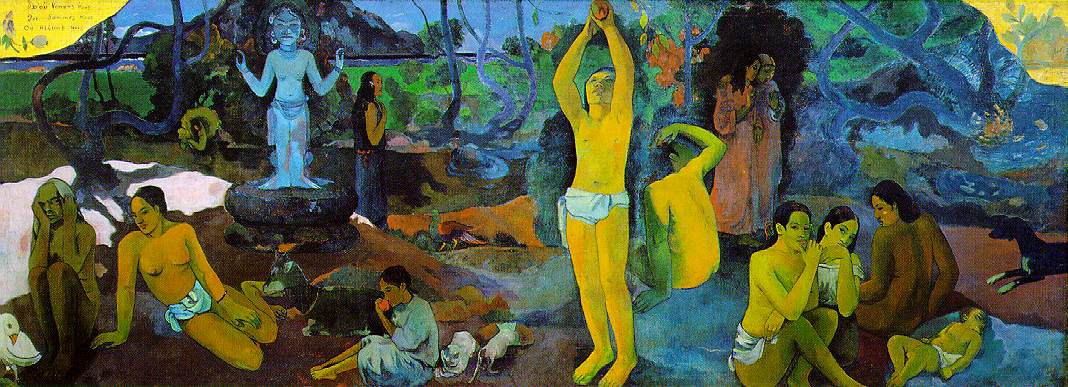
Who are we? Where do we come from? Where are we going?
(Gaugin, 1897)
**************************************************************************************the guide (in full) - if you want to check something...
Suggestions from IB Philosophy Guide
Doing philosophy—an independent approach**************************************************************************************
**************************************************************************************
Paper 1
CoreTheme:
What is a Human Being?
(This theme includes EVERYTHING that we will
cover - including the Republic,
Ethics and Political Philosophy)
Optional Theme 1: Political Philosophy
Optional Theme 2: Ethics
-----------------------------------------------------
For Paper 1 students will be required to write 800 words on each applicable theme
SL - There
will be two
themes covered during the next two years (Core Theme and Political
Philosophy)
HL -
There
will be three
themes covered during the next two years (Core Theme,
Political Philosophy and Ethics)
Paper 2
-----------------------------------------------------
Plato's "Republic" is the philosophical text that will be analyzed in detail and students will be required to write 800 words on this during the IB exam.
SL and HL
Paper 3
-----------------------------------------------------
HL Students only - will be required to write 800 words over "doing philosophy"
Internal Assessment exercise
Internal Assessment Assignment
SL and HL
**************************************************************************************
WEEK 1
Class 1 (SL-HL)
“Clearing the ground” for philosophical discussion; opening up the field with radical questioning...
Students will be able to recognize and analyze the concept of the Self, Identity (and Difference) in various modes of application.
Discuss
concepts of:
Identity <--> Difference
Consciousness <--> Unconsciousness
Self <--> Other
************************************************************************************
Class 2 (SL-HL)
Continue from Class One
Rehash (questions of Self-Other, ID-Difference)...
Discuss the truth of Science vs truth of Aboriginals; compare “Big Bang” w/ Myth; discuss concept of evolution; ...
What is Colonialism? [How can you describe it? [definition, etymology, stories, history class, news,....]]
Can you describe instances of colonialism that you know about?
What happens/happened with colonialism? Is it still happening today do you think?
Read the Case Study on Father Bartholomé de Las Casas / Marquis de Sade : discuss in class
**************************************************************************************
Class 3
(SL-HL)
Socratic Discussion
Handout : Quote of De Sade on history vs novel
Form a circle with chairs; read text in group and hold a “Socratic Discussion”
Discuss questions:
Can fiction portray “truths” that history, science and media (“facts”) cannot?
Who writes history books? Do things “happen” if historians don’t write about them?
Is the media ever unbiased? Who owns the media?
Can science ever be truly objective? Who do scientists work for?
Class 3a (HL)
Write an essay on the questions discussed during “Socratic Discussion” (200+ words)
Handout : Quote of De Sade on history vs novel
Discuss questions:
Can fiction portray “truths” that history, science and media (“facts”) cannot?
Who writes history books? Do things “happen” if historians don’t write about them?
Is the media ever unbiased? Who owns the media?
Can science ever be truly objective? Who do scientists work for?
Class 3b (HL)
Discuss and critique the assigned essay.
Give handouts for further discussion:
**************************************************************************************
WEEK 2
Class 4 (SL-HL)
Reflect on the last class when HL & SL were together (Socratic Discussion over history, novels, truth, in relation to the Self & Other(s), ID & Difference,…), whereby most students have claimed that truth is relative (to point of view), i.e., there is no Truth in itself.
Is it True to say that “truth” is relative? Or are you contradicting yourself?
If Truth does not exist, how can we know or believe anything?
If there is no Truth, is it possible to Lie? What is a Lie?
**************************************************************************************
Handouts:
Discuss these texts in class.
**************************************************************************************
Class 5 (SL-HL)
Give assignment on Kievan Rus’ – write an analysis/critique of a historical text; question "truth" of text (e.g. source); relate to colonialism; include discussion of question of Identity (and Difference), Self (& Other) in this context.
Give out “Philosophical Journal” assignment
**************************************************************************************
Class 6 (SL-HL)
Meditation on Micro-cosmos-Macro-cosmos
Group forms a circle and we hold a group meditation session (teacher as leader).
Everyone holds hands and closes eyes
Get grounded (aware of body) – focus on breath; blood flow
Become aware of others in group (focus on touching/being touched)
Return to self; focus on heart…
Go into heart and proceed to get “smaller and smaller” on journey to internal source…
Return to heart.
Proceed to others/group/school/city/country… until reach the outer limits of the universe.
Return to heart; to self.
Open eyes.
Write about experience.
Class 6a (HL)
Defending yourself: Seeking balance
Read text (example text with quotes/citations) to learn how to defend argument – “Predictable Distortions: Pirates, Profits and Propaganda” by Jeff Nygaard.
Discuss concepts of: racism, Eurocentrism, threats (to social status), tendency to simplify and individualize human behavior; in relation to the text.
Emphasize the elements the author has utilized to defend his arguments in critique of the current media (social) structure.
Note: this is a rather socially critical, “left-wing” text. Seeking balance: Next class we will look at a more “(ultra)conservative” piece from the NY Times.
**************************************************************************************
Class 6b (HL)
Defending yourself: Seeking balance II
Read text (example text with quotes/citations) to learn how to defend argument (from the other extreme -- a more “(ultra)conservative” piece from the NY Times) – "Pirates and the Law"
By ROBERT BECKMAN and TOMMY KOH
**************************************************************************************
Class 7 (SL-HL)
Socratic discussion -
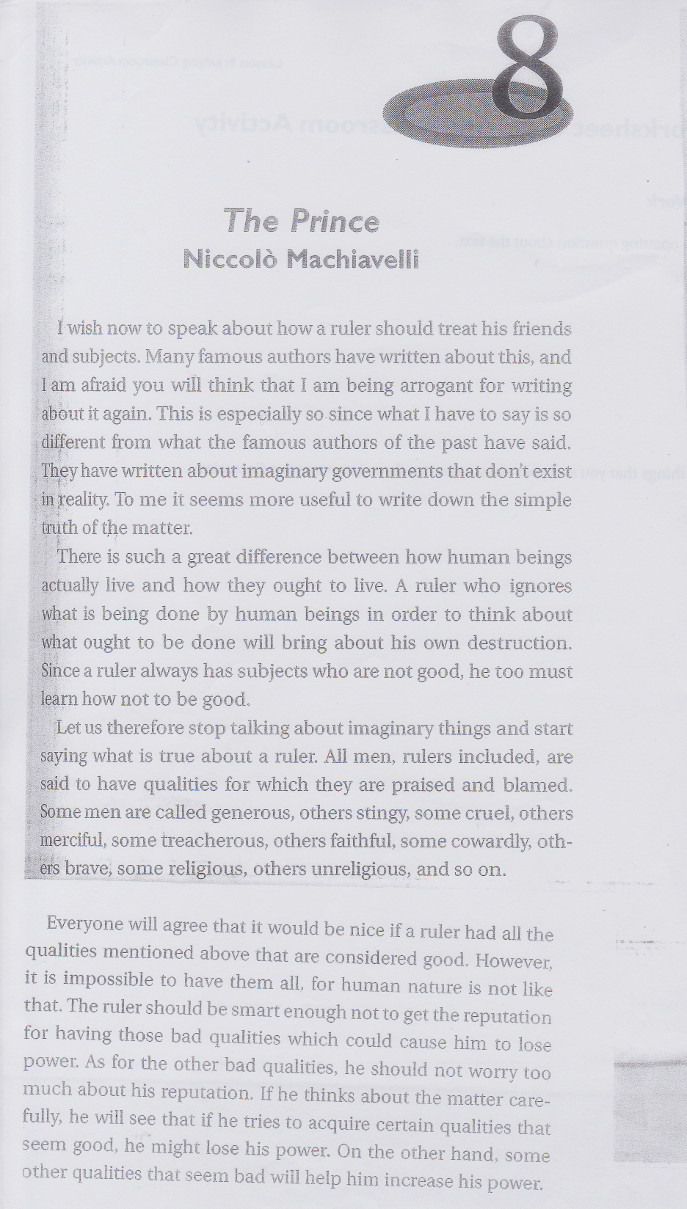
* Machiaveli – leadership
* http://www.geocities.ws/john_russey/philosophy/Machiaveli-excerpt.jpg
http://www.geocities.ws/john_russey/philosophy/Machiaveli-questions.jpg
**************************************************************************************
Class 8 (SL-HL)
reading and discussion over The One and the Many
**************************************************************************************
+ Following Weeks
Relationship of Elements : Hindu, Japanese, Greek and Chinese Systems
***************************************************
+ HL Questions about medicine (healing)
***************************************************
+ HL Myth, Religion and Philosophy
+ Induction-deduction (SL-HL)
* discussion and handouts (Philosophy in Practice by Morton, Adam, Blackwell Publ.: Cambridge, Massachusetts, 1996; pp. 125-153).
***************************************************
+ Presentaions – Philosphical Timeline
multiple classes
***************************************************
+ Writing Composition : linking words
*
***************************************************
+ Circle Discussion – Human Being (HB) vs animal
***************************************************
+ Essay assignment : HB vs animal
* http://www.geocities.ws/john_russey/philosophy/essay_human-being.jpg
* 1st draft – 250 words
* 2nd draft (500 words)
* 3rd draft (750 words)
***************************************************
4 Nov – HL begin watching Sandel on “Justice: What's The Right Thing To Do? Episode 01”
* http://www.youtube.com/watch?v=kBdfcR-8hEY
***************************************************
6 Nov – books arrive – start Plato's Euthyphro in class
continue Euthyphro
***************************************************
+ HL critique and rewrite essays
***************************************************
+ What the Bleep do We Know
* watch film over Quantum Physics and Spirituality
***************************************************
18 november -- HL
* Fractals: handout: How Mandelbrot's fractals changed the world
http://www.bbc.co.uk/news/magazine-11564766
Film: Fractals: The Colors of Infinity
***************************************************
25 November FINAL ESSAYS due
+ HL -- machines vs humans
* http://www.mnn.com/leaderboard/stories/7-real-life-human-cyborgs
* http://www.geocities.ws/john_russey/philosophy/man-machine_links.html
***************************************************
29 Nov –read Guthrie Greek Philosophy through to Democritus
+ Greek concepts
* Virtue (arete) is knowledge (epsteme)
+ read Guthrie Greek Philosophy through Parmenides
+ Test over Greek concepts ...
http://www.geocities.ws/john_russey/philosophy/test_greek-concepts.jpg
***************************************************
2 December -- Philosophy test due
Questions over Sendal “Do the Right Thing” - part 1 (take home qns)
* http://www.geocities.ws/john_russey/philosophy/Ethics_Questions_for_HL_Philosophy.html
***************************************************
4 December – go over test questions – concepts – only a few were handed in...
***************************************************
5 December – myth of Er
* http://www.geocities.ws/john_russey/philosophy/myth_of_er.html
***************************************************
9 December (Monday) - HL ethics qns due, but... only a few...
**************************************************************************************Internal Assessment Assignment – give examples, criteria and requirements
Example
A – student commentary
***********************
Example
B - student commentary
11 December – Apology discussion
* http://www.geocities.ws/john_russey/philosophy/Plato-apology.html
http://www.geocities.ws/john_russey/philosophy/Gadfly_on_Trial.html
**************************************************************************************12 December – Apology + Crito discussed
* focus on “Social Contract” in Crito
**************************************************************************************18 Dec
-- Analysis
of Plato's Crito:
Why does
Socrates Accept Execution? Or: The beginning of Polical Philosophy.
Borrowed from: http://www.philosophy.ucsb.edu/websites/phil4/Crito.pdf
Questions to prepare:
**************************************************************************************
SL: Discuss Plato’s “Meno” – read parts together in class
--- discuss elements that Plato has added to Socrates:
Questions
to prepare:
**************************************************************************************
Summary
of
Sandel’s
Justice :
Consequentialist vs. Categorical Ethics -- Sandel: Justice: What's The Right Thing To Do? Episode 01
(Introduction to Morality and Justice with case studies comparing two common strains of Ethics:
Consequentialism (Utilitarianism) vs. Categorical (Deontological) Ethics)
http://geocities.ws/john_russey/philosophy/Ethics_Questions_for_HL_Philosophy.html
*****************************************************
Utilitarianism
-- Sandel:
Justice:
What's The Right Thing To Do? Episode
02
Questions
http://geocities.ws/john_russey/philosophy/Justice(2).html
http://geocities.ws/john_russey/philosophy/Justice_Sandel-Episode2-ANSWERS.htm
*****************************************************
Libertarians
-- Sandel: Justice:
What's The Right Thing To Do? Episode 03: "FREE TO CHOOSE"
QUESTIONS
http://geocities.ws/john_russey/philosophy/Sandel_3-questions.html
Summary
of episode 03:
http://geocities.ws/john_russey/philosophy/Sandel_Justice-Episode3.html
*****************************************************
John Locke – Sandel:
Justice: Episode 4
QUESTIONS
http://geocities.ws/john_russey/philosophy/John_Locke_questions.htm
Summary:
http://geocities.ws/john_russey/philosophy/Sandel_4-questions.htm
*****************************************************
John Locke – Sandel:
Justice: Episode 5
QUESTIONS
http://geocities.ws/john_russey/philosophy/Sandel-Justice-Episode5_QUESTIONS.html
Summary:
http://geocities.ws/john_russey/philosophy/Sandel-Justice-Episode5.html
*****************************************************
Immanuel Kant – Sandel: Justice: Episode 6
( Kant offers an account of why we have a categorical duty to respect the dignity of persons... not to use people as a means, merely, even for good ends. )
Questions:
http://geocities.ws/john_russey/philosophy/Sandel-Justice-Episode6_QUESTIONS.html
Summary:
http://geocities.ws/john_russey/philosophy/Sandel-Justice-Episode6.html
*****************************************************
Immanuel Kant and John Rawls – Sandel: Justice: Episode 7
( Part I: Within Kant's stringent account of morality, is there a way that you could avoid telling a lie, (i.e., without selling out your friend)?
Part II: Kant says that just laws arise from a certain sort of social contract; not an actual contract . Thus, Sandel asks, what is the moral force of a hypothetical contract – a contract that never happened?
Rawls, [perhaps] similar to Kant, offers idea that principles of social justice can be founded on a hypothetical contract... )
Questions:
http://geocities.ws/john_russey/philosophy/Sandel-Justice-Episode7_QUESTIONS.html
Summary:
http://geocities.ws/john_russey/philosophy/Justice-Sandel-Episode07.html
**************************************************************************************SL:
Group Discussion: Locke’s
idea of Natural Rights: Focus on Property – (precedes
consent & Social
Contract)
SL: Discuss Plato’s “Republic” – in relation to Socrates, Greek history and what we have discussed so far...
--- Plato's Republic: Kinds of State or Person
**************************************************************************************A look at Corporatism in relation to Utilitarianism and Liberalism...
Libertarian view... Corporatism Is Not the Free Market
**************************************************************************************
SL: Discuss Plato’s “Phaedo” – read parts together in class
... discuss Pythagorean elements...
Questions to prepare:
**************************************************************************************
Essay Assignment:
redo TEST 1
focus on question 1: 500 words...
discussion of apeiron-peras in relation to early Greek philosophers
bring in aspects of mythos-logos...
**************************************************************************************"Dictation" --- on how to approach answering "question 1" from "Test 1"
**************************************************************************************Relate Quantum Physics to questions of "Test 1" over apeiron-peras and mythos-logos...
What The Bleep Do W Know? Down the Rabbit Hole I/II
http://www.youtube.com/watch?v=0rx9ogysYfA
.57 --> Void as infinite possiblity and "actuality"
32.
--> Perception
determined
by Consciousness --> Shaman
1.10-
1.25…
: double-slit experiment
– role of observer in determining "reality" – change of properties
Mathematics—only
possibilities -->
role
of consciousness (observer) in determining "field"
1.35-->
Quantum
field thy -->
Unified
field thy…
TIME
and SPACE
(Time-reversal
symmetry)
http://www.youtube.com/watch?v=ytyqhyZoSOM
2.09....
Flatlands
– dimensional
realities "side-by-side"
Panpsychism, Quantum physics, Sacred Geometry and some early Greek concepts...
The Book: Panpsychism in the West (Skrbina, Cambridge:MIT Press, 2005)
http://geocities.ws/john_russey/philosophy/Panpsychism_in_the_West_Skrbina.pdf
Edited doc with extra info...
http://geocities.ws/john_russey/philosophy/Panpsychism_in_the_West(Skrbina).html
Understanding the IS-OUGHT gap...
[A very general] history of the gap...
the "gap" begins "hypothetically" with the move from "Panpsychism" (Milesians) --> Pythagoras and Plato (with "separation" of soul (psyche) from body (hyle))
Hume's fork...
Kant's (very in-depth & complex) solution...
[an excellent text by Stephen Hicks] ... http://www.stephenhicks.org/tag/is-ought-gap/
**************************************************************************************Post-Kant
**************************************************************************************Daimon and Eros
Useful
docs:
**************************************************************************************
Introducing Philosophy: A text with Integrated Readings, by Robert Solomon, International 9th ed., Oxford: Oxford U. Press, 2009, pp. 551-605.
Student Resources
Chapter
8: Political
Philosophy
http://global.oup.com/us/companion.websites/9780199764860/student/chapt8/
Introducing Philosophy: A text with Integrated Readings, by Robert Solomon, International 9th ed., Oxford: Oxford U. Press, 2009, pp. 551-605.
Student Resources
Chapter 7: Ethics
http://global.oup.com/us/companion.websites/9780199764860/student/chapt7/
IB Exam Dates
Wednesday, 6 May (Afternoon examinations -- must start after 1200 hours and finish by 1800 hours local time.) :
Philosophy
HL paper 1 -- 2h 30m
Philosophy SL paper 1 -- 1h 45m
Thursday, 7 May (Morning examinations -- must start after 0700 hours and finish by 1300 hours local time.):
Philosophy HL/SL paper 2 -- 1h
Philosophy HL paper 3 -- 1h
30m
http://www.ibo.org/diploma/exams/documents/May-2015-exam-en.pdf
Suggestions from IB Philosophy Guide
Doing
philosophy—an independent
approach
Learning
philosophy can be achieved through a study of the history of philosophy
or by
doing philosophy.
The
emphasis of the Diploma Programme philosophy course is on doing
philosophy
within an international context. The aim is to encourage students to
develop
the ability to reason and argue and to take a personal and independent
position
on philosophical issues. Below is a suggested approach that will enable
students to study themes or texts in a consistent way. It is not the
only
approach available, but it provides a starting point from which
students can
develop into independent thinkers. This approach is suitable for all
the tasks
included in the syllabus.
Formulating
arguments
The
philosophy course does not include logic as a specific topic for study.
However, students should be familiar with the basic features of
reasoning necessary
to formulate their own philosophical arguments and to develop and
evaluate
those of others. Teachers should develop their students’ skills so that
they
are able to construct personal philosophical arguments.
When
formulating philosophical arguments students should:
Students
should adopt the same approach when they examine a classic
philosophical issue
or use a philosophical argument presented in a text. They should always
be
careful not to refer to the text or the author as an authority. In
addition,
students are expected to:
This
approach goes beyond the mere presentation of arguments and
counter-arguments
from philosophers’ texts, and insists on students developing their own
line of
reasoning. Students must always demonstrate how their own personal
reasoning
underpins their argument.
Some
common mistakes made by
students include:
**************************************************************************************
IB Exam Examples
Paper
3 (HL): Unseen
Text - Exploring Philosophical Activity
+ criteria for marking
Paper
3 (HL): Unseen Text - Example 1
Paper
3 (HL): Unseen Text - Example 2
**************************************************************************************