Into our third week now and getting into a routine - well a sort of one!
We work 3 days a week at Binny Mills school on the outskirts of the city, a desolate place. It's on the site of a disused British cotton mill established in the 1800s. The mill buildings are falling down and next to them is the school. Everywhere is incredibly dry and dusty. The shool gates are corrugated iron to keep out vandals (not much to vandalise). The classrooms have very little natural light (no electricity). There are no toilets and therefore lots of human waste around the buildings. There is a primitive toilet for the staff. Previous volunteers have converted a classroom to a reading room for which we have bought mats for the bare and dusty concrete floor where we and the children sit. The walls have been painted with the alphabet in English and Kannada (language of this state of Karnataka). There is a blackboard and that's the lot. Peace Child India has created 8 reading rooms in city slum schools and also in rural schools (one of which we're soon to visit). This one of ours is a pilot and they have ambitious plans to have 50 across the state. There are some books in Kannada and a few English story books kept in a cupboard. Previous volunteers have built a few rustic shelves.
After out nailbiting, white knuckle ride to school in an autorickshaw (tuktuk), we arrive dirty and hot after a journey of between 30 and 60 minutes. We are told that living in Bangalore is equivalent to smoking 20 cigarettes a day! We open up the reading room and enlist some children to brush the thick red dust from the floor. We open the shutters (sheets of corrugated iron). There are grilles on the window but no glass.
By this time, some of the small children (primary) begin to line up outside the windows and we feel very much as though we are in a zoo and we are the attraction. We take 3 to 4 children each from 8th standard (equivalent to Year 9) for 1 hour on a rolling basis throughout the day (1 day per week).
We've been assessing their level of reading, speaking, writing, etc. on a simple basis in order to place them in similar ability groups. Some are very bright but others understand nothing in English. In state schools, they are not taught in English (as in private schools) and so English is just another subject learnt mechanically with little real understanding as a second language. We have been playing word games, preparing things in the evening and trying them out the next day - thinking on our feet too as the day progresses.
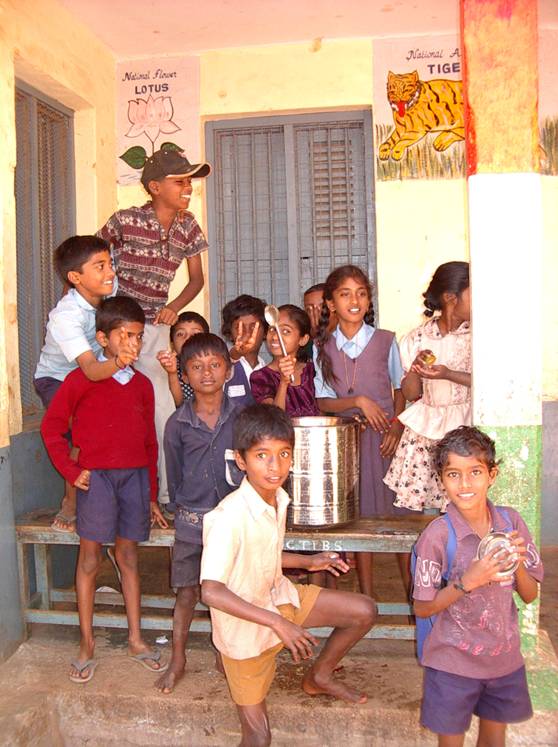
At lunchtime, most of the children have a free meal such as rice and samba (a watery dahl) or, another day, rice mixed with milk curd. This encourages them to attend school otherwise they might not get much to eat at all. Most of them are very small for their age. A 10 - 12 year old is easily mistaken for a 6 - 8 year old. They eat their food with their fingers, of course. All want to know our name and where we are from. The little ones are really delightful. Few have shoes but some have school uniform, 1 set being provided by the state which also gives them 1 notebook and a pen/pencil.
2 days a week we take the 9th standard. With the brighter ones we plan to do role playing etc. and will introduce the theme of what they are going to do after they leave school and help them prepare. Their ages range from 12 - 17 in 9th standard, as some are kept back if they underachieve.
For us, discipline is a big problem at this stage, largely as we are still a novelty. They are the same as teenagers anywhere. The teachers have little problem with them as they hit them!
We have looked at their English texts which are quite complex using words like despotism and nepotism. Many can read mechanically but don't understand what it means.
For our lunch we eat a jam sandwhich that "Aunty" (our landlady) lets us make in the morning and also a few bananas.
Next begins the journey home with the usual problem in finding a driver to take us to our district. Haven't been able to find a bus yet with enough space to actually get on!
So - we are living a very different life which is strange yet exhilarating at the same time. The children and the people make it of course and make up for the difficulties.
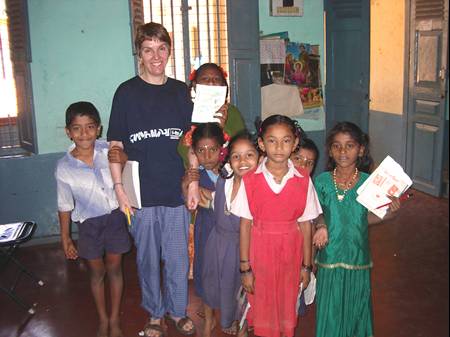
Below is photo of Deborah with some of the GKBMS school children and another where the pupils have just received their free lunch.: