
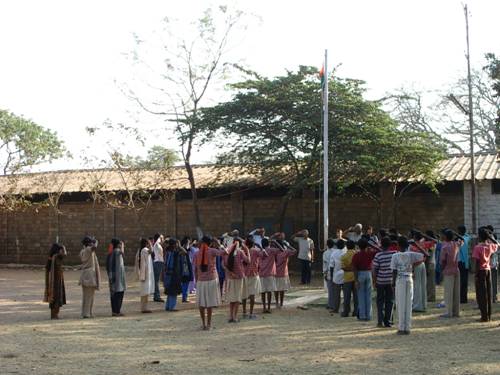
The people are, of course, India�s asset and, conversely, are the cause of huge environmental and social problems due to overpopulation, under-education, poverty and strong cultural traditions. We have been shown such kindness and hospitality wherever we go. Things happen, things get done (eventually) and anything is possible. The children we teach are so pleased to see us. Their smiles are infectious, they are curious, excited, full of energy, friendly and the majority are eager to learn. They always ask �What is your name?�, often the younger ones� only English phrase. When we compare their schools and the poor physical structures of their classes and buildings, lack of sanitation and few resources to UK schools and to those of fee-paying private schools in India, we realize that our help is just a drop in a very big ocean.
The charity Arivu (Peace Child India) has a vision of improving children�s and people�s lives through education and raising aspirations in order that individuals and communities enjoy a healthier and more prosperous life. We are proud to be a small part of that.
At Binny High School, we help the children 3 days a week. We use the reading room which we described previously. The children like to do something different and, as we take groups of 9 or 10, this is possible. We prepare lessons in the evenings and try to improve their English writing and speaking through reading, games, role play, basic grammar and vocabulary. Some of them are very bright and pick up concepts quickly. Others, of course, need more 1-to-1 supervision.
We are attempting to involve some of the 9th standard in producing a newsletter for the school. What might seem a straightforward task is made complex by language barriers. Communicating just the concept is difficult. The surprisingly primitive computer facilities (Bangalore is India�s IT capital) in Internet cafes doesn�t help. There are few CD drives and no software for image processing. We have to think on our feet every day and adapt. It is a challenge to think up new activities to keep the pupils engaged in what they do as well as learn. We are drawing on all our experiences to do this. At the end of each session, the children shake hands to wish us goodbye.
The first school has a visionary headteacher who goes out into the villages and speaks to parents about the importance of education in terms of getting better jobs etc. It is common that children are sent out to work to help feed their large families. Most of those in this school are well behaved and want to learn. They receive free meals, notebooks & pen and uniforms to help encourage attendance. We felt these children were better off environmentally & socially than those in suburbs/slums where mothers are often the wage earners, usually as rubbish collectors - an awful job. Children there often augment family income by making incense sticks for Rs13 (10p) per 1000. Fathers are often drunkards.
The 2nd school is called Born Free School, designed and built by Bernadette's brother, an artist. Bern is the founder of he Arivu charity, the mother organisation that can legally accept donations, but part of Peace Child India. She works tirelessly to improve the fabric of schools and the lives of the children and their communities. Her sister runs a shelter for 200 children. Jagan, her son, now runs Peace Child India. They are an inspiring family. Born Free School has an amazing head who has introduced activity-based teaching into primary (1st to 5th standard, 5-9) which is not in the curriculum. He uses large nos. of match boxes that the children collect, making each one into a square shape and them glues them into geometrical shapes to explain geometry problems and algebra formulae - very novel and effective.
The reading room in this school is used by the whole community with lots of books. We met 3 of the interns (volunteers) with Peace Child who gave us lots of ideas for our schools. We feel their job is slightly easier than ours as discipline is good and the teachers English is much better. The classrooms were light and airy, the windows having leaves and flowers pressed between perspex panes for decoration. Maps are painted on the floors, blackboards made in animal shapes and pupils can study in the shady courtyard. There are 40 to a class but all seem engaged in their work.
The 3rd school was a little les orderly but had lovely staff and a good reading room. 2 of the interns (from UK and Austria) were making papier-mache puppets and are planning a puppet show. When we mention better resources we mean in relative terms as children sit on the floor & there are only a few dozen books in the reading room (compared with 12 in ours). There are a few posters of flowers, fruit, animals and weights & measures etc.
We were made welcome wherever we went, being given chai and a snack.
Bern told us that we must not underestimate the effect of our presence in these schools giving exposure for the children to different lifestyles, different countries, etc and their interaction with us broadens their horizons.
Bern and Jagan are setting up a bee-keeping scheme in the local village. Jagan and the intern Ben have been on a course and are now to train local people. This will provide a good income if crops fail. Bern and her friends are also trying to educate and change the caste system. She is effective at getting in funds, enlisting help and getting things done. She wants to start a credit union in local villages. She is very inspiring.
Back at Binny Mills School, lessons are going well with the introduction of interactive activity-based teaching, which the children respond to well. Normally teaching is old fashioned, mechanical and repetitive. They are practising for exams sitting outside in rows in the dust with the odd cow wandering aimlessly about.
Teachers were on strike today, as they have received no pay for 3 months. This is India. Deborah's name is now Jabra, Aunty or Grandmother!