TV Verdict
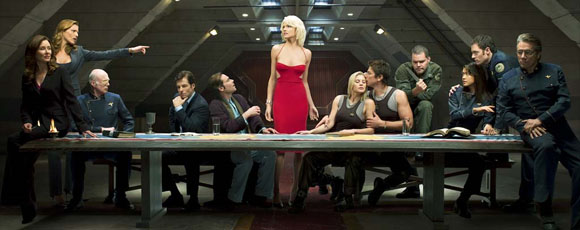
Battlestar Galactica
(2003-2009)
Forget the 1970s Star Wars cash-in. The update of Battlestar Galactica, under the creative guidance of Ronald D. Moore, has firmly ensconced itself near, or at, the top of the TV science fiction pantheon. In a scant four seasons, having come to a close earlier this year (except a still-to-be-aired one-off special titled The Plan), it broke all the rules of network TV with boundary-pushing plotlines and truly thought-provoking moral ambiguity. The plot is beautifully simple: the last 50,000 survivors of the human race, fleeing the nuclear destruction of their home planets by the robotic Cylons, voyage through space looking for the mythical planet Earth. That premise, with some new twists for this modern reincarnation (such as Cylon models who look and feel human), leads to one of the greatest TV series ever made, science fiction or not.
One of the main reasons it works is that it eschews the usual science fiction conventions of aliens and technobabble, instead concentrating on the characters. And what a bunch they are: led by the commanding - literally and figuratively - Edward James Olmos (Blade Runner), the cast are all exceptional. As well as Olmos, standouts include Mary McDonnell (Dances With Wolves) as the schoolteacher-turned-president, and James Callis as science genius and unwitting traitor to humanity Gaius Baltar. Katee Sackhoff deserves credit too for making what looked like a stunt - turning the character of Starbuck into a woman - into a logical and natural decision.
Unfortunately, buried on the US Sci-fi Channel, the series never attracted the audience it so richly deserved. With its realistic approach to normally outlandish subject matter it seems more geared towards mass acceptance than the likes of Star Trek. Ratings began strongly, but gradually tailed off as the series progressed, which, given the show's quality, is a massive injustice. Indeed it probably would have lasted longer had the ratings been stronger. But we should just be grateful that this show existed in the first place. For the first three seasons in particular, it was as compelling and exciting as TV drama ever gets, with superb acting, crisp writing and a coherent, gripping vision driving it forward.
 |
The Miniseries 
Unusually, this "reimagining" did not begin with a standard pilot episode. Instead, the Sci-Fi channel tested the waters by greenlighting a three-hour miniseries event originally screened over two nights. Although it is clearly the set up for a series (watching it before starting Season 1 is an absolute necessity), it wasn't guaranteed from the start, so the miniseries functions too as a 3-hour standalone epic. Easily transcending the usual restrictions of TV budgets and mass-market expectations, the miniseries gives any SF film released in the last decade a run for its money in terms of entertainment, intelligence and even production values. Director Michael Rymer (who would ultimately direct many of the series' best episodes) cleverly conceals any financial limitations by making maximum use of the superb Galactica set, and CGI is used sparingly but effectively. The miniseries takes its time to begin with, but it's well worth persevering with, and once you've become familiar with these characters, re-watching it proves to be a different, and even greater, experience.
 | Season 1
The thirteen-episode first season continued where the miniseries left off, never dropping in intensity one iota. There's a superb run of form early in the season from opener "33" to "Act of Contrition", but even thereafter the quality barely drops: the season is absolutely gripping from beginning to end. Eddie Olmos takes the first of several sojourns behind the camera to direct ninth episode "Tigh Me Up, Tigh Me Down", and crafts a definite series highlight. One of the undisputed stars of the series is James Callis, whose Baltar character is enormously entertaining and often hilarious. Episodes such as "Six Degrees of Separation" and "Colonial Day" really showcase his talents and give the character a huge amount of depth and murky motivations. One of his defining characteristics is his imaginary repartee with the Cylon Number Six (Tricia Helfer, who adorns most promotional materials and DVD covers for the show), which sounds odd on paper but is integrated brilliantly into the show. "The Hand of God" is a rare uplifting episode centring around a superbly orchestrated space battle, taking clear inspiration from the Death Star assault in
Star Wars. Finally, there's the concluding two-parter "Kobol's Last Gleaming", which brilliantly connects all the various plot threads that the season had been building and resolves them hugely satisfyingly, while opening up the scope for further revelations to come and ending on a (literally) heart-stopping cliffhanger.
 Season 2 Season 2
With an extended run of 20 episodes, Season 2 expands the scope of the series and begins to craft its own mythology. The first seven episodes continue the Kobol arc begun in the first season's two-part finale and are packed with incident, including more than a few stunning moments. Once the season finally departs from Kobol, focus shifts back to the ongoing search for Earth. Tenth episode "Pegasus" ends the first half of the season on a jaw-dropping note, with clear present-day parallels integrated into the action. After the two-part "Resurrection Ship", the series returns to the standalone episode style prevalent earlier in Season 1, and the results are slightly hit and miss (but more the former). Highlights include "Scar" and "The Captain's Hand", and the much-derided "Black Market" is harshly underrated. Meanwhile, the award-winning "Downloaded" takes an unusual Cylon-centric approach which acts as a precursor to some of the demystifying of the robotic race that occurs in Season 3. Then, just as it seems the show couldn't top itself with astonishing twists, the season finale, "Lay Down Your Burdens", ends with a turn of events that seems destined to radically change the very fabric of the show - in a good way.
|  Season 3 Season 3
In the third season a couple of questionable decisions were made by the creative team - arguably the first of the entire run - but they do not prevent the season from continuing the stellar form. The superb twist ending of the previous season leads into a brilliant 4-episode arc that really take the series in a daringly new but completely successful direction. Real world issues such as terrorism, suicide bombing and torture are brought to the fore in a compelling and truly thought-provoking way. After this masterful arc, the series does return to a degree of normality, but the psychological impact of the momentous events continues to haunt the characters. The sustained brilliance continues in the middle of the season, with one of the greatest episodes ever made: "Unfinished Business", which takes a hackneyed-sounding concept (characters work out their issues in a boxing ring) and turns it into something moving and even operatic. Only the decision to expose the inner workings of the Cylon world is relatively poorly handled, apparently constrained by budget and lack of aesthetic coherency. As with season 2, the latter half of the season does dip in quality slightly as events start to feel slightly dragged out, but it goes out on a high with the emotional, beautifully made "Maelstrom" followed by three episodes that focus on the trial of Gaius Baltar. Once again, Ron Moore proves his knack for barnstorming finales with a pulse-pounding end to the season. Bob Dylan's "All Along the Watchtower" seems an unlikely choice to score an episode of BSG but here (in composer Bear McCreary's assured hands) it works surprisingly well. There is, however, one revelatory twist in the final episode that seemed misjudged and, in light of the subsequent episodes, proved to be a misstep.
|  Razor Razor
Acting as a bridge between seasons 3 and 4 (although set during the events of season 2), Razor is effectively a standalone, feature-length episode. Intriguingly, it is set earlier in the series' chronology, fitting between Season 2's "The Captain's Hand" and the Season 2 finale, and offering backstory - in the form of a web of flashbacks - to the events of "Pegasus", and even the first Cylon war, 40 years past. Simultaneously, Razor provokes more questions about the events of Season 3. It's an action-packed rush of fan-pleasing moments as the story unfolds, with even classic 1970s-era Cylons making an appearance. The central thrust of the plot follows new character Kendra Shaw, who trains as a Razor - an elite soldier - and quickly ascends to a position of authority in the Colonial fleet, inevitably clashing with Starbuck along the way. As such Razor doesn't really add anything essential to the saga, but it is a thrilling standalone adventure, with spectacular sights and a grand scope expanding the mostly intimate scale of the drama in the rest of the series.
|  Season 4 Season 4 
The fourth season, unfortunately, is where Ron Moore's lack of prior planning for the direction of the series really begins to negatively affect the show. The cliffhanger end of Season 3 leads to an exhilarating space battle in the teaser of the opening episode, but thereafter the storylines start to become convoluted and muddled. Before this season almost every individual episode, while continuing the overall storyline of the series, had its own minor arc making each episode satisfying in its own right. Here, however, that approach is mystifyingly eschewed, leaving the season 4 episodes without any real structure to them and meaning that they all just blur into one another with no real highlights. It appears there may have been a tightening of the budget for this season, which would reflect the fact that the viewing figures had been inexplicably falling ever since the first series. The season is sustained by an inspired tenth-episode development that left jaws on the floor when it was first shown, and made the wait for the second half of the season (extended by the writers' strike) all the more intolerable.
|  Season 4.5 (The Final Season) Season 4.5 (The Final Season)
Eventually it starts to become clear that the writers have written themselves into such a corner, particularly in regards to Starbuck's arc and the "Final Five", that they are not able to resolve all the hanging questions. There's an infuriating reluctance to simply get on with it in these final episodes, with several filler instalments that just drag out proceedings unnecessarily. "Deadlock" is one of the worst episodes in the show's entire run, as it tries to make sense of the show's tangled mythology with an ungainly lump of hard-to-swallow exposition; BSG's roots as realistic and plausible science fiction seem a sadly distant memory. However, there are some gems that recall the show's glory days, such as the mutiny arc of "The Oath" and "Blood on the Scales". Three-part finale "Daybreak" wraps things up as well as could have been reasonably hoped for, and viewers who do not find tears rolling down their cheeks by the end have hearts of stone. Sadly, the final misstep occurs in the last scene, an epilogue of sorts that is too glib and trite and rather out of place in the saga. That's the one point where the DVD skip button will be used.
The DVDs 
|  |
Until the final season, us Region 2 buyers were royally shafted in the extras when it came to the show's DVD releases. The UK DVDs of the Miniseries (other than a brief featurette) and Seasons 1, 3 and 4 are barebones, while Season 2 only merits a handful of commentaries and deleted scenes.
Razor, which comes as an extended edition, also receives a worthwhile commentary, deleted scenes, and webisodes. It was only with the final 10-episode set - marketed misleadingly as "The Final Season" whereas it's in fact merely the second half of Season 4 - that loyal fans were rewarded with some meat, though still less than on Region 1. The upcoming complete series box set, pictured, is a simple repackaging of the existing season sets without any new material. Thankfully, there are many podcast commentaries by Ron Moore downloadable from the Syfy (formerly the Sci-fi Channel) website.
The summary
An unmissable odyssey for science fiction fanatics and something well worth seeking out for those not normally interested in space opera, the reimagined Battlestar Galactica is a unique slice of TV brilliance. Light-years removed from its dated '70s source yet still respectful of it, Ron Moore's BSG is a rare instance of a TV show capturing lightning in a bottle. Unfortunately, it fumbled the ball in the final stages, but the stellar ensemble and obvious passion for the material ultimately pulls it through to an emotional finale.


Previous TV Verdicts: The West Wing, The Sopranos
TV Verdict is a new feature devoted to the retrospective assessment of the most iconic shows the medium has ever produced. To allow for a complete, informed perspective, only shows that have completed their runs will be considered for inclusion in a TV Verdict overview.
Agree? Disagree? Say so in the Guestbook!
Text copyright (c) Filmverdict 2006-present. Any film titles and artwork used are copyright of their respective owners.