TV Verdict
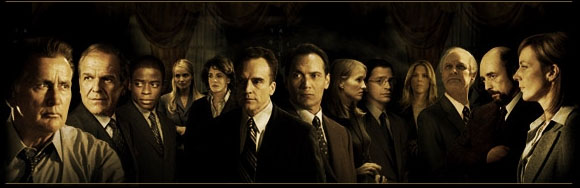
The West Wing
(1999-2006)
There's a reason that The West Wing is regularly seen as reference material for how to write for TV. Almost every episode, particularly in the first four seasons, is a perfectly formed little 42-minute film that both tells its own self-contained story - except in the case of the occasional two-parters - and furthers the overall narrative of the series. The show is, basically, a fantasy envisioning of what life inside the White House looks like. Although the programme makers collaborated with advisors who have worked in the real place, this is clearly not the real world because everyone, despite their foibles, is fundamentally a good person. If only there could have been a real Jed Bartlet. So, chock full of liberal, rose-tinted idealism it may be (the fact that Bartlet is a Democrat is keenly felt), but that's no flaw. At its best, which is the majority of the time, The West Wing is up there with the best TV shows ever made.
The cast is impeccable; they are clearly an ensemble selected on the basis of acting ability rather than simply good looks as often seems to be the case with US TV. Leading the way and becoming something of a father figure in the series is Martin Sheen as President Josiah "Jed" Bartlet, who seems born to be the leader of the free world. Everyone else pulls their weight too. Only Moira Kelly is given a poorly defined character whose arc never goes anywhere, and she is dropped without any fanfare at the end of the first season. If Sheen is the undoubted star, there is no slack elsewhere either; particularly excellent are Bradley Whitford as a presidential speech writer - who rose to become probably the most prominent character by the series' end - and Allison Janney as press secretary. Meanwhile, Stockard Channing, as the First Lady, begins as a guest character appearing in a handful of early episode but soon becomes an integral regular, sharing a superb warm chemistry with her presidential co-star.
There's little denying, however, that the real reason for the raging success of the series all comes down to one man: Aaron Sorkin. Sorkin, who has written some films (among them A Few Good Men and The American President, the latter of which provided an unplanned basis for the show), absolutely excels in his showrunning duties here. Remarkably, out of 89 episodes in the first four seasons, he wrote or co-wrote 87 of them, revealing an unmatched ear for witty, intelligent quick-fire dialogue. When in serious mode, The West Wing can be as pulse-poundingly dramatic as any feature film (even though the action rarely leaves the confines of the White House), but it shouldn't be ignored that it is also at times incredibly funny. Brilliantly, the humour comes from the characters rather than at their expense, so it always seems organic. Sorkin departed after the fourth season, leaving a cavernous void to fill, but he crafted such solid foundations that even without his guiding hand, the show continued to be one of the best things on the box. The quality throughout is remarkably consistent, but here I'll break it down season-by-season.
 |
Season 1 
As an establishing season, this first year of the show fits the bill superbly. Personally, I find the pilot episode to be one of the weakest in the 7-year run, but it does have the task of introducing all the characters, after which the show could really get going. And it does. By episode 3 at the latest, the show has its hooks in you and does not slacken that grip. Generally, season 1's episodes are more self-contained than in subsequent years, with less of an overall storyline for the whole season, but here that proves not to be much of a problem. For much of the season, the White House staffers are still finding their feet (as the season opens the Bartlet administration is still in its first year), which leads to several of the episodes dealing with them trying to impose their authority on the impenetrable Washington political scene. Individual highlights here are many, but standout episodes include "The State Dinner", which really encapsulates what the show is all about, and series finale "What Kind of Day Has it Been", which climaxes in a stunning cliffhanger that really cements
The West Wing as something special.
 | Season 2
The second season truly consolidated the series' reputation with a succession of unmissable events. It begins following directly on from the first season's conclusion with a compelling two-part story, "In the Shadow of Two Gunmen", which may not only be the high point of the series but one of the high points of TV drama ever. The quality hardly drops from there. This second season shows the increased confidence of all involved, with a greater emphasis on long story arcs that last for several episodes, or indeed half the season (such as one character's post-traumatic stress caused by the events of the season opener). Sorkin makes plenty of bold decisions that steers the show away from chichéd soap opera melodramatics and into truly moving, powerful territory. The last brace of episodes proves Sorkin's assurance and control over the show as it defies convention by closing with an emotional rather than action-centric finale, flashing back to Bartlet's youth in the celebrated episode "Two Cathedrals". Sheen in particular shines in the episode, summoning up reserves of intense feeling that even the actor was unaware he possessed.
 Season 3 Season 3
The first season of the show to air after the 9/11 attacks, Season 3 opens with a one-off episode, "Isaac and Ishmael", written and filmed in record time that deals directly with terrorism. The intentions of all those involved are clearly honourable, but the episode is not great, with some overly heavy-handed moralising. Nevertheless, the series is back to business as usual with the next episode, and the subsequent season is perhaps the most consistent of all seven in terms of quality, even if specific high points are less easy to identify. It's sometimes said that most of a politician's time is devoted to making sure he gets re-elected, and that is borne out in season 3, as much of the season deals with Bartlet's re-election campaign, starting with the two-parter "Manchester", referring to the New Hampshire town where he's from. Concurrent with this is the fallout to the announcement of his Multiple Sclerosis (MS), the non-disclosure of which he may face trial and impeachment for. These engrossing threads are weaved throughout the season as skilfully as has come to be expected. As the finale nears, Bartlet faces a thought-provoking moral quandary regarding a suspected terrorist, leading to yet another superb climactic episode.
|  Season 4 Season 4
After an entertainingly light-hearted opening two episodes, the first half of the fourth season is actually fairly uninspired (of course, it's relative to the immense quality that has come before). This part of the season focuses on the election battle between Bartlet and the rather Bush-esque Governor Ritchie, but the drama of the storyline is damaged by the fact that the result is something of a foregone conclusion. To suggest that these episodes are at all poor would be misleading; they just lack a certain spark. But any hints that the writers are running out of ideas is resolutely brushed aside by the season's second half, which from Bartlet's second inauguration onwards hardly pauses for breath, with superb episode followed by superb episode. Everything comes to a head in the breathtaking penultimate week, "Commencement", which ends with an extraordinary sequence that recalls, if anything, the work of Michael Mann. The last episode of the season and the last of Aaron Sorkin's tenure leaves matters in a state of breathless disarray, with several plot threads left tantalisingly hanging.
|  Season 5 Season 5 
Any fears that Sorkin's absence would lead to an immediate drop in quality are assuaged by the start of the fifth season, which carries on from where the previous year left off. Some have suggested that the threads are wrapped up too quickly (by the end of the second episode, "The Dogs of War"), but this is followed by several more excellent episodes. It is only in the second half of the season where things start to sag ever so slightly, with the nagging feeling starting to encroach that the series is simply going through the motions. Several episodes are still extremely strong, but there's a slight lack of overall cohesion and there's no real overarching narrative to drive the season onwards. The season is shaken up a bit towards the end, with a couple of new directions for the show, including one episode shot as a fake documentary ("Access", which actually works very well indeed), and the show's first excursion to another country ("Gaza") where, predictably, all does not run smoothly. It remains highly enjoyable fare, but, almost inevitably, it cannot quite sustain the unparalleled quality and relentless wit of the first four years.
|  Season 6 Season 6
John Wells, the man in charge of the show since Sorkin's departure, was clearly aware of the few shortcomings of the fifth season, because season 6 picks up the pace and drama noticeably. The season starts at Camp David as Bartlet attempts to broker an Israel-Palestine peace accord, in a pair of episodes packed with incident. A couple of new characters are seamlessly worked in, adding some variety, and many existing regulars change roles. What's more, Bartlet's long-dormant MS finally begins to rear its ugly head. Half way through the season shifts gears to focus on the primaries to choose Bartlet's successor, and some great guest stars (Alan Alda, Jimmy Smits) prove to be perfectly cast. Particularly engrossing is the fight for the Democratic nomination between Smits' idealistic Texas Congressman Matt Santos, Vice President "Bingo" Bob Russell, and disgraced former VP John Hoynes. Episodes alternate between dealing with the people on the campaign trail and those still working in the White House, culminating with the strands converging at the Democratic National Convention in "2162 Votes", the season finale. It all has a slightly different flavour from classic West Wing, but maybe that change-up was needed to prevent staleness from setting in.
|  Season 7 Season 7
The season that would ultimately prove to be the season's last is quite a departure from its early years but is nevertheless of an extremely high standard throughout. Continuing in the same vein as the second half of season 6, these episodes focus largely on the presidential campaign between Santos and Alan Alda's Arnold Vinick. Perhaps surprisingly for a show that has sometimes been so democratic-leaning that it earned the nickname The Left Wing, the show presents a very even-handed portrayal of both candidates, making the eventual outcome rather unpredictable. Both candidates are implausibly morally upstanding, honest people, but that is in keeping with The West Wing's patented brand of optimistic idealism. Meanwhile, Martin Sheen's screen time as the outgoing President is unavoidably diminished, but the season still manages to concoct some engrossing White House-centric storylines for Bartlet and his staff to deal with. Unfortunately, series veteran Richard Schiff receives short shrift, saddled with a storyline that sees him exiled, but otherwise the various characters' arcs are wrapped up satisfyingly (actor John Spencer sadly died midway through the season, but it is well integrated into the story). The strength of the supporting players meant that the show surely could have succeeded had it continued even without Sheen as a regular, but this was probably the best time for the show to end. The West Wing without President Bartlet just wouldn't seem right.
The DVDs 
|  |
The DVD presentation of the early seasons is, at least where Region 2 is concerned, underwhelming. Seasons 2 and 3 are presented in the wrong aspect ratios - the former in full-screen 4:3 (even though it was filmed in 16:9) and the latter in non-anamorphic widescreen. Moreover, the various commentaries provided on the R1 discs are nowhere to be found for any of the seasons. However, in the Complete Series box set there are two new bonus discs which cover a fair bit of ground, even if two discs of extras compared to 42 discs of episodes seems a little skimpy.
Disc 1 of the two bonus discs covers Seasons 1-3, with multiple featurettes on many aspects of the series including the White House set (the largest ever built for a TV show, apparently), the improbably named W.G. "Snuffy" Walden's excellent musical score, and some deleted scenes. Easily the best feature on the disc, and indeed in the whole set, is an episode-length (i.e. 42 minutes) special detailing the people who work in the real West Wing, with many interviewees from past administrations offering real insight. Disc 2 is divided into sections on Seasons 4-7. The extras here are fewer in number but often more substantial than those for the earlier seasons, looking at such things as comparing Stockard Channing's Abbie Bartlet to real First Ladies, a featurette solely concentrating on Allison Janney's C.J. Cregg, and a behind the scenes glimpse of how the unique live debate episode in Season 7 was filmed. Overall, though, extras for the last two seasons in particular are disappointingly sparse.
The summary
A television marvel, The West Wing has rightly earned its place as one of the best shows the medium has ever given us. Now, finally with a president in the real White House who seems to know what he's doing, is a great time to revisit the series. It deserves to be watched and studied for many years to come.


TV Verdict is a new feature devoted to the retrospective assessment of the most iconic shows the medium has ever produced. To allow for a complete, informed perspective, only shows that have completed their runs will be considered for inclusion in a TV Verdict overview.
Agree? Disagree? Say so in the Guestbook!
Text copyright (c) Filmverdict 2006-present. Any film titles and artwork used are copyright of their respective owners.