TV Verdict
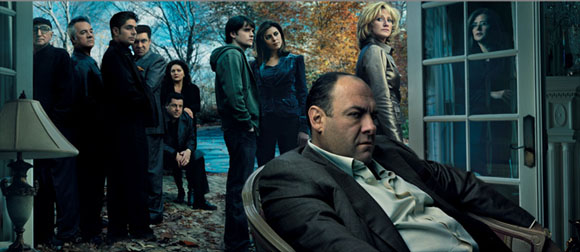
The Sopranos
(1999-2007)
On its arrival in 1999, The Sopranos basically redefined what television drama was capable of, shifting the boundaries in terms of the quality of writing and production that it could aspire to. Thanks to its home being on the pay-TV cable channel HBO, the show could ignore the restrictions usually in place on American television. Instead of the mass-marketed, commercial-driven, make-sure-absolutely-no-one-is-offended approach demanded by the networks (although there are rare shows which have managed to transcend such restrictions), The Sopranos is resolutely personal, idiosyncratic and unflinching. Dialogue is more colourful and profanity-ridden, not to mention well written, than the vast majority of features, while the frequent yet mostly brief outbursts of violence are depicted as matter-of-fact, unsensationalistic and uncensored.
The Sopranos is about the family and The Family. The former in the traditional domestic sense, and the latter in the organised crime Cosa Nostra sense. It is the way these two elements are melded that makes the show so unique and so often powerful. Influences from classic mob movies from The Public Enemy to Goodfellas is clearly manifest throughout (the characters themselves regularly quote from the Godfather films, which basically act as their bible) but the show is resolutely its own entity. What emerges is the most believably realistic depiction of the Mafia ever filmed; there are moments of The Godfather's operatic grandeur and Scorsese-esque stylised bloodletting, but the more glamorous sides of Mob life are constantly contrasted with the mundane and the less seemly aspects. Few people would watch the show and want to be a gangster; for all the accrued wealth on show, it is clearly a brutal and permanently stressful living, even for the boss.
The boss in question here, Tony Soprano, is played by the towering James Gandolfini. Perfect for the part, Gandolfini exudes a commanding and intimidating presence immediately, simultaneously combining it with a paradoxical vulnerability and humanity. The crux of the show from the beginning are his sessions with psychiatrist Dr. Melfi (Goodfellas' Lorraine Bracco), whom he sees due to suffering from panic attacks. While being a mafia boss he's also a fairly typical family man, with a son and a daughter and a somewhat antagonistic relationship with his wife (the excellent Edie Falco). His other Family are, to a man, all superbly drawn characters with their own distinctive character traits, and each of them receive their time to shine over the show's duration.
Despite its oft-cited status as the greatest TV show ever made, The Sopranos isn't flawless. The pacing is always measured but this sometimes slips into sluggish. Meanwhile, the show's unwavering avoidance of convention is sometimes both its primary selling point and its main weakness, as their are occasions where dramatically satisfying (yet less adventurous) outcomes are jettisoned in favour of expectation-subverting twists. This makes for a certainly unpredictable but not always fulfilling watch where, rarely, potential is not lived up to. After the first season, for instance, it seems the writers ran out of ideas for the Tony/Dr. Melfi storyline as it never really develops further and becomes increasingly superfluous as time passes. But the fact remains that at the end of its 86 episodes, few will deny that they have watched something consistently remarkable.
 |
Season 1 
The first season is where the show set the standard, but is also ultimately probably its most conventional batch of episodes (in a good way). Everything builds relentlessly from first episode to last (with the exception of one misfire, episode 10, "A Hit is a Hit"), coming together in a beautifully realised narrative arc. The show is mainly serialised in nature, but creator David Chase has professed that it was his intention that each episode should work as a mini-film, and it is in the instances where this is most adhered to that
The Sopranos reaches its greatest heights (case in point: episode 5, "College"). As this first season was constructed with no future seasons in mind, it comes as no surprise that it is the most well-rounded and self-contained of all of them, and is consequently probably the best of the lot.
 | Season 2 
With such an unprecedented and unexpected hit on their hands, Chase and his creative team had an unenviable task in the sophomore season. That they succeeded in cementing the series' reputation is a testament to its quality, but for me Season 2 is a noticeable, if not massive, step down from the first. Early episodes suffer from having to restart the story after the relatively conclusive finale of the last season, and there is never really one overall plot implemented to drive the show forward. In fact, the season is rather representative of real life, with events happening in a rather haphazard order. It seems to be one of Chase's central points that life itself has no real arc, and this is reflected in the show. The cast expands substantially in this season, but it is achieved organically and without feeling forced. Despite some missteps, there are some great highlights here, such as when the New Jersey crew visit the old country, Italy, in "Commendatori" (episode 4). Never a show to choose the easy option, the finale, "Funhouse", engrosses and confuses in equal measure as Tony suffers from food poisoning and we are presented with his increasingly bizarre hallucinations. It's a memorably offbeat way to end the second year, which while still good, feels rather transitional in nature overall, mainly serving as a bookend to the first season rather than a new story in its own right.
 Season 3 Season 3
The third season begins in highly entertaining fashion with "Mr. Ruggerio's Neighborhood", probably the most plain fun of all the episodes, which mostly follows the hapless FBI as they try to bug the Soprano house. Although this playful instalment is basically an anomaly in the series, the quality is largely sustained. Whereas the volatile Richie Aprile was the source of most of Tony's headaches in Season 2, this time we meet Ralphie Cifaretto, played by Joe Pantoliano (of The Matrix, amongst others). Meanwhile, Jackie Aprile Jr., attempts to ride the fast track to the top of the Family, against Tony's wishes. The season as a whole is extremely consistent in quality, with each episode having something to offer. This season's eleventh episode is probably the most celebrated of the entire run, the Steve Buscemi-directed "Pine Barrens", which takes the form of a dark comedy centring on two of the lead mobsters getting lost in snow-covered woodland. Although not an emotional rollercoaster like some of the greatest episodes, it's certainly one of the funniest. Another strong season which just arguably lacks a bit of variety.
|  Season 4 Season 4
Originally intended to be the show's final season, Season 4 does not introduce many new faces to the Jersey Family, instead expanding the roles of some existing characters. Tony's marriage to Carmela becomes increasingly disharmonious, and, significantly, Johnny Sack, Capo in one of New York's Five Families, begins to encroach on Tony's Jersey turf, with murmurs of an impending gang war towards the end of the season driving the drama. The new characters introduced alongside Johnny Sack, as well as the new locations - the gentlemen's club where the New York family hold their meetings is a wonderfully textured set - add a further level of intrigue, interest, and humour. One of the best episodes in the season, "The Weight" (episode 4), focuses on a disagreement between Johnny and Ralph (the returning Joe Pantoliano) regarding an insult to the former's wife. The episode also cements one of the season's other primary threads, the will-they-won't-they romance between Carmela and Napoli import Furio, which provides Edie Falco with some much-deserved acting opportunities. The season overall may lack the dramatic momentum of 1 and 3, but everything is beautifully developed (after a slow beginning) and the season concludes with the series' longest ever episode, "Whitecaps", which is as emotionally wrought and powerful as TV gets.
|  Season 5 Season 5
The fifth go-round for everyone's favourite Mafia pals only reached TV screens after an extended hiatus, which it seems was good for the creative energy of the writers, as this is probably the season that most closely challenges the first for supremacy. One of the reasons for this is Steve Buscemi, who, after directing some earlier episodes, finds himself in front of the camera as the season's central character, the newly released from prison Tony Blundetto, cousin of Tony S. Tony B.'s arc forms the primary dramatic thrust of the season, as he begins as an idealistic reformed man but soon finds himself enticed back into the world of organised crime, to inevitably violent - but utterly gripping - results. Episodes "Irregular Around the Margins" and "Long Term Parking" (the latter especially is an absolute masterpiece) also give Drea de Matteo's long-suffering Adriana La Cerva a more meaty role, which results in one of the series' most moving plot threads. By this stage in the show there's a complete connection to all of the characters, despite their flaws and foibles - many of them are murderous criminals! - and Season 5 really makes use of that personal investment to increase the dramatic stakes. The season is the most dramatically well-structured and wholly realised since the first. A debatable misstep - a marmite moment for sure - is the decision to focus a whole episode, "The Test Dream", around an extended dream sequence, which ends up just testing the patience of this viewer.
|  Season 6, Part I Season 6, Part I
As plans for the climax of The Sopranos kept expanding, the sixth and last season would eventually be divided into two parts, with 12 episodes in the first and 9 in the second to complete the saga. The season continues the strong form of the previous season, with the exception of a less-than-compelling detour from episodes 2 to 4 as Tony recovers in hospital from being shot. After this languorous distraction is out of the way (which really demonstrates how instrumental Tony is for the show), the season goes from strength to strength. A potentially out-of-place storyline about one of the Tony's Capos being revealed to be gay is generally well-handled and effectively drives three of the episodes, while Phil Leotardo's elevation in status in the New York family after Johnny Sack's incarceration gives the excellent Scorsese regular Frank Vincent much-deserved screen time. Later in the (half-)season the quality is consistently superb (with arguably the standout episode of the twelve being "The Ride"), but there is a slight sense that an overall arc is absent and takes too long to materialise, probably as a result of this season's extended run and its separation into two chunks. Nevertheless, there are several wonderful episodes - alongside "The Ride", highlights include "Cold Stones", "Mr and Mrs John Sacrimoni Request" and "Live Free or Die" - which rank with the best episodes made in the series.
|  Season 6, Part II Season 6, Part II
This climactic bunch of 9 episodes suffers from a slight over-emphasis on the youngest Soprano, AJ (Anthony Jr.), who is not one of the more compelling characters, having always suffered from a lack of definition. There is a slight sense too that, after the brilliant opener "Soprano Home Movies", there's a little too much treading water going on considering the end is so near. The much anticipated gang war which finally materialises after six seasons of waiting is over after a solitary episode (the thrilling "The Blue Comet"). The fourth episode, "Chasing It", is almost completely extraneous, not adding anything whatsoever to the ongoing storylines of the show and concentrating on characters no-one cares about. The middle of the season is, other than the death of one major character, mostly filler, but it is compensated by the very strong opening and closing episodes. And what of that ending? It's possibly the most talked about and contentious final scene of any TV show, and while the final cut to black is rather staggeringly abrupt, with hindsight it becomes more tolerable, and entirely in keeping with the rest of the series. After spending years avoiding dramatic cliché, it's only natural that David Chase would end the series on a completely unconventional note.
The DVDs 
| 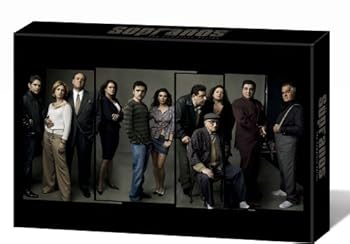 |
The series was re-released in a special edition box set in late 2008 with two exclusive extras discs and all contained within attractive, if slightly impractical, packaging (impractical as the sleeves for the 30 discs are made from cardboard and are a tight fit). Inside the robust outer box is also a glossy 16-page episode guide, which is helpful to keep track of all the plotlines; the episode summaries are the same as those contained in the official
Sopranos book (which, incidentally, is well worth a purchase for fans).
Firstly, there are some commentaries dotted about the various discs, involving various participants, including Chase, directors, writers, and cast members. Unfortunately not many of them are really worth a listen, not offering much of interest, nor having much to say (particularly when the commentaries are by actors such as Robert Iler and Drea de Matteo). The commentary for the pilot episode covers much of the same ground as an hour-long chat found on Season 1's third disc between Chase and film director (as well as rabid fan, and later occasional guest star) Peter Bogdanovich.
Sadly, the two discs of brand new extras are moderately disappointing. The first contains two roundtable discussions involving various cast and crew members; both last around half an hour and are diverting but not exactly revelatory. Also on the disc are some "Lost Scenes". Disappointingly few in number, they are nevertheless mostly extremely interesting, and some arguably should have even been kept in (particularly a flashback filmed for Season 3 involving Big Pussy). Disc 2 is home to 50 minutes of Alec Baldwin interviewing David Chase, which, after a slow start, offers some insights. "Whacked Sopranos" is a filmed seminar that takes place in a lecture theatre and involves Chase, writer Terrence Winter, and five cast members who met a grisly end during the series. Running over an hour, it's quite enjoyable but a bit too preoccupied with death scenes -
The Sopranos had much more to offer than simple Mafia violence. Finally, there are three
Sopranos spoofs, including one from
The Simpsons, none of which are particularly memorable.
The summary
The Sopranos is the epitome of pulsating, exciting, intelligent TV. Those who come to the series hoping for a serialised version of The Godfather should adjust their expectations - the show is much slower and less operatic, fundamentally more real than Coppola's masterwork. And when The Sopranos is at its best, it's a series of unique brilliance. Although only two of the individual seasons merit 5 stars as separate entities, as a whole The Sopranos is unquestionably a 5-star show.


Previous TV Verdicts: The West Wing
TV Verdict is a new feature devoted to the retrospective assessment of the most iconic shows the medium has ever produced. To allow for a complete, informed perspective, only shows that have completed their runs will be considered for inclusion in a TV Verdict overview.
Agree? Disagree? Say so in the Guestbook!
Text copyright (c) Filmverdict 2006-present. Any film titles and artwork used are copyright of their respective owners.